
Sun, 3 May 2026: 6:30 pm
Synopsis
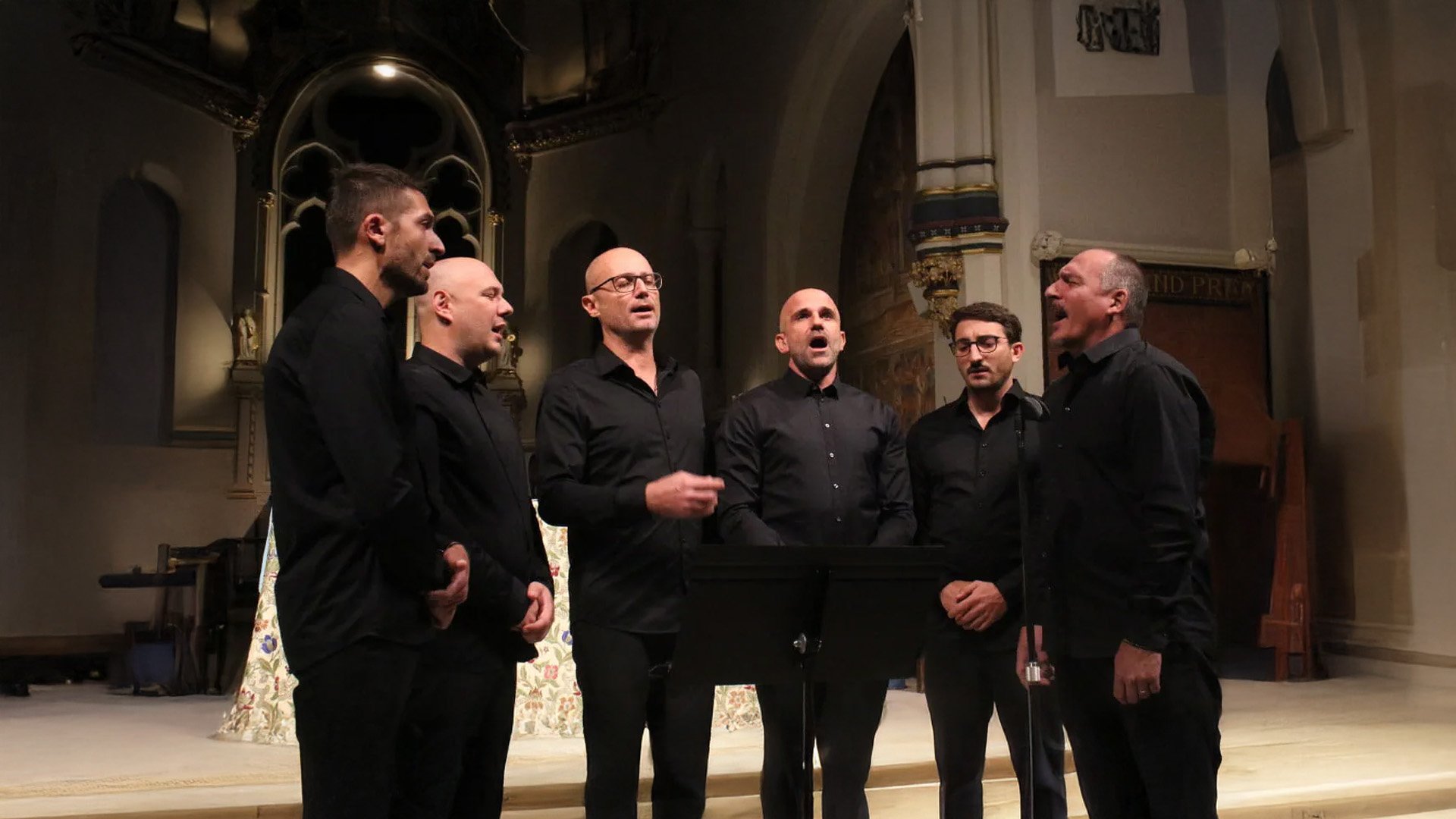
Across the rugged mountains and remote villages of Corsica, the Île de Beauté (the island of beauty), voices rise in raw harmony—ancient, resonant, and alive. Spartimu, one of the most celebrated vocal ensembles on the island, brings forth the sacred tradition of cantu in paghjella. Shaped by faith, geography, and centuries of oral transmission, their unaccompanied harmonies move beyond performance to create an authentic sound that reflects their idyllic life.
Join them in this rare invocation of place and spirit, where every tone carries the breath of spirituality and the wild grace of the Mediterranean. In Spartimu’s hands, Corsica’s ancient polyphony becomes both living memory and luminous offering.
Experience the power of collective singing with Spartimu in Workshop: Introduction to Corsican Polyphonic Singing. Then, join the Corsican brothers and Deveni Temu of Kapari Viriolo Village Cultural Ambassadors, as they share their devotional songs and island traditions in Exchange: Cantu in Paghjella meets Peroveta.
The tradition of cantu in paghjella
Nicknamed Île de Beauté for its rugged, picturesque scenery, the French island of Corsica lies in the Mediterranean Sea, a melting pot of languages and culture. Situated closer to Italy than to France, yet isolated from the mainland, the island developed a distinctive identity shaped by Latin, Italian, and French influences.
Its rugged mountains and remote villages, connected more by shepherd’s trails than roads, fostered a culture rich in both isolation and individuality. In olden days, semi-nomadic herders traversed the island carrying news, stories, and songs from village to village. When Christian and Latin plainsong were brought to Corsica from monasteries in the surrounding lands, Corsicans infused it with their own melismatic lines, ornamentation, and local pastoral laments. Each village developed its own variant of the song styles, preserved by Catholic lay brotherhoods who performed for mass, processions, funerals and feast days. Over centuries, the music blended and evolved, passed down through oral tradition, and came to be known as cantu in paghjella, or paghjella for short.
The term paghjella means “a pair”, in reference to the couplet of eight syllables that make up each line of poetry, though it has come to represent the practice of singing in three distinct parts: the singer with the melodic line (segonda) always begins the song first, followed by the bass providing a bass line (bassu), with finally the top (terza) line embellishing the melody in counterpoint with the segonda to provide an additional layer of harmony. At once ancient and immediate, these harmonies echo the rhythms of Corsican life: pastoral, spiritual, and deeply communal.
Paghjella songs are most commonly heard in churches during mass, but are also sung in festive or social occasions and performed at village squares and bars. Texts, often in Corsican, Sardinian, Latin or Greek, contain themes that resonate strongly with the islanders: of love, exile, identity, and politics. Napoleon Bonaparte was also a subject of some songs, having been born in the west-coast town of Ajaccio, the capital of Corsica.
Bringing ancient art to the modern stage
Deeply rooted in the vocal traditions of their native Corsica, Spartimu is a vocal ensemble that brings the ancient art of cantu in paghjella to the modern stage. Their powerful, unaccompanied harmonies have resonated in prestigious venues across Europe, the Caucasus, Australia, and the United States. Beyond preserving tradition, Spartimu is celebrated for its artistic encounters, blending Corsican sounds with diverse international repertoires. Their work has been documented by the US Library of Congress and featured in Ridley Scott’s Napoleon. Their performances offer deeply emotional and immersive experiences that capture the raw spirit of the Mediterranean.
Artist Information
Artists
Date & Time
 Explore Offstage
More to Explore


More to Explore
Frequently Asked Questions
 View All
Frequently Asked Questions
When a show is cancelled, ticket buyers will be duly notified by the event organiser primarily via email. You may also be notified through the event organiser's authorised ticketing agent, media or any other applicable communication channels. Information will be provided on where and when you can get your refund. For postponed performances for which the date of the new performance is known, refunds are optional.
For free programmes, any cancellations or postponements will be updated on the event website and/or relevant official communication channels. As no tickets are issued, refunds do not apply.