
Fri, 1 May 2026: 10 pm
An Evening of Qawwali: At the Feet of the Beloved
Synopsis
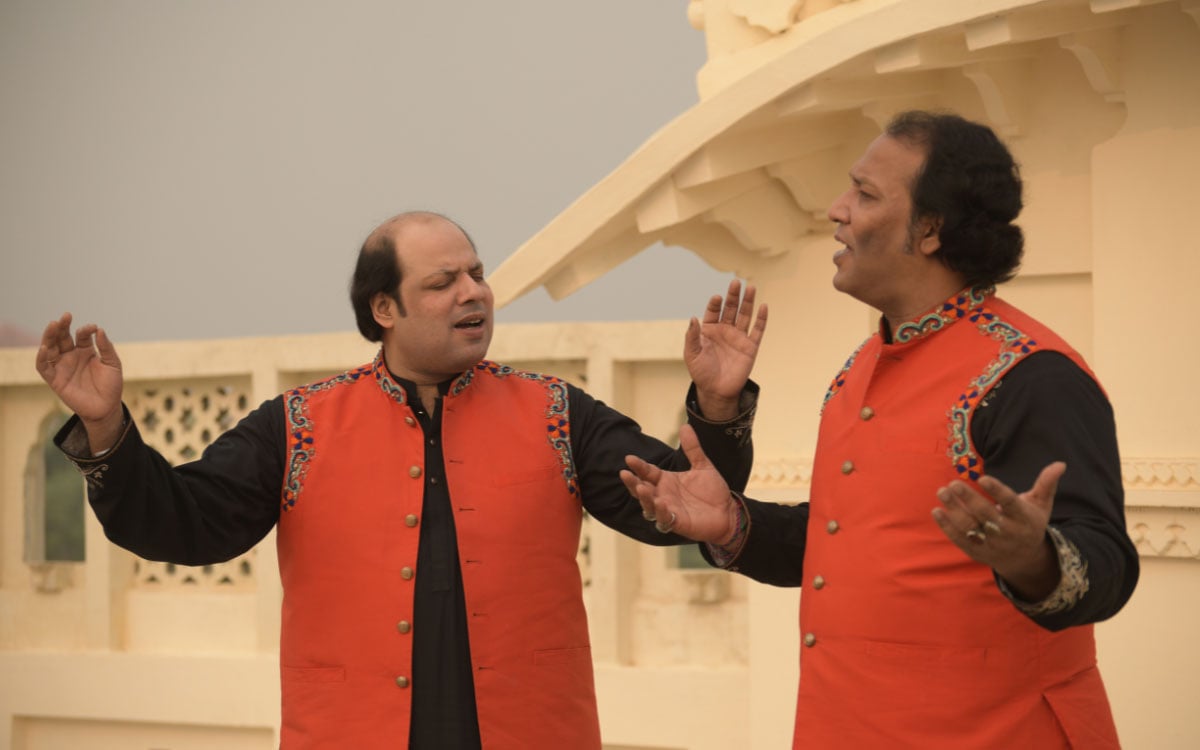
Heirs to the 700-year-old tradition—and nephews of the legendary Nusrat Fateh Ali Khan—Rizwan and Muazzam Mujahid Ali Khan invite you into the world of the Sufi mystics, whose music is meant not just to be heard, but to be felt. Their performances are journeys of the heart, carrying audiences from quiet reflection to rapture. With harmoniums, handclaps, and voices rising in hypnotic cadence, they weave music that awakens the soul.
Prepare not only to witness, but to be swept into a pure devotional spirit that speaks of love, faith, and the divine pulse that connects us all.
The Sufis of India and Pakistan and their songs of devotion
Sufism was born in 8th century Persia as a mystical expression of early Islam. Its adherents believed that love was a projection of the essence of God to the universe, and they sought to focus on man’s innate potential to have an embodied and personal experience of divine love. For this reason, Sufi music and dance do more than express Sufi beliefs but are ways truth and divine love can be felt viscerally. And instead of being something devotees watch passively, Sufi music and dance are communal experiences that the everyone would participate in as fully as the musicians do.
As Sufism spread from Persia, the musical expressions evolved in the lands where the Sufi mystics brought their beliefs. The musical form that has taken root in Pakistan and north India is qawwali, whose creation is often attributed to the 13th century Sufi saint Amir Khusrau. He fused the musical elements of Persian, Indian, Turkish and Arabic traditions, which morphed over centuries into its current form. Poems of ancient Sufi mystics still make up the bulk of the qawwali repertoire and are sung in Urdu, Hindi, Farsi and Arabic. Its performance has since thrived and is sung regularly in a religious context at the shrines of Sufi saints such as Data Dabar in Lahore and Hazrat Nizamuddin Dargah in Dehli.
Qawwali and its torchbearers
A typical qawwali performance is an interactive, fully engaging experience for both audience and musician, and may be described in this way:
A qawwal—an ensemble of performers including lead singers, chorus singers, drummers, harmonium players—sits on the floor at the Sufi shrine. The performance begins with a line of melody and the singing of a poetic couplet. The qawwal assesses the audience for response. Building on the introduction, they launch into the main body of the qawwali, introducing rhythm at a moderate tempo. Gradually, the rhythm quickens, and the vocals, handclapping and instrumentation intensify. The qawwal remains observent, sensitive to audience reactions. Here and there, they see faces glowing with rapture. A powerful line may prompt audience members on their feet in dance, inspiring them to repeat it with renewed vigour, improvising with virtuosity until both the audience and performers are lifted to joyous heights.
Qawwali is not only associated with religious occasions, but have become a part of popular music. It was introduced to the West through early world music festivals like WOMAD, where, for the first time, international audiences could encounter the powerful singing of qawwali legend Nusrat Fateh Ali Khan and his contemporaries.
When Nusrat Fateh Ali Khan passed away in 1997, he left a musical vacuum that his two teenage nephews later stepped in to fill. Despite their youth, they were determined that their group, Rizwan-Muazzam Qawwali, would continue their uncle’s pioneering efforts to transcend cultural, language and religious barriers, and to bring the vibrant qawwali vocal music of the Sufi mystics to the world.
In South Asia today, qawwali is widely recorded, performed and loved as musical entertainment in Pakistani films and in Bollywood soundtracks, with its traditional poetic lyrics of devotional, spiritual love re-interpreted as lyrics of secular love and its mystical imagery used for dramatic effect. Nevertheless, the core of its practice still remains at the shrines of Sufi saints, as a means to connect to the divine. Its treasure trove of philosophy, poetry and music continues to touch all who encounter it.
Connect with Rizwan-Muazzam Qawwali
Instagram | Website | Apple Music | Bandcamp
Date & Time
Our Sponsors

 Explore Offstage
More to Explore



More to Explore
Frequently Asked Questions
 View All
Frequently Asked Questions
When a show is cancelled, ticket buyers will be duly notified by the event organiser primarily via email. You may also be notified through the event organiser's authorised ticketing agent, media or any other applicable communication channels. Information will be provided on where and when you can get your refund. For postponed performances for which the date of the new performance is known, refunds are optional.
For free programmes, any cancellations or postponements will be updated on the event website and/or relevant official communication channels. As no tickets are issued, refunds do not apply.