We use cookies to improve your experience on our site. To find out more, read our data protection and cookie policy. By using our site, you agree to our use of cookies. Close to continue browsing.
Find what you're looking for.
Esplanade Presents
30 Apr 2023, Sun, 6.45pm & 9.15pm
(Intermission: None)
Esplanade Concourse
This event is over.
This event is over.
The act of singing the name of God, or namasankeerthanam, is a lively form of musical worship that took root in the south of India about two hundred years ago. The tradition is related to kirtanam (the Sanskrit verb of kirtan), an earlier practice from the north that glorifies and describes the attributes of Hindu deities through chant and song.
In namasankeerthanam, a spirited congregation gathers, seated on the floor, led by a singer who calls out the name of their deity in short, melodic phrases. The devotees sing the name back at him, clapping their hands to the beat of the mridangam (double-headed drum) and kartal (brass hand-cymbals) in a call-and-response manner. The consciousness of the worshippers melds together through the repetition of the name of their beloved divinities.
This communal exercise is typically practised on special occasions in the Hindu lunar calendar or on days that bear significance for their religious leader or guru. Namasankeerthanam is also sung in processions where worshippers travel on foot proclaiming sacred names, or by lone ascetics who sing as they seek alms for sustenance.
Neither the melodies nor lyrics—repeating the name of the deity—are complex, as namasankeerthanam is meant for all devotees to participate in, regardless of their musical abilities. The belief is that in the current era of Kaliyuga, an age of vice and spiritual decline, the sincere recitation of the name of God is a way of expressing devotion and seeking salvation. The practice of namasankeerthanam thus allows worldly miseries and worries to fade away.
While the songs encourage lay participation, worship leaders are often formally trained in classical Carnatic vocals, and in recent times the practice has taken on more performative presentations. From simple tents and function halls of temples, namasankeerthanam has now been brought onto larger auditoriums that accommodate thousands of devotees. Sometimes a percussion solo, which showcases the virtuosity of the mridangam or tabla player—a feature of Carnatic concerts—are incorporated as well. However, the core of practice is still a devotional one, and regardless of presentation format, aims to bring worshippers closer together to the divine.
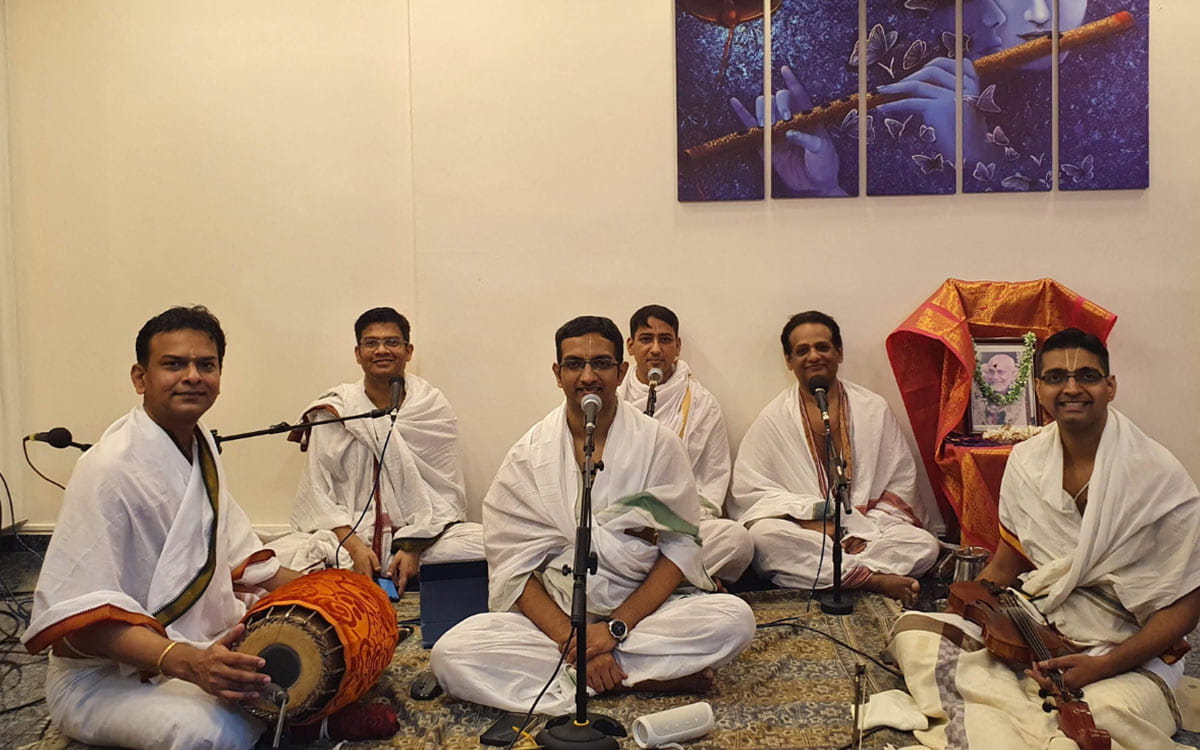
At this year’s edition of A Tapestry of Sacred Music, prominent torchbearers of this form of worship, Sri Rajaraman Iyer and Party, will perform two sets of namasankeerthanam. The first features the songs related to various Hindu gods, while the second set focuses on devotional songs for Vishnu, one of the principal deities of Hinduism.
No tickets will be issued. Seats are available on a first-come, first-served basis.
Sri Rajaraman Iyer and Party
Sri Rajaraman Iyer and Party are the most prominent torchbearers of the namasankeerthanam tradition in Singapore. The group also performs bhajans (devotional songs) in temples, at religious gatherings and private functions. The members of the group are devotees of Sri Krishna Premi Swamigal, who is a spiritual leader from South India.
30 Apr 2023, Sun
6.45pm
9.15pm
Great arts experiences begin with Esplanade&Me. Join this membership to enjoy ticket specials on shows at Esplanade, early bird specials, promotions at Esplanade Mall, unlimited access to Offstage and more.