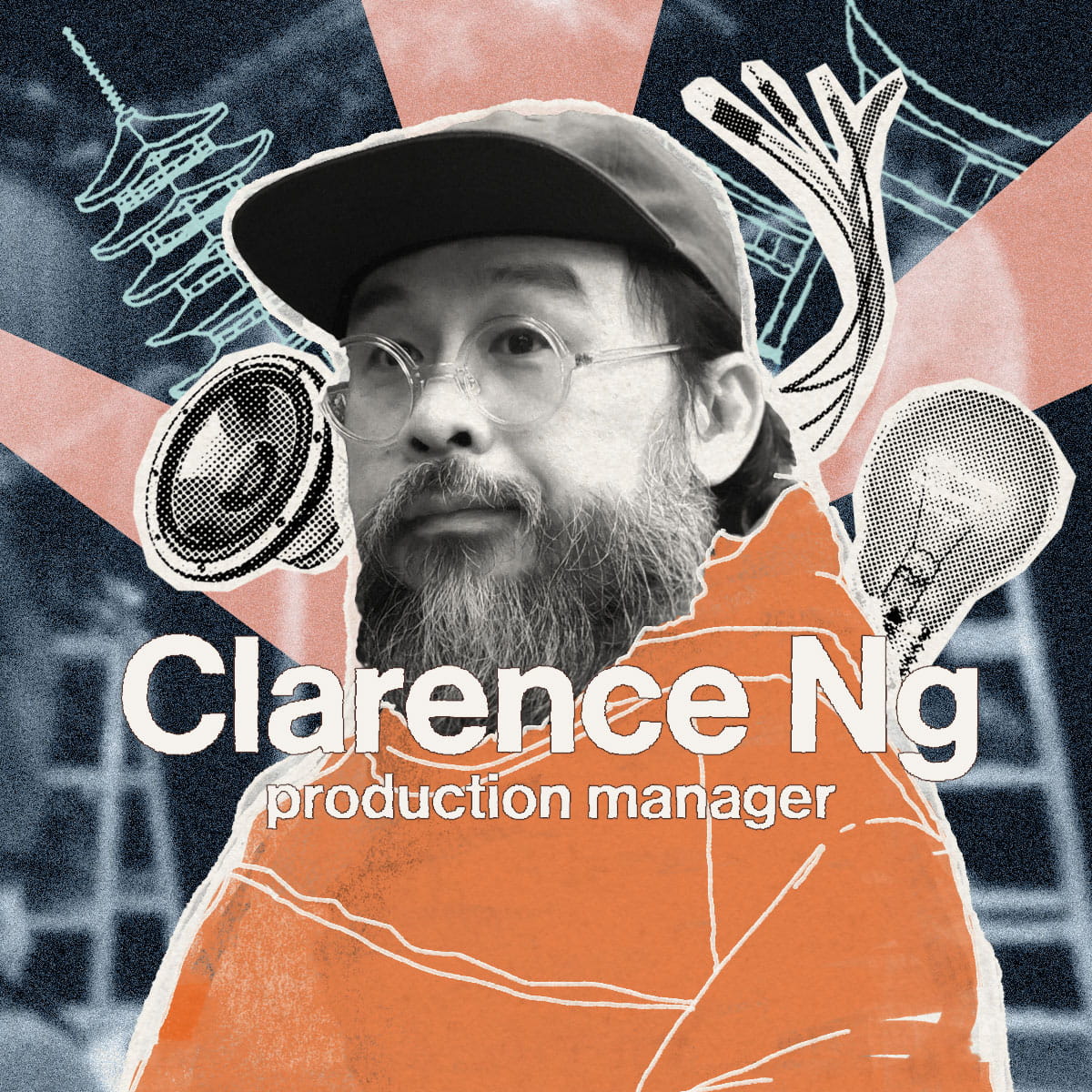
The art and tech production manager with a wild imagination

Published: 19 Dec 2025

By: Rydwan Anwar

Time taken : <5mins

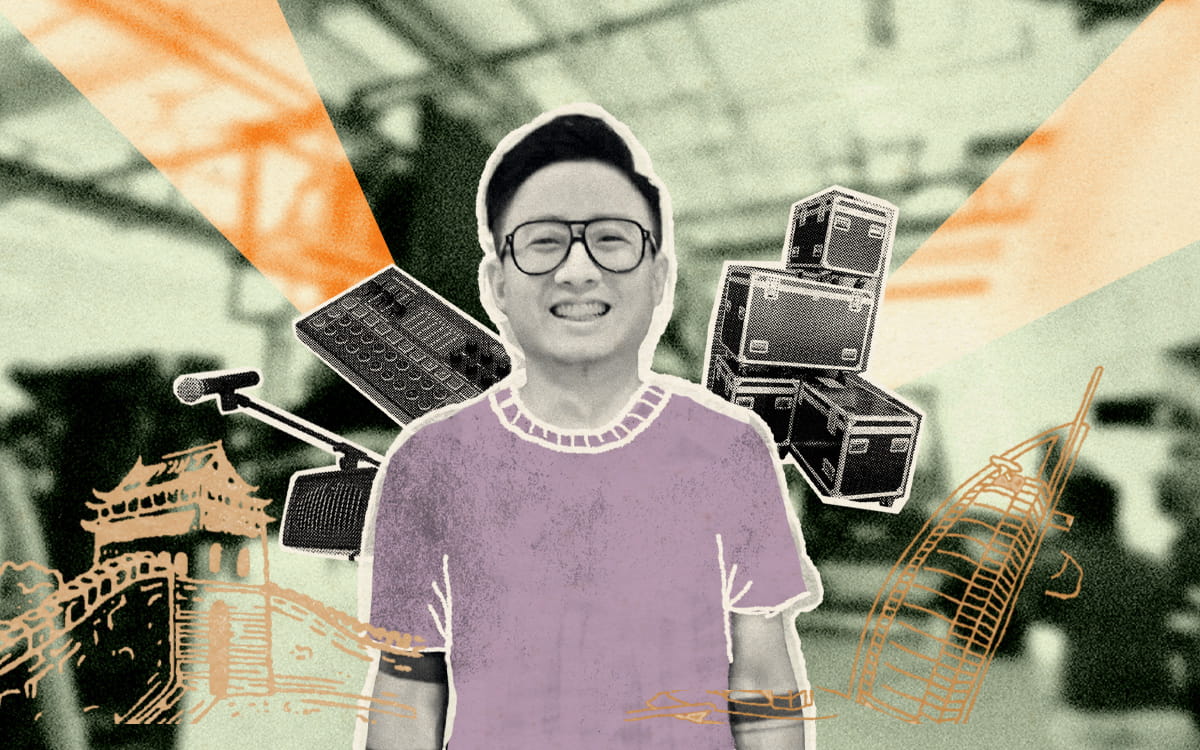
Working with Ryuichi Sakamoto to make trees sing is just one of the ways Clarence Ng has created out-of-this-world performances. The art and tech production manager based in Tokyo, Japan has spent the past 25 years using technology to create mesmerising worlds that challenge the possibilities of how audiences experience art.
Clarence started out at Yamaguchi Center for Arts & Media (YCAM), a leading performing arts centre that explores artistic expression with new forms of media technology. When he began his three-month Japan Foundation residency there in 2009, he never thought that the stint would lead to 12 years of living in Yamaguchi. During this time, he discovered endless possibilities to experiment with ideas and the performance experience, and worked with world-renowned artists like Shiro Takatani.
Even overseas, he was never far from home. His wealth of expertise proved handy when he was on the advisory panel at the Art & Tech Lab organised by Esplanade and the National Arts Council in 2024.
Clarence moved to Tokyo in January 2025 to join NEON Global, an international production company that produces large-scale immersive exhibitions. His most recent project, the Machu Picchu and the Golden Empires of Peru touring exhibition at the Mori Arts Center Gallery, encompasses his unique and innovative storytelling skills: imagine projection mapping, robotics and video production that bring historical artefacts to life.
He tells us how he stumbled into this unique artform and how his time abroad has shaped his practice today.
I stumbled into theatre by accident. I was roped in by a friend to be part of the stage crew for the Singapore Arts Festival in 2000. It was for Kuo Pao Kun’s The Coffin is too Big for the Hole performed by Jack Neo at the old Drama Centre. I found backstage life and theatre very exciting.
After a few years as a freelancer, I became a full-time production coordinator at Esplanade. I happened to work on a lot of Japanese productions which were presented during The Studios season. I was then introduced to YCAM’s production manager who told me about a residency programme offered by Japan Foundation. I successfully applied for it and went on a three-month residency at YCAM.
The experience was so good that I decided to go back for a one-year period to work on their 10th anniversary season. I stayed on until earlier this year when I moved to Tokyo.
YCAM is a playground for creating new productions. On average they spend two to three years investing time, money and resources into new works. During my first internship, I worked on a production where the director wanted the audience to be seated in a 50-seat circle so that they could have a bird’s-eye view of the performance.
The production took two years to create and ran only four shows. There was no sponsor. I was impressed with that level of commitment because I’ve never seen that kind of approach before.
I really enjoyed the creative process. It wasn’t just the theatre director and playwright talking. The director kept challenging the technical team. Can this or that be done? The process was driven by trial and error and was very fun.
YCAM prioritises ideas, instead of building a show around resources. The curators and producers first research interesting artists and topics, think about how to fuse them with technology, then look for funding. This collaborative and creativity-first approach is so unique to me.
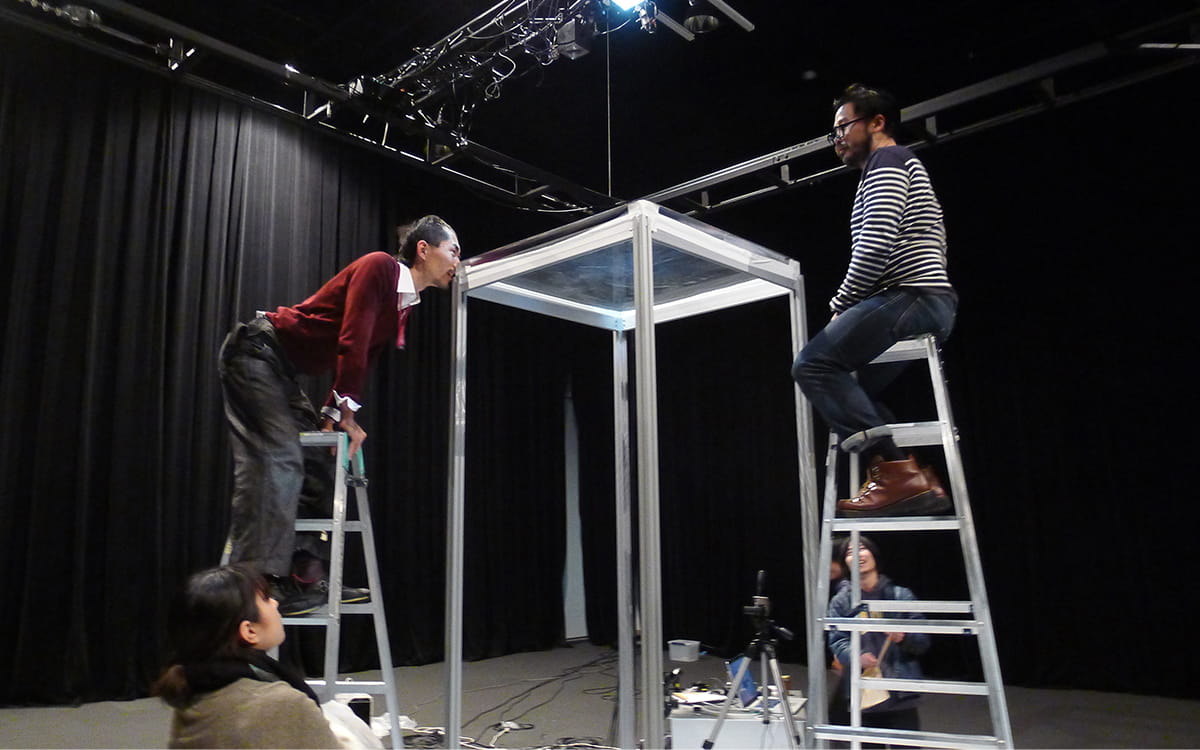
Clarence (right) experimenting and working on <em>LIFE―fluid, invisible, inaudible... Ver.2</em> (2013), by Ryuichi Sakamoto and Shiro Takatani, commissioned by YCAM.
Loneliness and language barriers. But I’m a positive person so I told myself to overcome it. I took it as a challenge and an opportunity to learn. The environment kept me inspired as I had constant discussions with many different artists. I have learnt so much and my continuous discoveries continue to motivate me.
I came to Japan only knowing some basic Japanese. The challenge was trying to understand the detail and depth of what my collaborators were trying to say. My only regret is not being fluent enough to participate in deeper discussions with Sakamoto and other artists during the creation process. It was only later when I pieced everything together that I really understood.
It’s difficult to share just one project. The last and only project at YCAM where I served as producer, curator and technical production manager was The Sakoku Project (with Kyle McDonald and Lauren Lee McCarthy). It’s an exhibition about social media and AI’s impact on truth and misinformation. The name means “closed country” (when Japan isolated itself) and it’s a metaphor for how we build walls. It shows how social media manipulates thinking, our vulnerability to hacking and AI data gathering.
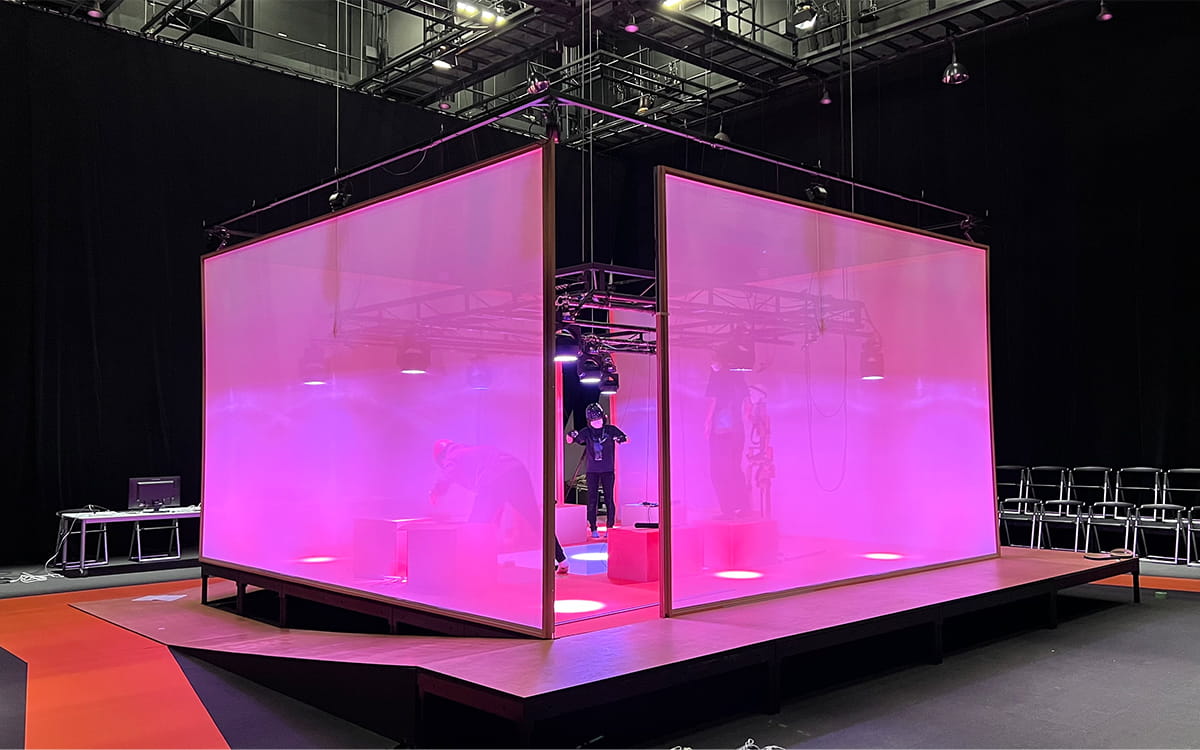
Lighting adjustments for <em>Unlearning Language</em> (2022), by Lauren Lee McCarthy and Kyle McDonald, YCAM.
The other one is Forest Symphony with Ryuichi Sakamoto. We created circuit boards to capture data from trees photosynthesising, and connected trees globally (Australia, Europe, America, Japan) to create an orchestra where each tree represented a musician. We gathered all the trees’ data, put it into a foyer and listened to the trees sing through Sakamoto’s direction.
He mentioned to me during YCAM’s 10th anniversary that it would be great if we could gather the data from Southeast Asian rainforests and the Amazon. So I hope we can do a Southeast Asian iteration and present this work one day. I’m finding every opportunity to bring this work to Singapore. It might even be a good collaboration opportunity with NParks and ASEAN countries. So if any curator is reading this, please get in touch.
If you get the opportunity, please go and explore. Along the way you’ll find something you like and a community of like-minded people. That has been my journey so far. Now I’m thinking of how I can share my experiences with the Singapore audience. The more we come together, the more we do things differently, the more we can discover—especially in Singapore where we are so diverse.
Contributed by:
Rydwan Anwar spent two decades programming theatre and festivals in Singapore. He is now based in Newcastle upon Tyne.