da:ns Lab 2020: Prognosis, Treatment & Rehabilitation

da:ns lab 2020: co-immunity (how to dance when we are all ill)

da:ns lab
da:ns Lab 2020: Prognosis, Treatment & Rehabilitation
Differing modes of reflection and analysis while looking into the concepts of illness and recovery
da:ns Lab is an annual workshop-seminar for artists and arts practitioners to critically reflect on key issues surrounding their creative practice. This year's theme is Co-immunity: How to Dance When We Are All Ill, inviting participants to reflect on all that has been disordered amidst global crises and health emergencies. In this paradigm of illness, we challenge the preconceptions often assumed of the dancing body—as one that is able-bodied, productive and live.
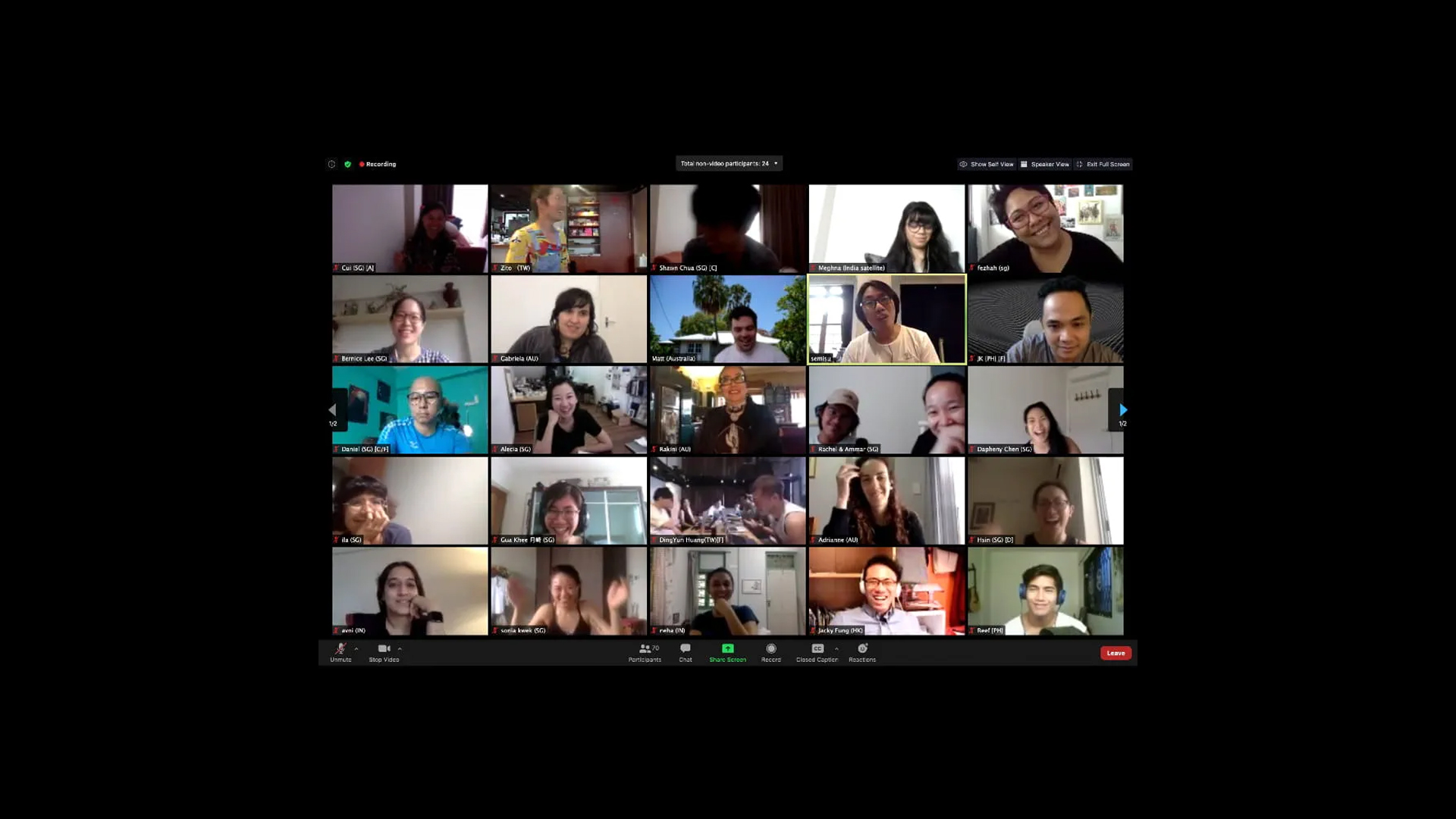
da:ns Lab 2020 is a remote meeting taking place online with 60 participants from six regional clusters across Hong Kong, Manila, New Delhi, Singapore, Sydney and Taipei. Participants explored how dance can operate within the paradoxical framework of co-immunity, developing infrastructures of support and relations of care, while building resistance and resilience across the different arts ecologies in the region.
Satellite Proposals
The following section comprises the satellite proposals presented on Day 2 of da:ns Lab, which served as the basis for discussions on Day 2 and 3. Longer proposals have been paraphrased.
Atomisation

- Isolation does not protect us. Neither in the long-term, nor without sacrificing particular groups. How do we build co-immunity and resilience in our community/ies through the approach of collective and shared bodies?
- Atomisation: Disconnection/Splintering/shattering of bodies. Fragmentation of community.
- Fear of the unknown/failure manifests in the body
- How can our bodies serve each other?
- Touch will be a paradigm shift (see Wall-E clip).
- What is Covid-19 allowing us to see that we couldn’t see before? Covid-19 as a symptom of the illness of privilege/s. The pandemic stops us from participating in our roles in the (capitalist) machine. By pulling out, we gain a different perspective. Let’s recognise the current situation as a symptom rather than an illness.
Breath as Shared Space
Breath as Shared Space
x Score For Co-Immunity In A Time Of Masked Impunities (PHP)
E/co(I)mmunity
Systemic // anthropocentric systems of co(i)mmunity
How do we make sense of our realities using our bodies and how do we perform our ways of survival?

Performance as direct action and mutual aid
Performance as survival
Performance as life support
Mapping
- How do we use our bodies to navigate the ill terrain towards a mutualistic relationship with our environment?
- How do we make sense of our realities using our bodies and how do we perform our ways of survival?
- How do we us our bodies to navigate the ill terrain of our mutualistic relationship with the environment?
Politics of Breathing
Breath as a connector of landscapes
Breath as a liminal space
Politics of breath
Breathing co(i)mmunity
Breathing for survival
The COVID body & social choreography (SIN)
What is the Covid-19 Body? A Diagnosis on Social Choreography in the time of Covid-19
How to choreograph social rehabilitation?
How to negotiate social proximity through performance?
Choreography of the Covid-19 body
The Social Body in Singapore - Dancing Together, Public Engagement, Audience Outreach
Reconceptualising “Got To Move”* as a nationwide dance movement in the time of Covid-19
Covid-19 as Choreographer
- A body constrained by Covid-19 measures
- Trapped in the body - senses deprived of stimuli
- Attention span; desire for undivided attention
- Movement of stillness, distancing, digitisation, etc
- Bigger sense of empathy despite being more isolated
- Trust - issues of intimacy and authenticity
* Got to Move (GTM), an initiative by the National Arts Council (NAC), is the nationwide dance movement that celebrates the diversity of dance in Singapore. With popup events throughout the year in addition to an anchor festival held annually in October, Got to Move aims to ignite Singaporeans’ interest in dance and to deepen their appreciation of the art form. It is a national platform to bring together Singapore’s dance professionals and enthusiasts and to showcase their talents and works to a diverse audience. (First edition: 2015) https://www.nac.gov.sg/gtm-events/gtm/overview.html
Creating for the online journey (HKG)
From the perspective of Chinese medicine, we are not sick; instead, the internal mechanisms of the body are unbalanced, so we have not been able to face the challenges of the external environment.
This pandemic is not about illness but a moment to study our past journey/knowledge. How can we use our past knowledge to adapt to a new world?
Are we using an “offline” mentality to approach an “online” situation?
Can online media convey the human aura (灵光)?
What is an online art work?
Embodying Omission (INA)
How can we counter/respond to omissions/erasures/absences/disappearances?
What do leaky bodies look like?
How do we occupy space and time, as a response to omission?
How do we learn to read the hierarchies of doing, understanding that not all bodies are allowed to produce and consume differently?

Recent socio-political developments in our context lead us to consider the ways in which institutions repeat and reaffirm violent forms of erasure and forced disappearance. We have experienced and encountered these omissions in various forms. India’s Citizenship Amendment Act does this by actively invisibilizing particular religious groups. This spurred nationwide protests, and the lockdown announced to deal with the Covid-19 pandemic was essentially another form of omission, effectively silencing all material forms of dissent, even as the government continues to target citizens on flimsy pretexts, eerily twinning with what is happening in Hong Kong right now. Since the lockdown, we have also considered what it meant for such structures to be replicated constantly within artistic practice. For example, a series of seminars organised by the Sangeet Natak Akademi, India’s central cultural body, in the 1950s, still continue to define how forms are identified as ‘classical’, ‘folk’, ‘tribal’, or ‘experimental’, also beginning to dictate how these forms are funded and supported, and who gets funded to practise these forms. Though we continue to make work outside of these structures, they perpetuate a violence that generationally enables some forms of practice at the cost of others.
Currently, much of the state’s cultural policy is shaped by its political ideology. In inhabiting new modes of doing and being, do we continue to reinforce old patterns? What indeed, is the ‘new normal’ and how can we read and embody this normal with a sensitivity to the hierarchies of doing, i.e., recognising, in Sharmila Rege’s words, that ‘struggles for survival are inseparable from struggles for
cultural meaning’?
If these erasures represent ‘institutional omissions’, what would it mean to occupy and embody these omissions, to fill the spaces we are kept out of? What would it mean to arrive at, and to write a manifesto, an action statement, for our task of ‘embodying omission’?
Virus as Queer and the Digital Umwelt (TWN)
Virus as Queer
What is the sexuality/otherness/transness of the virus?
When the virus interacts with a cell, is it a non-consensual sexual intercourse?
Inclusion: would you include a virus?
Virus as border-crosser
Digital Umwelt
Merging of our physical reality with data streams, information to form a new digital umwelt.
Can we communicate with other life forms and other umwelts via digital interfaces?
Trajectories
The six proposals began as reflections of the contexts and concerns of the artists in each satellite. Almost immediately, participants saw points of connection and interest across the various proposals, developing discussions on intersecting topics. It is impossible to encompass 64 self-directed experiences, but the following maps and notes from the documentarians and contributions from participants may give some idea.
Rehabilitation
At the close of Day 3, participants returned to their satellite groups to process their thoughts and ground their experiences. Each group generated an offering or a presentation for the final day. It would be misleading to characterize each of those offerings as a conclusion to the earlier proposals; some individuals had developed their lines of enquiry from day one, and others had been inspired by a synthesis of new ideas.
Again, it is impossible to capture all the offerings in this report, but here are some highlights.
Survival, Regeneration
In the weeks after the conclusion of the da:ns Lab programme, I spoke to several participants about whether they desired/found channels for the energy, ideas and connections generated at this da:ns lab even as we returned to our daily preoccupations. I learned about the integration of new reflections into personal projects. In cities now re-entering lock-downs and political turmoil, one participant described the lab as “a preparation” for personal resources for self-care and re-connection with others. Also plans for a reading group in Taipei, and an invitation for the Philippine satellite artists to present their work in a new festival, Comunidad X, at the end of the year.
Six weeks after the event, it may still be too early to expect visible stirrings of anti-bodies, or of recuperation. Further observation is required.