Time taken : <5mins

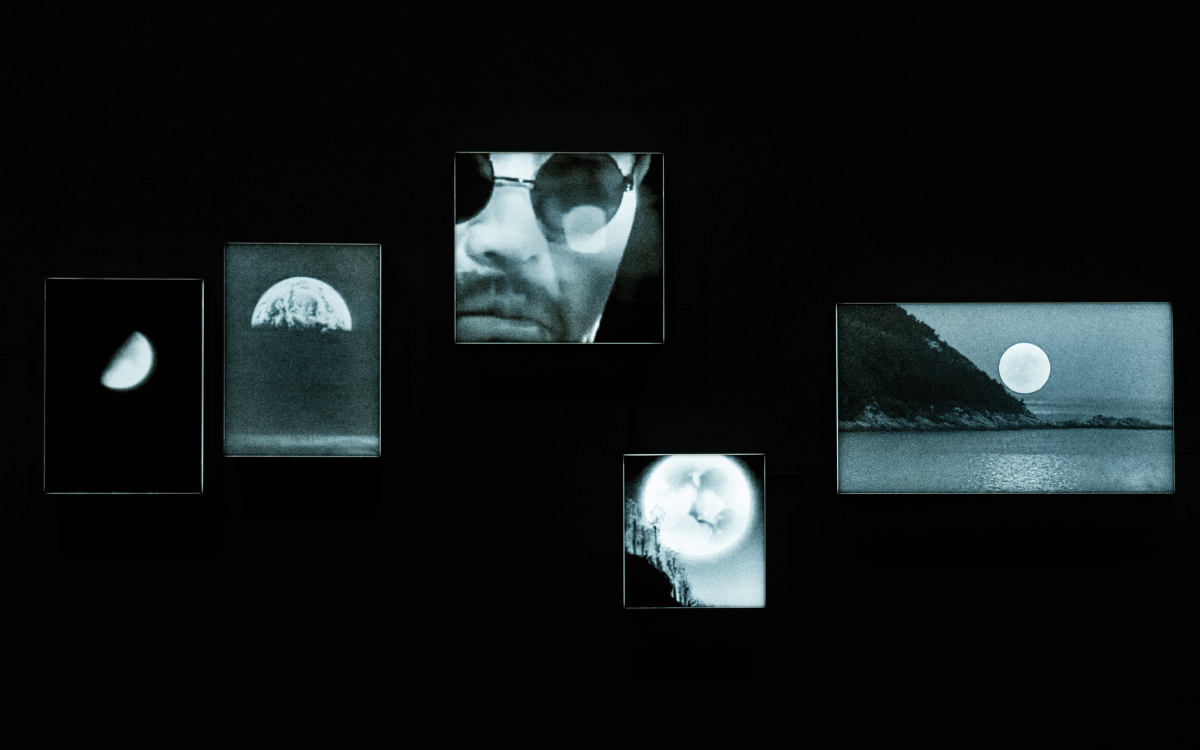
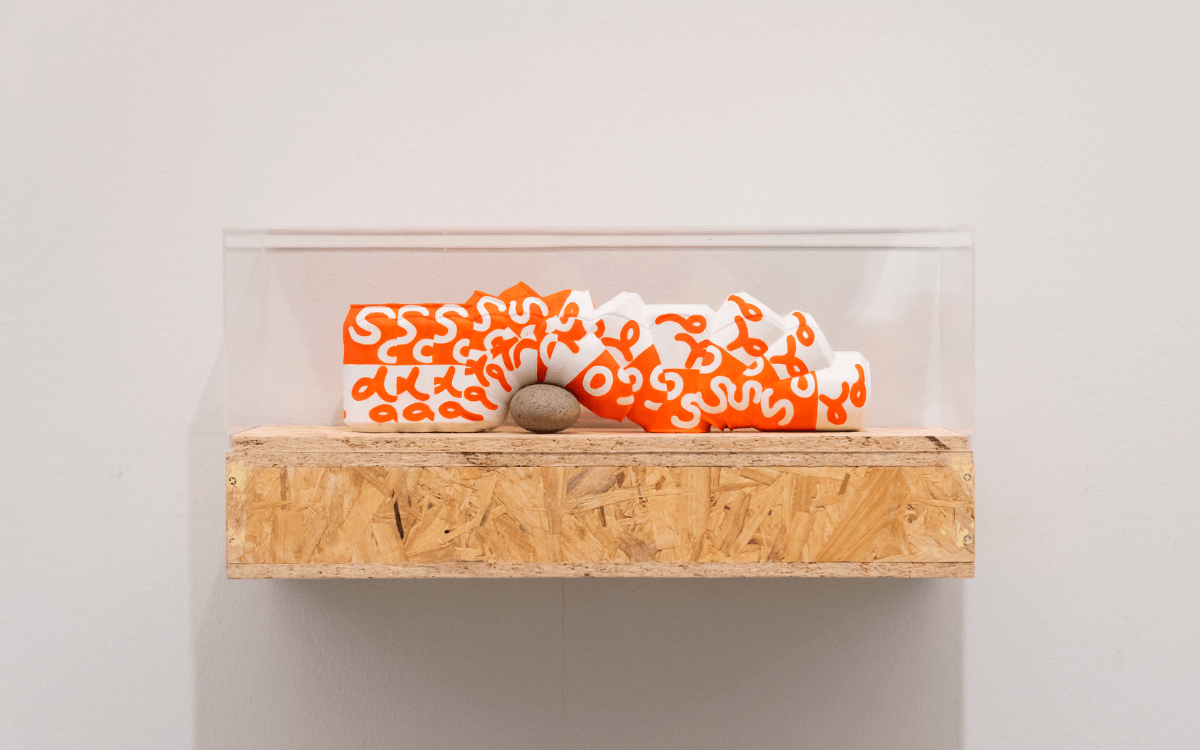
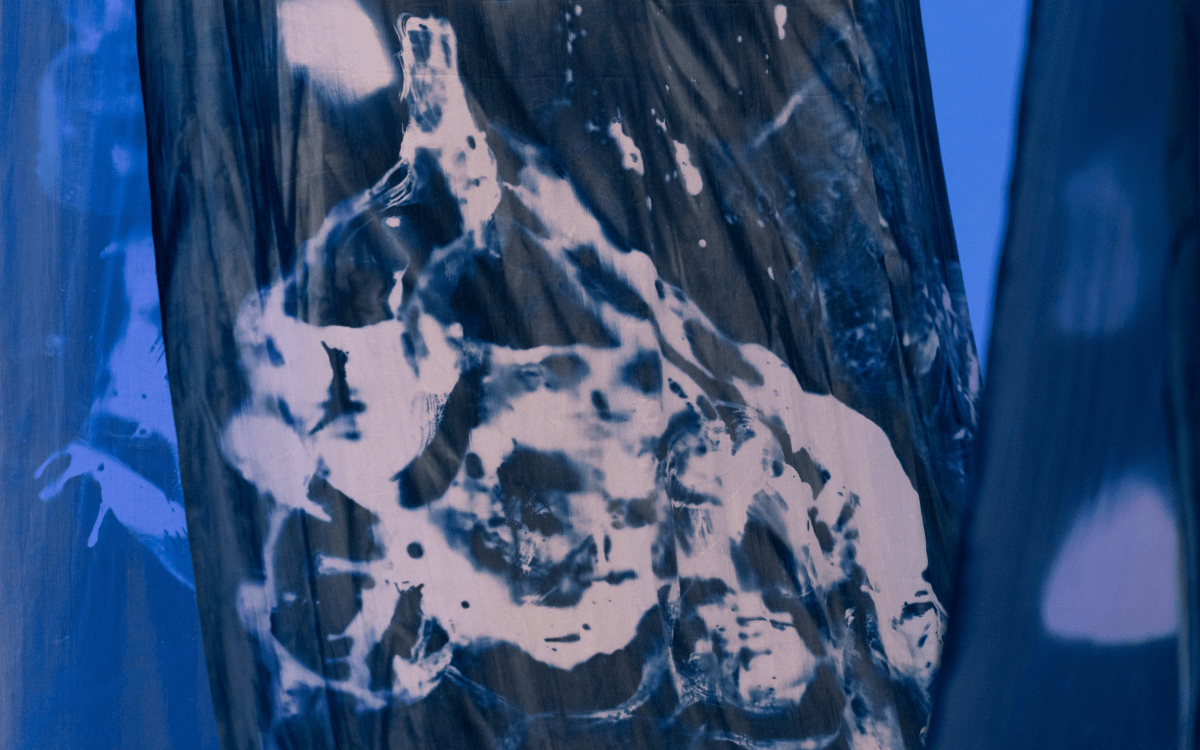
My Grandfather's Road—Ten Year Series 2015–2025 traces the decade long evolution of Neo Kim Seng’s multifaceted project in its various forms. This iteration brings together photographs, artefacts, books, video, music, video documentation, a new photomontage work, as well as live readings and dance activations. All these come together in a museum of memories, past and present, personal and collective, to explore how they shape our social fabric.
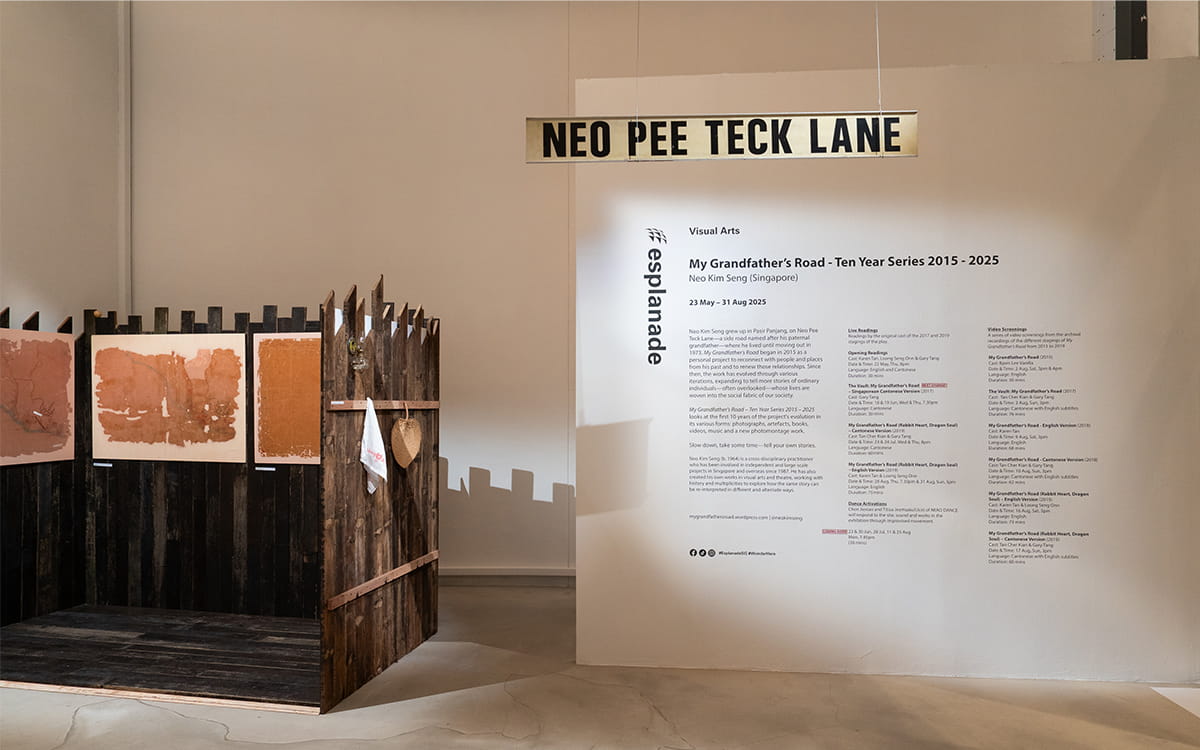
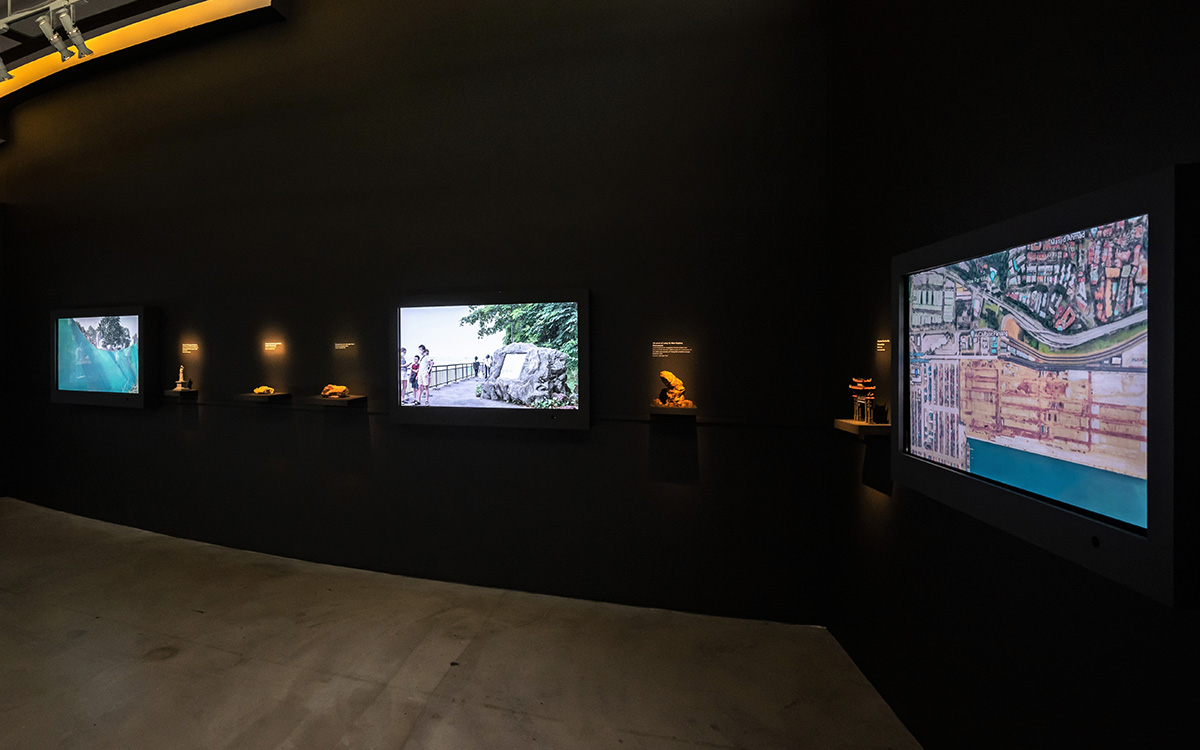
Installation view of <em>My Grandfather's Road—Ten Year Series 2015–2025</em>, Neo Kim Seng, 2025
In this interview, Esplanade – Theatres on the Bay's Head of Visual Arts Tamares Goh and Visual Arts Programming Trainee Ryan Tan sit down with artist Neo Kim Seng in conversation about My Grandfather's Road—Ten Year Series 2015–2025, his new exhibition at Jendela (Visual Arts Space).
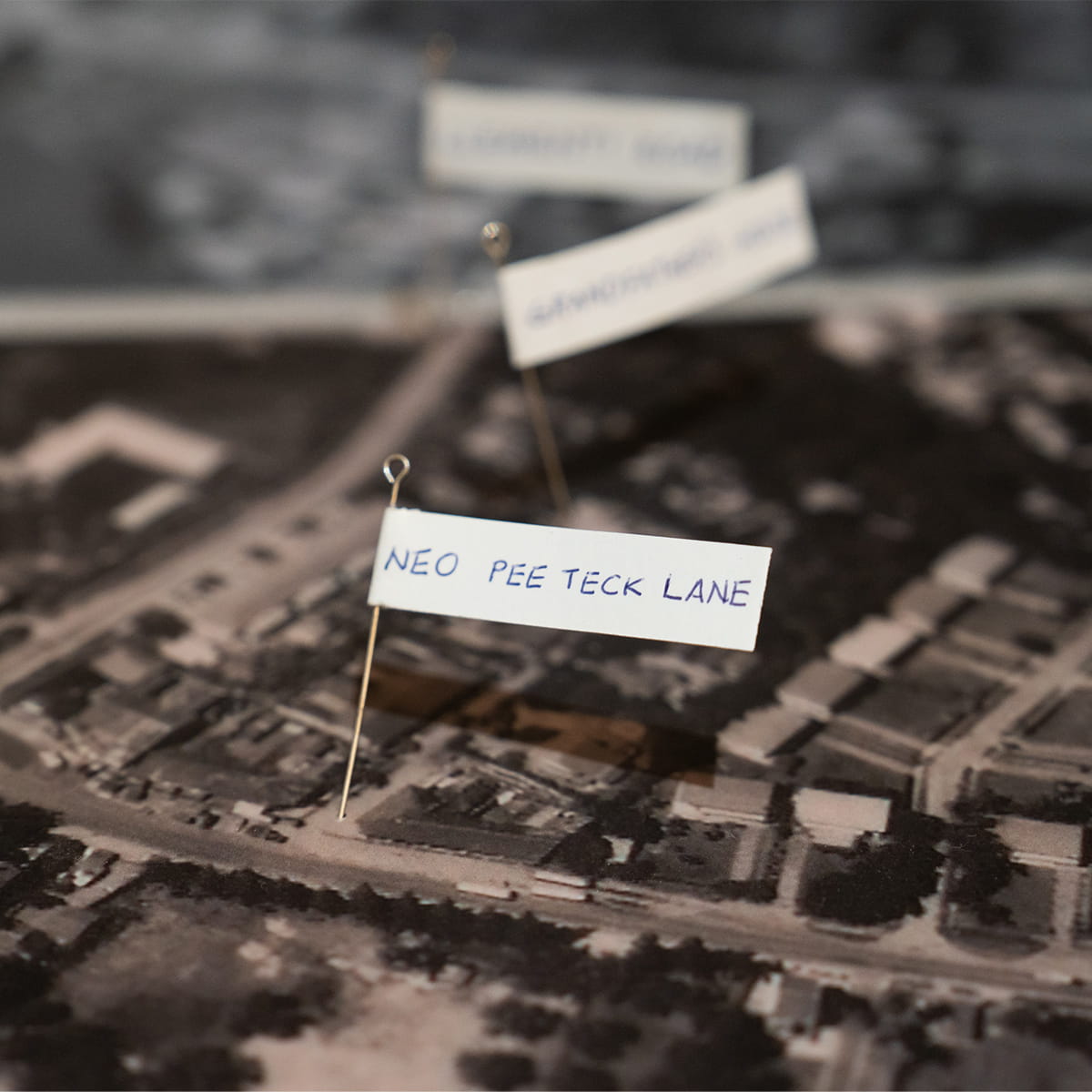
Neo Kim Seng (NKS): The project was planned from the beginning with text, performance and photo-installation in mind. So, I would be able to create different versions of My Grandfather’s Road (MGR)—not necessarily all three parts at once, but whenever the opportunity arises. The iterations over the first five years were more text-based: digesting the text further and gathering new stories, correcting factual errors and writing new materials for performance. The text also evolved from focusing on my family to other residents of Neo Pee Teck Lane to a more personal narrative in the 2019 iteration. When the Arts House offered a more visual arts-based iteration, I looked at how to visualise the stories. I decided to show the old family photos and family artefacts in showcases in The Chamber at the Arts House, where Members of the Singapore Parliament once debated policies that affected us all.
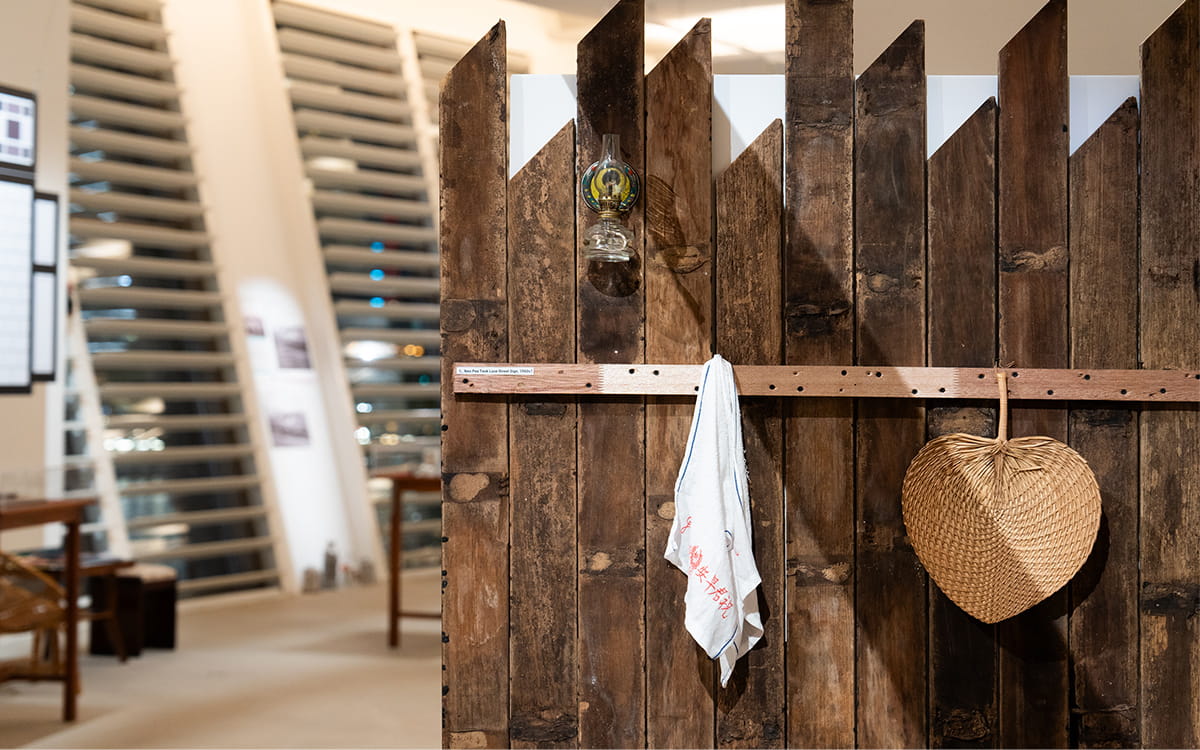
Installation view of <em>My Grandfather's Road—Ten Year Series 2015–2025</em>, Neo Kim Seng, 2025
NKS: I was hoping to take the 2019 stage production overseas but the pandemic in 2020 dashed all plans. I was toying with some ideas during this time and a small, wild idea of recording a different translation of the short text Colours from the MGR script. Later, discovering that funding was available to expand this wild idea led to the inception of the more audio-visual side of MGR—an area I’ve always wanted to explore but lacked technical expertise in. So, I roped in collaborators who knew better than me and I fed them the ideas. I previously worked mostly on my own but the newer projects are more collaborative.
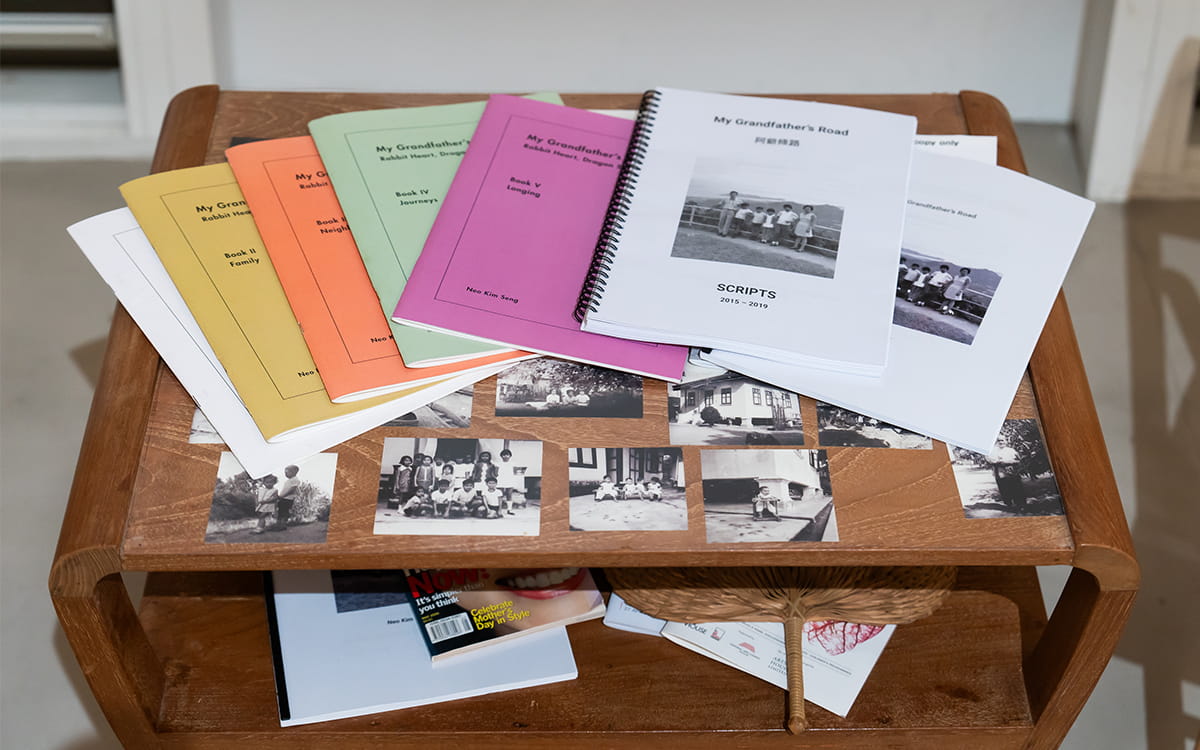
Installation view of <em>My Grandfather's Road—Ten Year Series 2015–2025</em>, Neo Kim Seng, 2025
NKS: I started work on the project without telling any of my family members about it. They found out about it online. I don’t have a very good relationship with my family before this project and because of MGR, I speak and see them more and join them for family gatherings. They are very supportive of my work. They actually found out more about me through various iterations of the theatre productions as well. But I also had to be mindful of how much I wanted to reveal to the public about my family and myself. I’m a very private person and usually keep a low profile. But some friends who attended the performances also told me that they have come to learn more about me through the performances.
NKS: I didn’t want this to be a nostalgia project because people tend to only recall the good things and memories when they talk about nostalgia.
“
”
Some people carry painful memories that they never truly get past, and these memories haunt them forever. It takes time to understand yourself, to forgive, sometimes forget, and to let go of things.
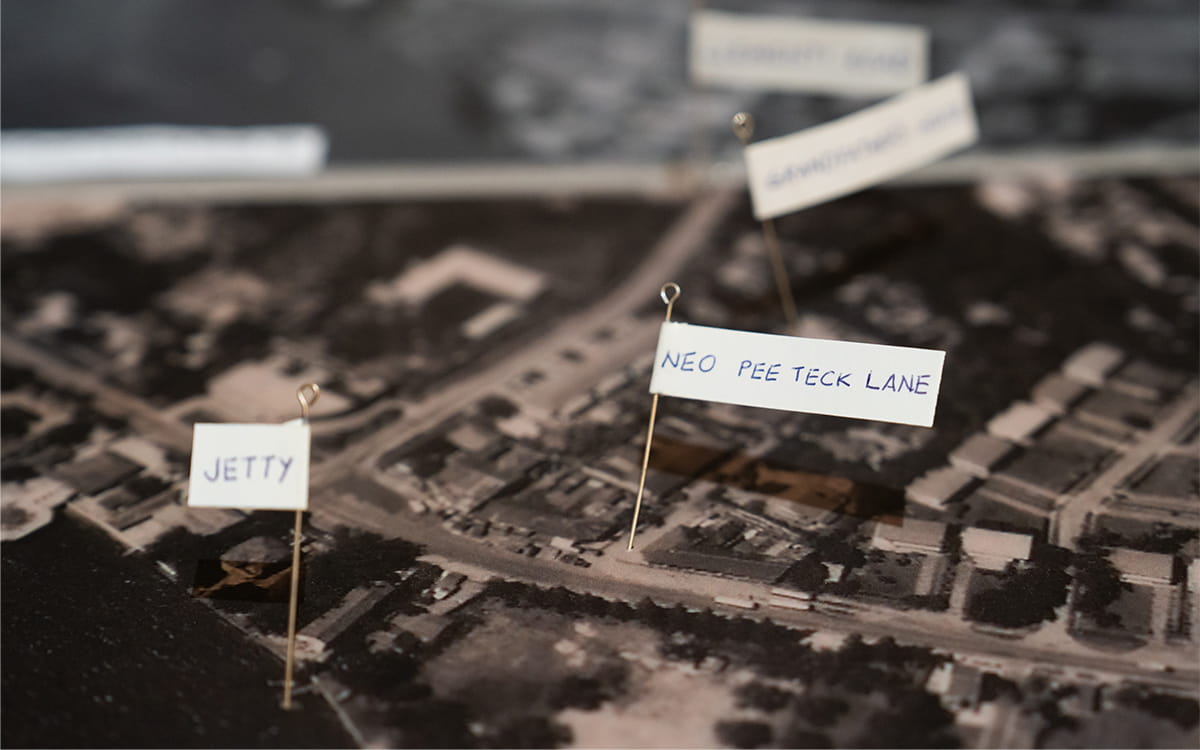
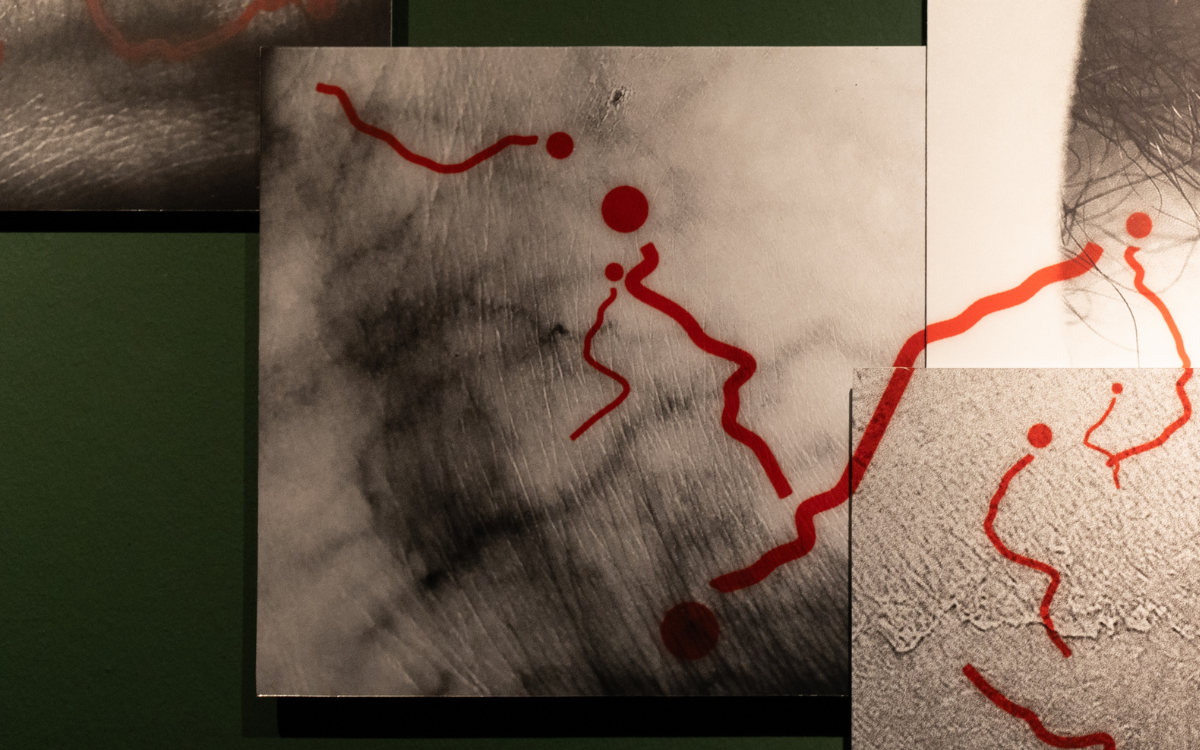
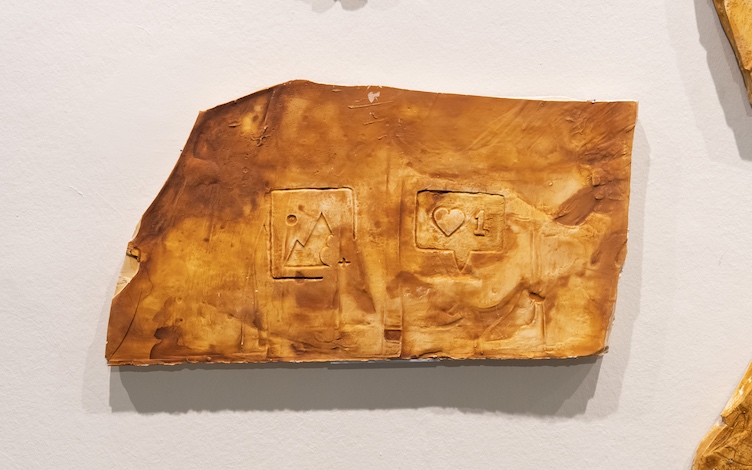
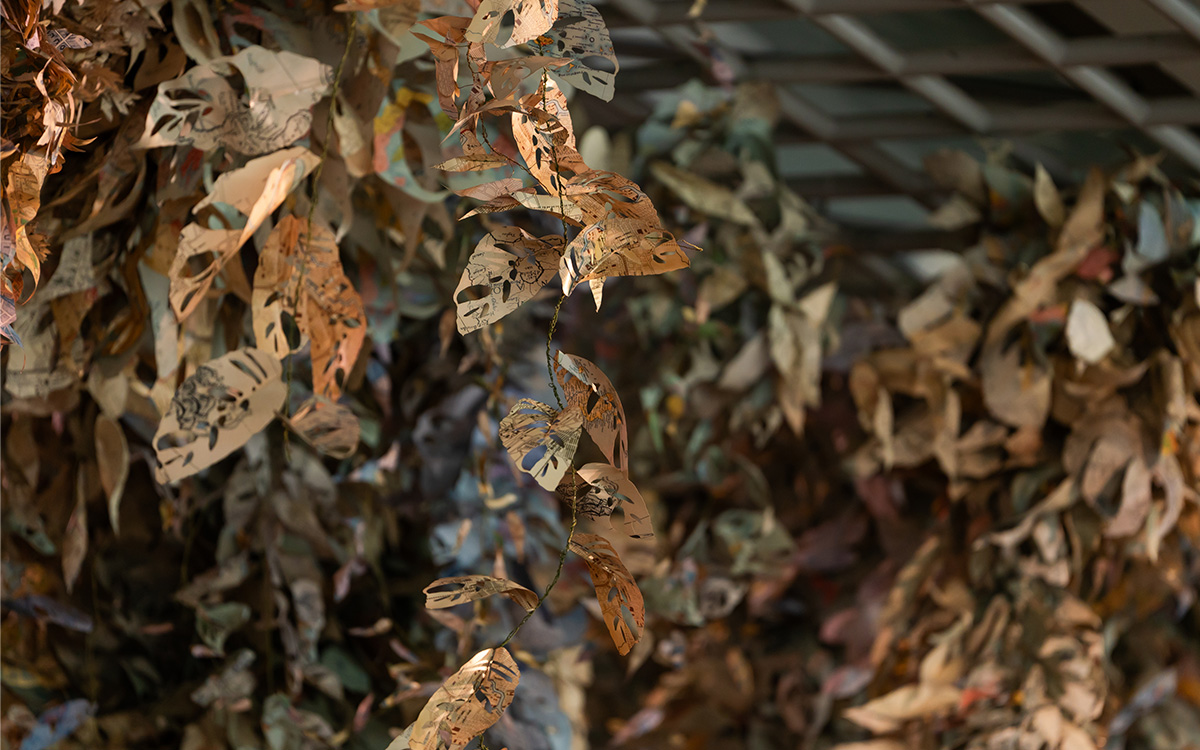
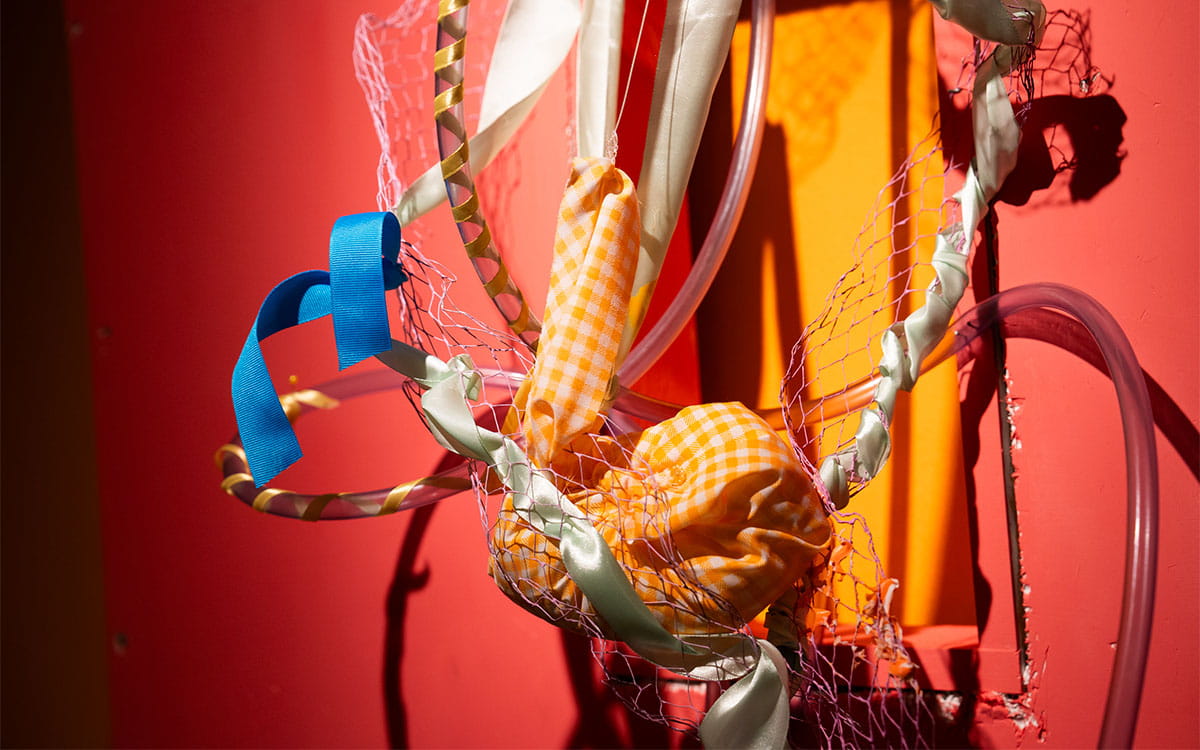
Details from <em>My Grandfather's Road—Ten Year Series 2015–2025</em>, Neo Kim Seng, 2025
NKS: I see heritage as living memories. An ancient temple visited only by tourists, where no worship or activities take place, is just a place to visit and not a live space. But once people worship there it comes alive with the living memories of its worshippers. Quite a lot of people are now becoming more interested in keeping non-mainstream languages like Cantonese alive. Languages are living memories, especially if it they are only learnt and transmitted orally, taking on the influences of the place where they are spoken; this makes the evolution of these languages inevitable.
NKS: The different theatrical versions of My Grandfather's Road held and anchored the whole project through the years as it began as a text-based work. For visitors who wish to engage deeper with the exhibition, it’s best for them to read the various publications available: the Artefacts 2025 exhibition guide, the 2025 edition of the original book, the different scripts, the set of colourful books first published for the 2019 Arts House exhibition and the catalogue with information on the evolution of the project. Many things in the publications can be understood only as text and cannot be expressed visually as a physical work or exhibit. The text also helps to give background information on the exhibits that you would otherwise just see as an object from someone's past. As it was not possible to re-stage the theatrical productions, the next best thing was to have live readings of the scripts. The Cantonese versions of the play also serve as reminders of how fragile an oral tradition like language can be, how memories and heritage are sometimes rewritten, swept away and lost forever, both physically and mentally.
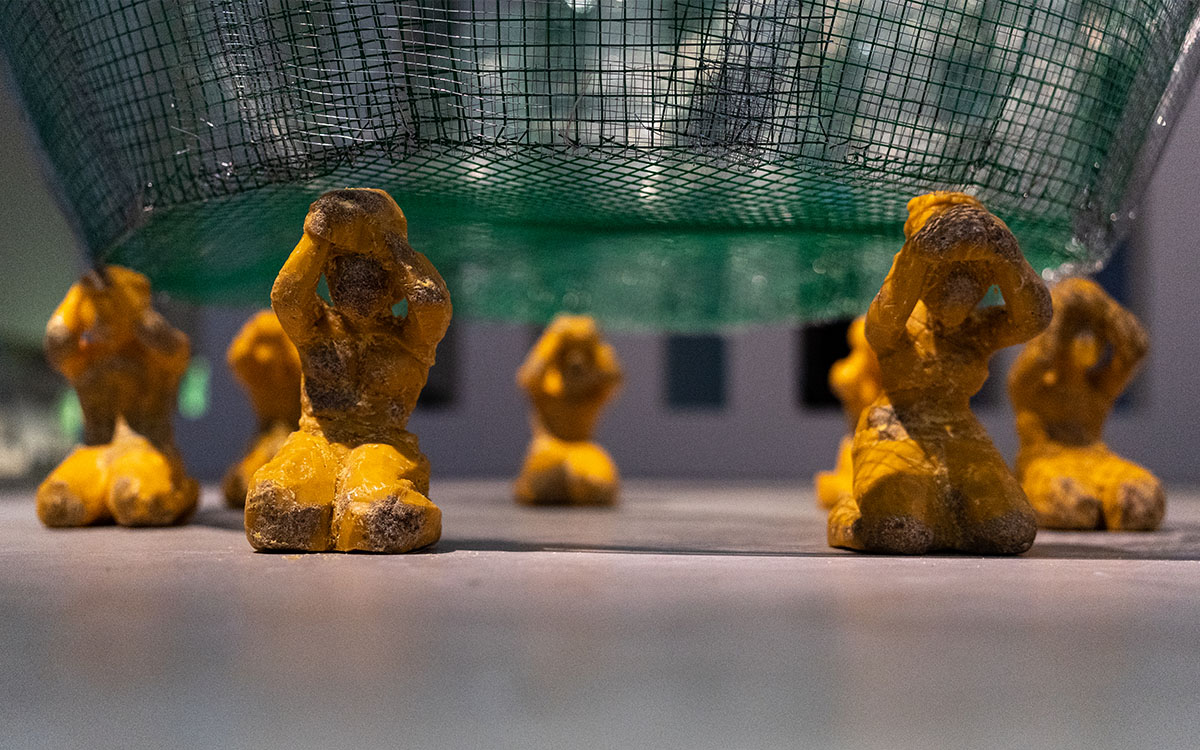
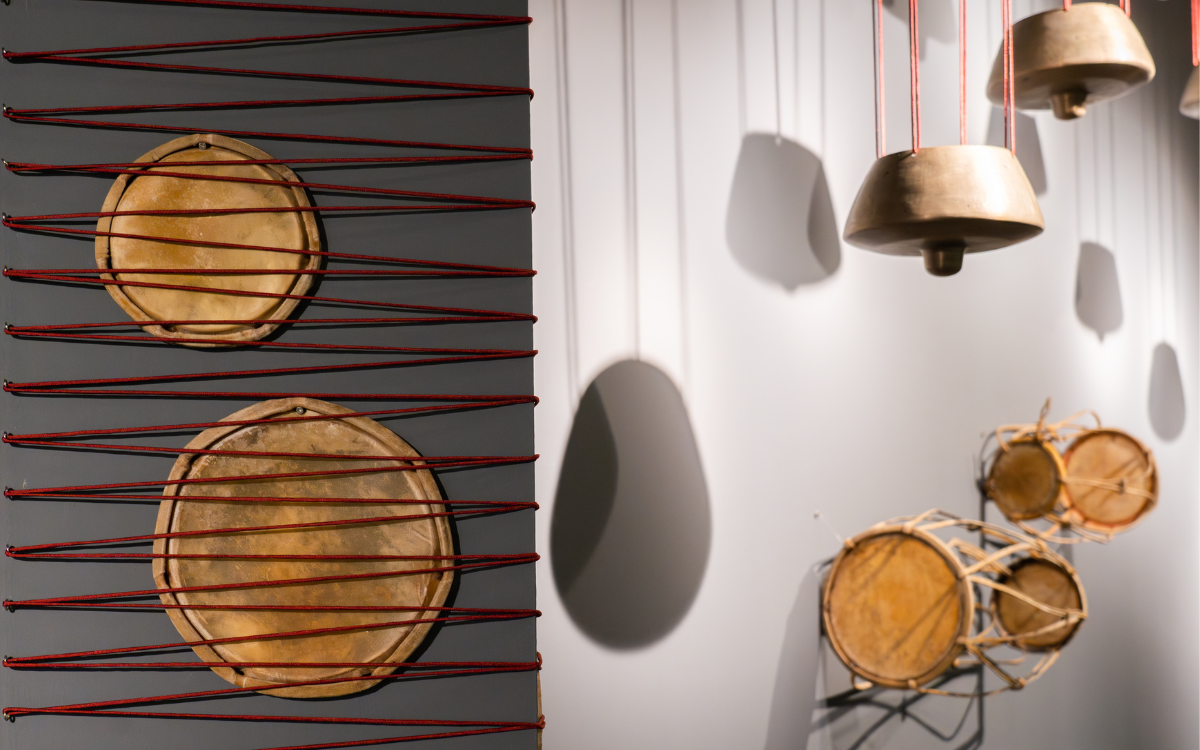
I've always been interested in space and how you could transform it. Jendela is a challenging space, and this exhibition was conceptualised and designed with different entry points for different visitors from toddlers to old folks, each of them choosing how they want to enter and engage with the space as there are many narratives and levels to this work. I did not want a space where visitors would merely be passive viewers but rather one where visitors could engage deeper and interact with the works and space by sitting, touching, playing, relaxing, and slowing down in the space. The exhibition is an exploration of the different possibilities of the Jendela's space as a social and performance space.
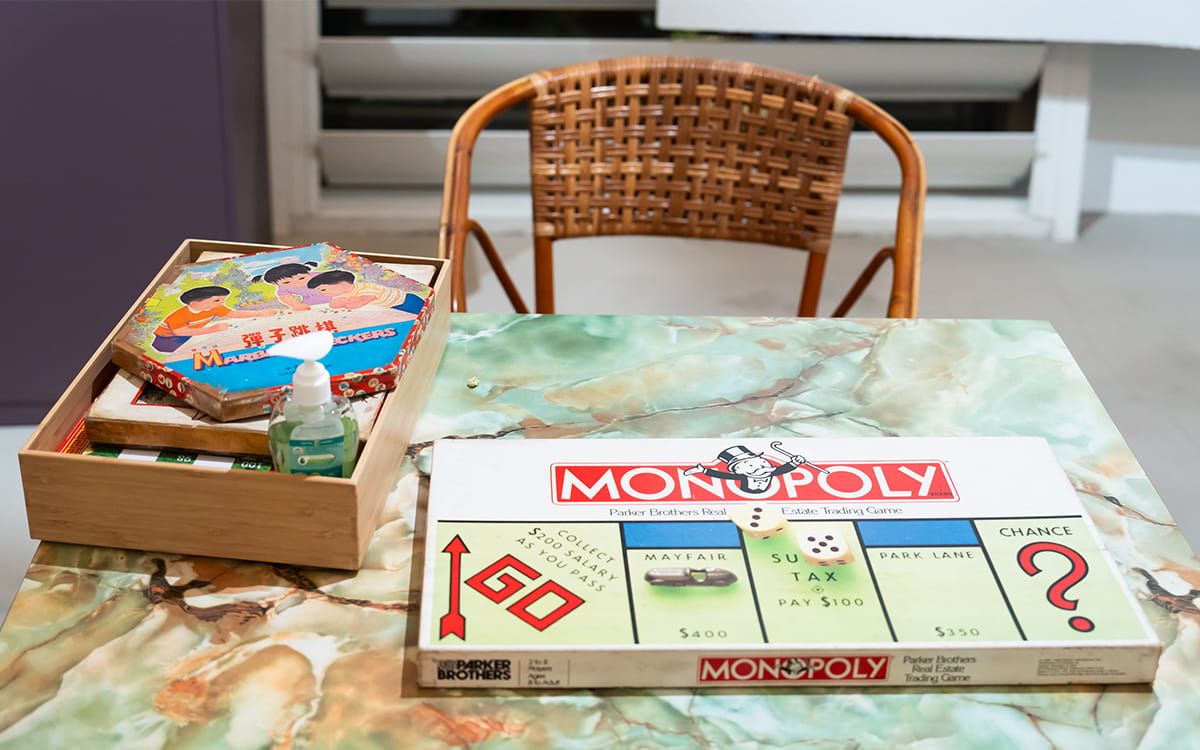
Installation view of <em>My Grandfather's Road—Ten Year Series 2015–2025</em>, Neo Kim Seng, 2025
For the dance activations, Chen Jiexiao, Titisa Jeamsakul (Ice) and their daughter Keiko are already part of the exhibition as they are featured in the Secret Places video screening in the Jendela's children's/fun room. The video was filmed in 2021 and was first part of the Colours (2022) online project and later as Secret Places (2023) as an outdoor video installation as part of Singapore Art Week 2023.
So it was only natural that I asked Jiexiao and Ice to be part of the exhibition programme to continue their involvement with the evolution of the project as I was interested to see how performers would respond to the exhibition site. Both Jiexiao and Ice actively practice and promote dance improvisations with their company MIAO DANCE.
NKS: When I first embarked on this project in 2015, I was concerned that it was too personal and specific and would not be relatable. The duration of the two previous iterations of the exhibition in 2019 were quite short and there were not that many visitors. There were not many opportunities to find out visitors' response or even strike up conversations.
Speaking to visitors in the last few weeks, it became clear to me that my personal memories, stories and artefacts are not important in this work. What was more important was how the visitors relate to the objects and artefacts, how they trigger their own stories and memories. The space became like a museum of collective memory and I am but a small part of it. It was unplanned and I was pleasantly surprised that it evolved spontaneously. These memories of ordinary people are important and must be recorded for future generations. This aspect of collective memory will most probably play an important role in the evolution of this project in the next ten years.
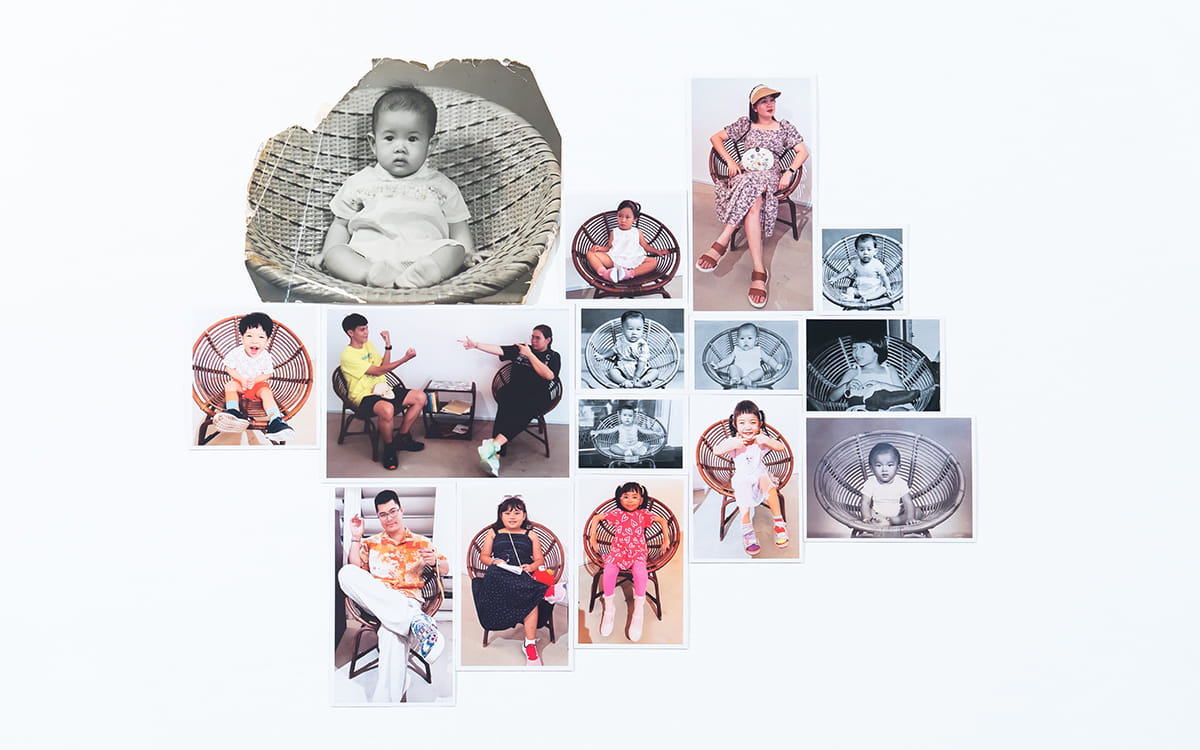
Installation view of <em>My Grandfather's Road—Ten Year Series 2015–2025</em>, Neo Kim Seng, 2025
Neo Kim Seng (b. 1964) is a cross-disciplinary practitioner who has been involved in independent and large-scale projects in various capacities in Singapore and overseas since 1987. He has also created his own works in visual arts and theatre. He works with history and multiplicities as he is keen to explore how the same story can be re-interpreted in different and alternate ways.
Tamares Goh
Tamares Goh is an art administrator and the current Head of Visual Arts at Esplanade. In her own art practice, she works and thinks in a cross-disciplinary manner and is currently creating objects from found materials.
Ryan Tan
Ryan Tan is a Visual Arts Programming Trainee at Esplanade. Engaging his studies of Fine Art, Design and History of Art, he explores the interplay between these aspects through his illustrative and curatorial practice.
My Grandfather's Road—Ten Year Series 2015–2025 is on view at Jendela (Visual Arts Space) from 23 May – 31 Aug 2025.