Time taken : <5mins

The terrains and spaces around us have long inspired and challenged artists, engendering varied responses and narratives. Between Vistas delves into the language and visual traditions around the concept of the “ideal landscape”. Informed by his formal training in Western art techniques and interest in Chinese artistic traditions, Chen Shitong melds these diverse influences into the scenes he creates. The Mustard Seed Garden Painting Manual, a seminal publication on Chinese painting philosophy and colour block painting published in 1679, led Chen to consider how landscapes can be a storytelling device.
Printmaking, painting and ceramics are harnessed to conjure evocative landscapes that explore the relational condition of the individual with the environments they dwell in. Chen’s compositions range from abstract, panoramic landscapes to scenes fraught with narrative intent. He experiments with juxtaposition and perspective, building images that hint at what lies beyond the edges of the works. Between Vistas considers the limits and possibilities of visual representation in helping us relate with the world around us, where the boundaries between the real and imagined are constantly shifting.
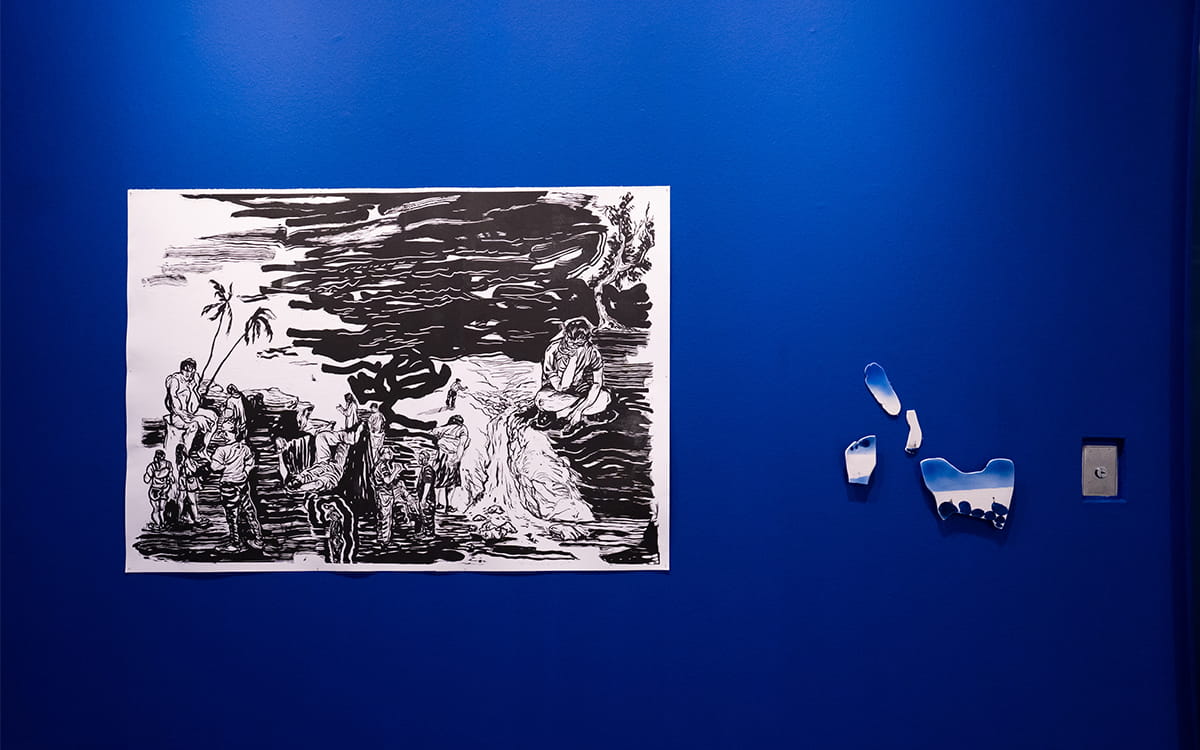
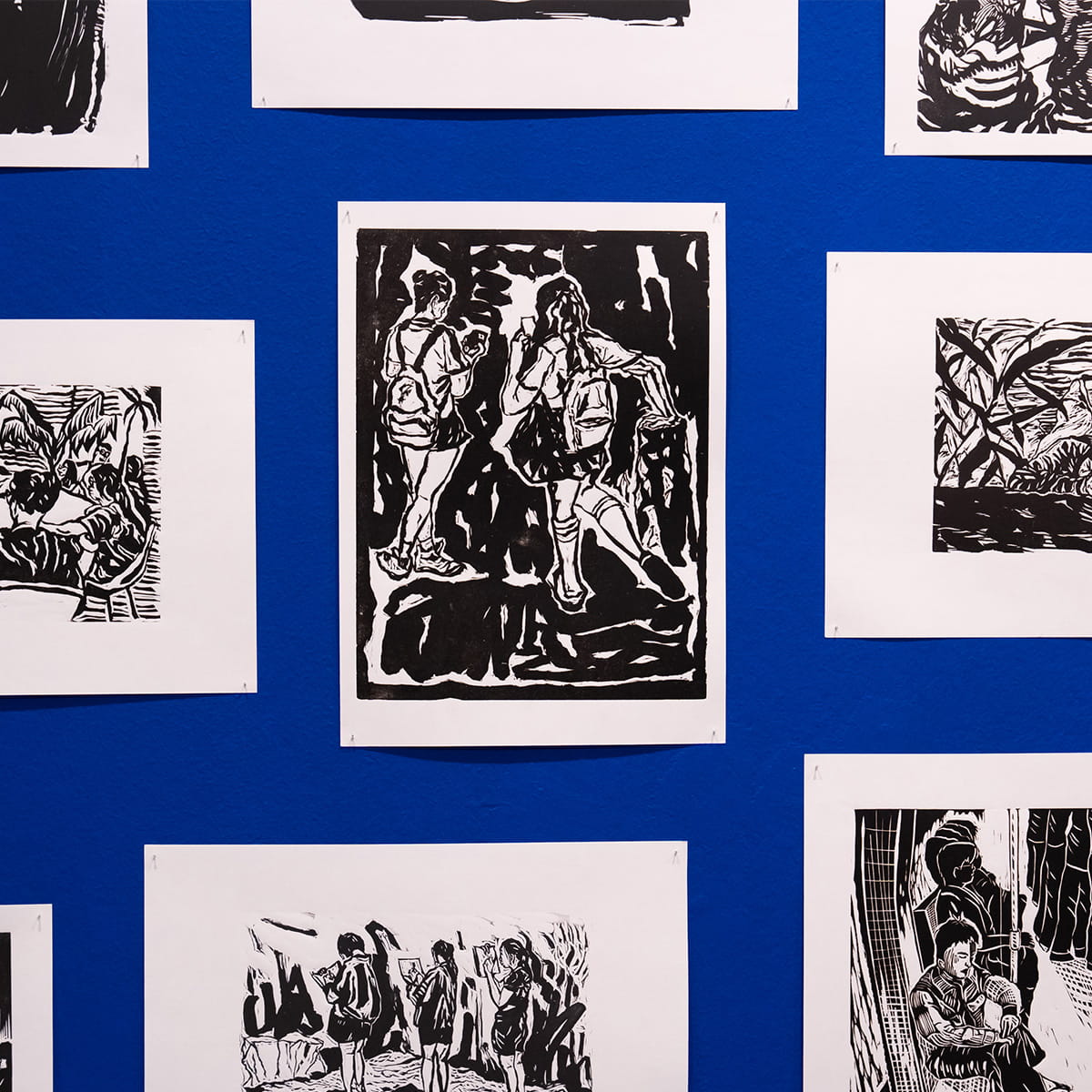
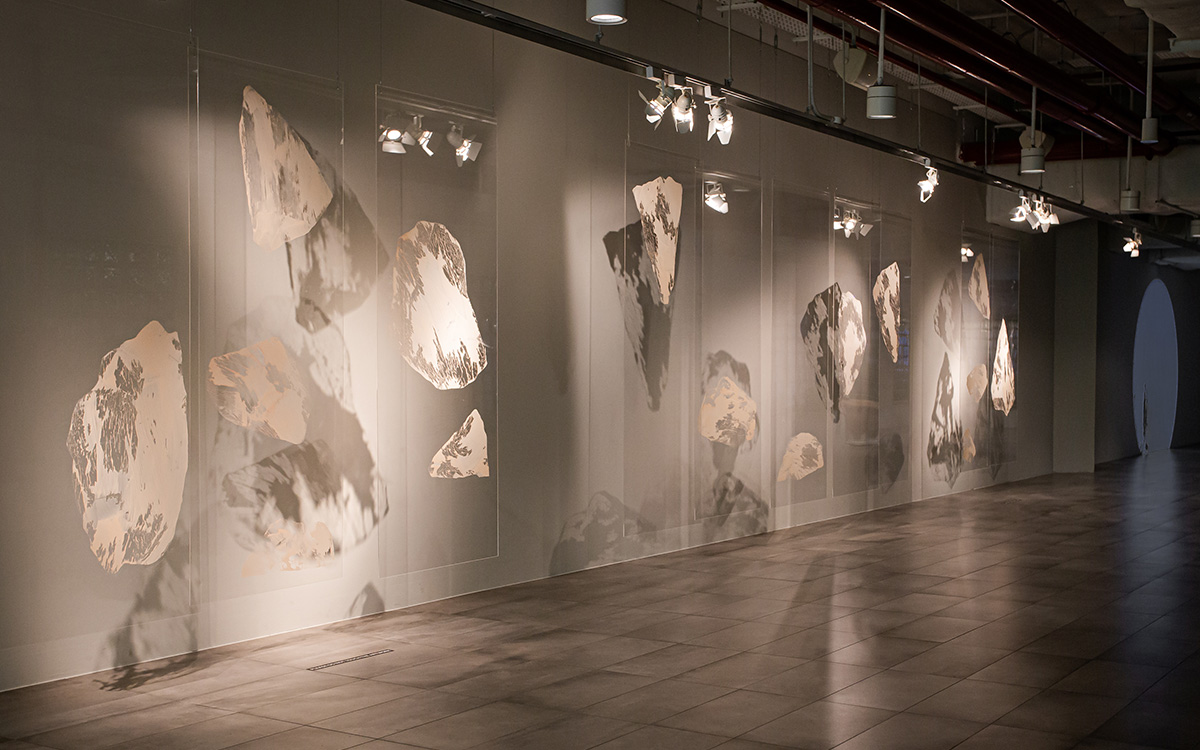
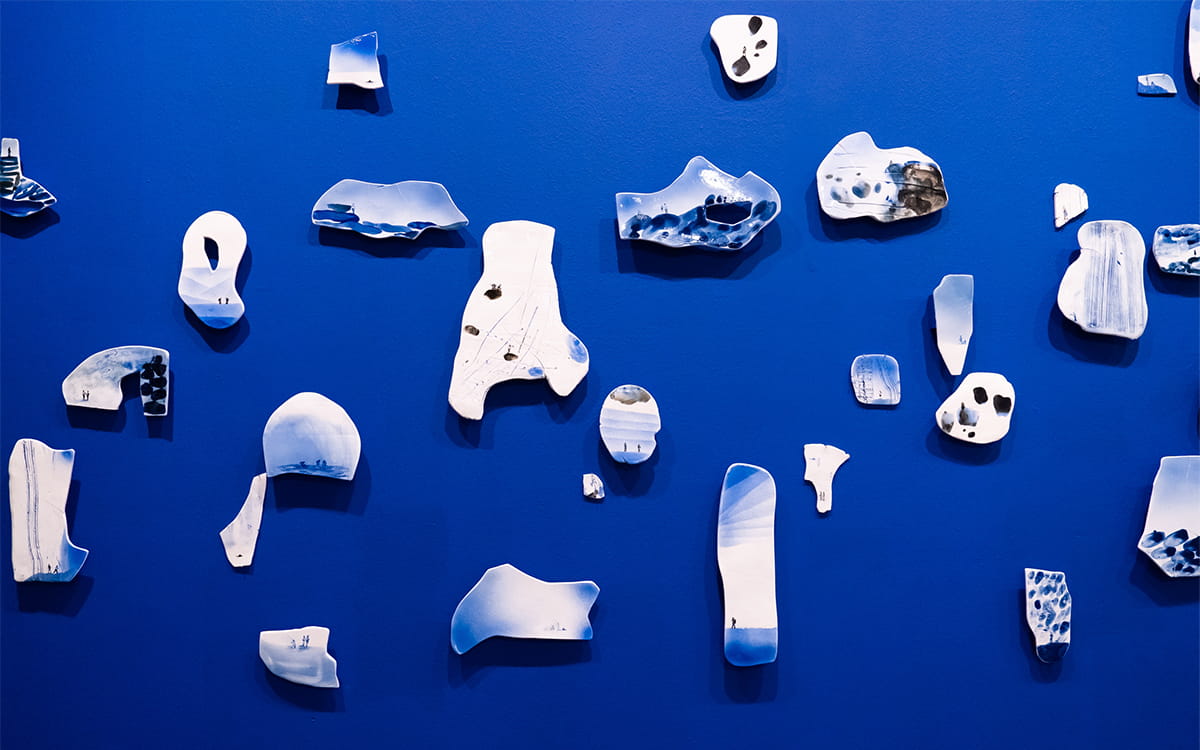
Installation view of <em>Between Vistas</em>, Chen Shitong, 2025.
In this interview, Muhammad Azfar Bin A Rahim, Visual Arts Project Assistant at Esplanade – Theatres on the Bay, sits down with artist Chen Shitong in conversation about Between Vistas, his new exhibition at Esplanade Mall Level 3 Community Wall.
Chen Shitong (CS): I started off as a painter in Western painting at Nanyang Academy of Fine Arts (NAFA), where I got my diploma. From there I developed an interest in printmaking, mainly through art books that I borrowed. Many of these books featured illustrations done with etchings or lithography, and that was where it started. I then signed up for a weekly printmaking night class at NAFA with artist April Ng. Through learning from her we became good friends, and I eventually started creating many prints of my own.
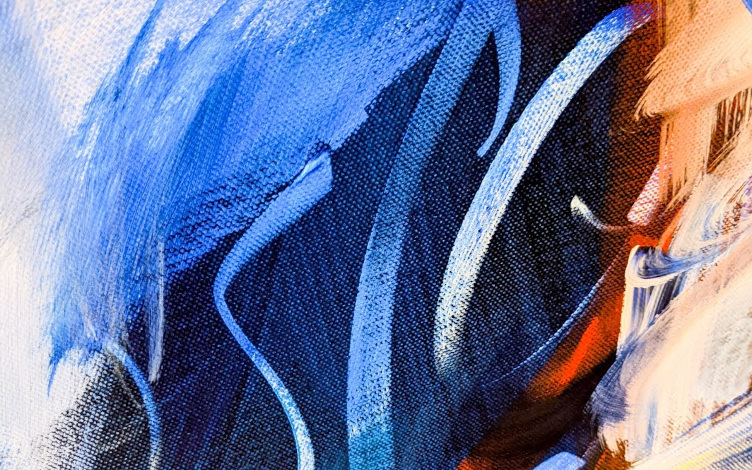
Details of <em>Between Vistas</em>, Chen Shitong, 2025.
CS: Yes, there are certain books that I am particularly drawn to, like old history books, those about Singapore with old photographs of plantations and such. I find myself coming back to them whenever I start a new project to gain new inspirations.
CS: That is a question I always ask myself. I am not sure what draws me to them, it could be the colours—aside from various the techniques that created these engravings—and perhaps the figures. They always feature lone figures within their environment, like a person surrounded by lush vegetations, for example.
CS: Come to think of it, I think history is the only subject that I passed in secondary school. I also like taking photographs, collecting photographs of human figures. Perhaps partly due to my training in Western figure drawing. There’s an interest and habit in observing the human body.
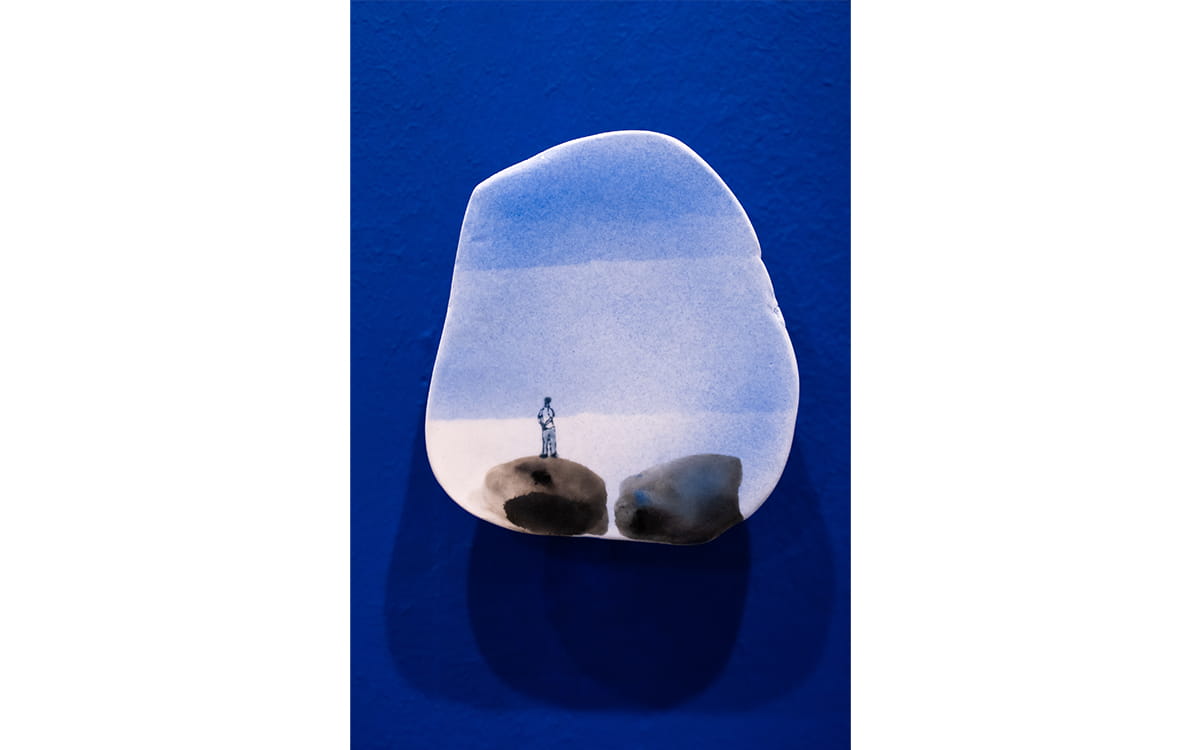
CS: I think of my works as landscapes in which I have the freedom to place them in different situations and surroundings, creating possibilities of stories and evoking certain feelings. I have always been interested in creating places where human figures can dwell, offering a space that could be inhabited. In a way the landscape is completed by the presence of the figure. I often get asked about how I compose the image and why I choose to place a figure in a particular spot, and that prompted me to reflect on what would be my definition of a “perfect landscape”. And I am still searching for that today...
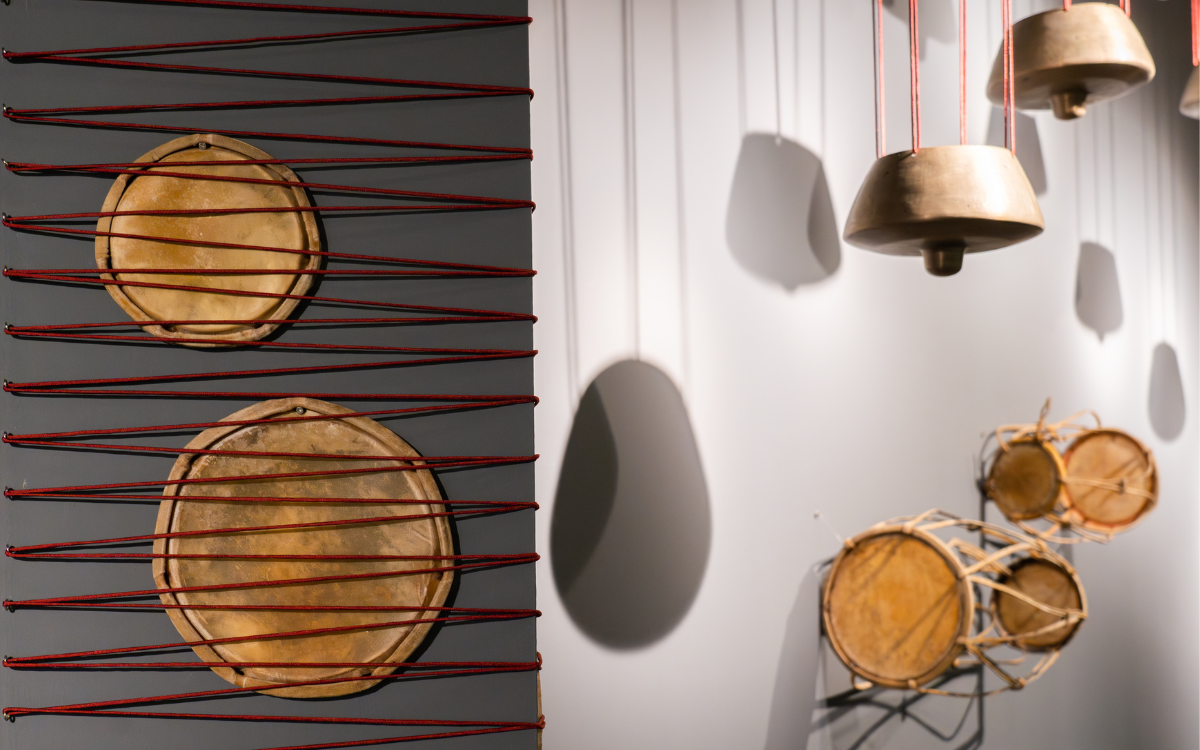
Details of <em>Between Vistas</em>, Chen Shitong, 2025.
CS: Perhaps it is the colour of the landscapes. This time I’d chosen blue. When I make works, I think of the colours and how they can express my feelings. I always find myself coming back to blue; like for this series, I explored with the visuals of blue and white porcelain.
CS: Yes, again there is that reference to historical objects and imageries. Landscape paintings of the past are almost always populated by human figures, or at least something that is living and animate.
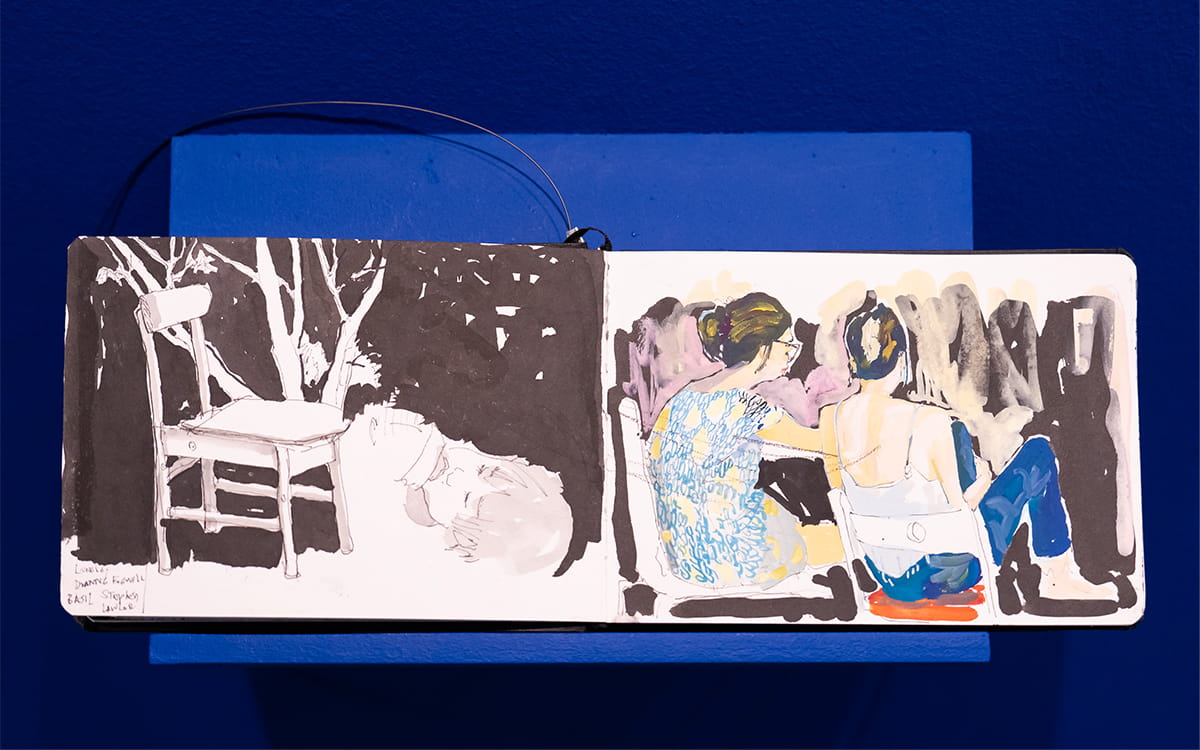
CS: I tend to observe the people around me, whether at home or in public spaces, to see how people behave and the shape of their silhouettes. It is a little bit like collecting. I lookout for people who are engaged in specific tasks or doing something unusual and interesting.
Details of <em>Between Vistas</em>, Chen Shitong, 2025.
CS: I came across a book called The Mustard Seed Garden Painting Manual, and have been learning from it. The book itself is a Qing-dynasty manual on Chinese ink painting, but due to the limitations of printing back then, the illustrations and examples in the book were made by woodblock printing. This lent a different aesthetic to the representations, resembling prints rather than ink. I found myself liking the idea of trying to replicate brushstrokes with relief printing. So, I took a Chinese brush and painted on my linoleum sheet and then carved out the strokes as best as I could. I felt that woodcut has a sort of angular stiffness to it, and the print would not be revealed until the first print. On the other hand, painting on linoleum before carving it allows me to follow a certain shape to a higher level of faithfulness, as I would be able to see it when I make my cuts. There is better control in the mark making process, which helps me in attempting to blur the line between relief prints and painting.

Details of <em>Between Vistas</em>, Chen Shitong, 2025.
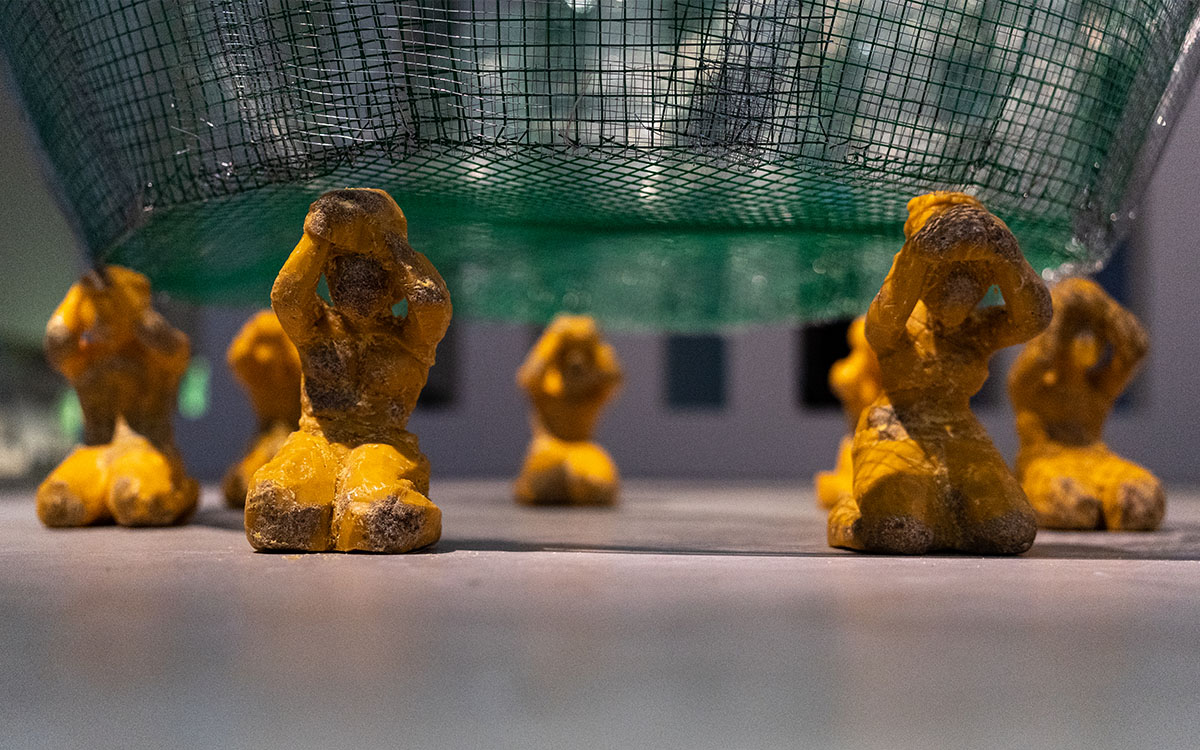
CS: Actually, the figures in the ceramics were printed. Clay is a material that can capture a lot of textures, so I thought of using them like paper, which is why you see that these ceramic pieces are flat and thin. It is my attempt at combining printmaking with ceramics. I guess you can say that it is an experimentation of different mediums; how do I evolve from printmaking and incorporate it into different mediums.
Trained as a painter and printmaker, Chen Shitong (b.1984, Singapore) weaves stories that explore how individuals and society relate with the spaces around them. His practice surfaces the layered stories that are unveiled through interactions between humans and our surrounding environments. His works have been exhibited in Singapore, China and the United States. Chen started Pulp Editions in 2017, a workshop that focuses on professional fine art collaborative practices with artists.
Muhammad Azfar Bin A Rahim is a Visual Arts Project Assistant at Esplanade and is involved in the making of exhibitions across the centre's Visual Arts spaces. With a background in arts management, he works closely with artists to bring their visions to life.
Between Vistas was on view at Esplanade Mall Level 3 Community Wall from 16 Jan – 11 May 2025.