Why are independent creative spaces vanishing?

Published: 19 Nov 2025

By: Pragya Jha

Time taken : ~10mins

Pragya Jha is a Baybeats Budding Writer mentored by Ilyas Sholihyn, editor-in-chief of RICE Media and Eddino Abdul Hadi, music correspondent for The Straits Times.
The room was packed when the night gig organisers KelikoSound ran a farewell show for Spectrum by Phil Studio. Phil Studio is no stranger to the gig venue space, having had previous spaces in other locations since 2023. The third iteration, Spectrum, had only just opened in early 2025.
I found myself sitting outside the venue in the basement of GR.iD with the owner, who prefers to go by Phil, himself.
With the warm air circulating alongside the hazy sounds of shoegaze, the 50-something, who is said to be a martial arts sensei armed with two master’s degrees and a PhD, talks to me about the stream of notifications—more than 800 personal messages ever since he announced the closure of the third iteration of his beloved performance venue. It was an overwhelming outpouring, to the point where “[he] couldn’t even answer all of them.”

Photo collage of the message book at KelikoSound’s Farewell Phils gig. Photo Credit: Pragya (@prgyeah)
The string of recent closures of well-loved independent arts venues like The Projector, Enclave and now, Phil Studio has left many in the scene reeling.
These were places that seemed successful and deeply embedded in their communities. Phil himself says he “had no intentions to close.” So what’s really going on beneath the surface?
As expected, for venue operators, the biggest concern in Singapore's land and rental markets is financials.
Krysta Joy D’Souza, owner of Saylah Studios, located at 180 Paya Lebar Rd, opened her studio in the fallout of COVID-19 in August 2022. “We all lost all our opportunities,” she says. Stuck at home and realising she was not alone in her struggles, she decided to “dedicate the next couple of years to just creating space for people.”
She described her early days starting the studio with clarity and gratitude. When she moved into her first proper unit, the space was “in shambles.” The first of many hurdles to overcome was the pressing cost of the down payment, which she was fortunate to have the support of her father for, who offered to pay the sum if the vision for the studio was something she truly believed in.
The second, of course, was the renovation. Krysta recalls fondly: “Our contractor really, really believed in the project.”
“I only learned afterwards that not only did he give us huge discounts without telling us, but he even paid for some of our stuff.” From the beginning, it seemed, community initiative was crucial to building Saylah Studios.
And this generosity was necessary because the financial model was fragile.
“It was just like, very, very much trial and error, whatever I could do to just cover the rent,” she says. “I never paid myself [a salary]—the priority is that we can keep the lights on.”
Even in Saylah’s second community space, all the entry fees go straight to rent. A team of volunteers carries out the rest of the work.
Phil echoed the same reality, but on a larger scale.
“You have to be invested in making losses for quite some time,” he says. “If you don’t have at least 120 people showing up to each show [of his size], you will lose money.”
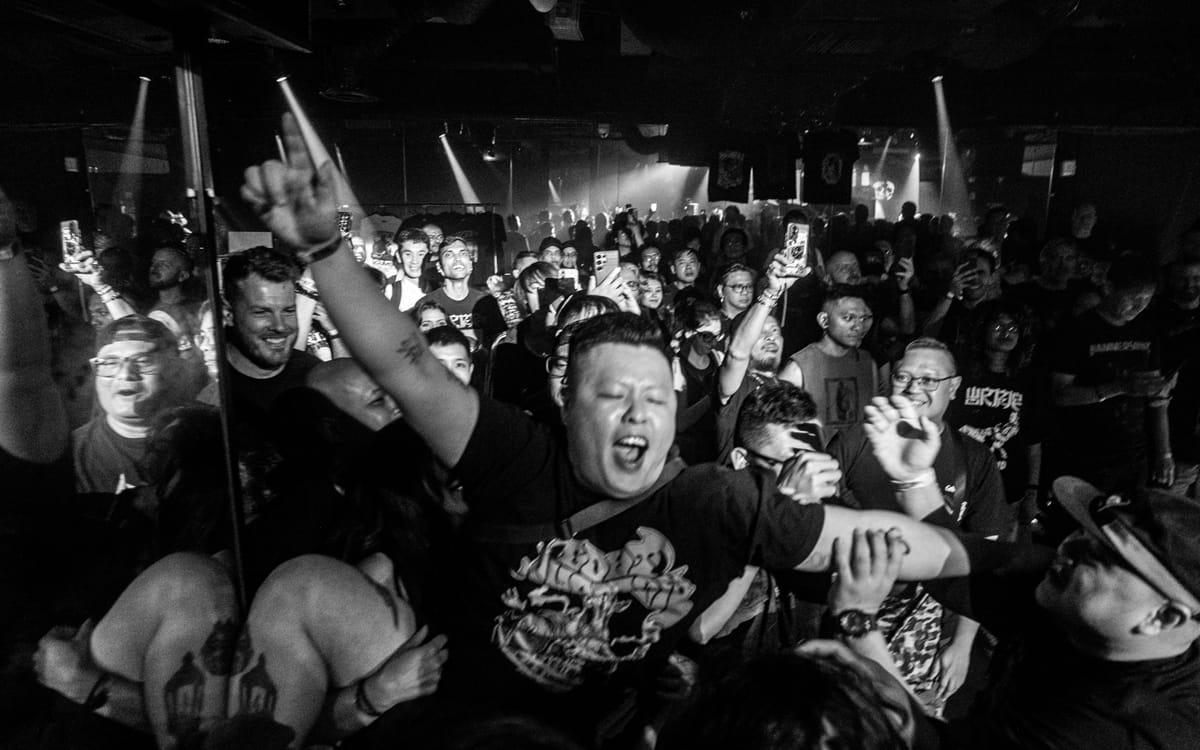
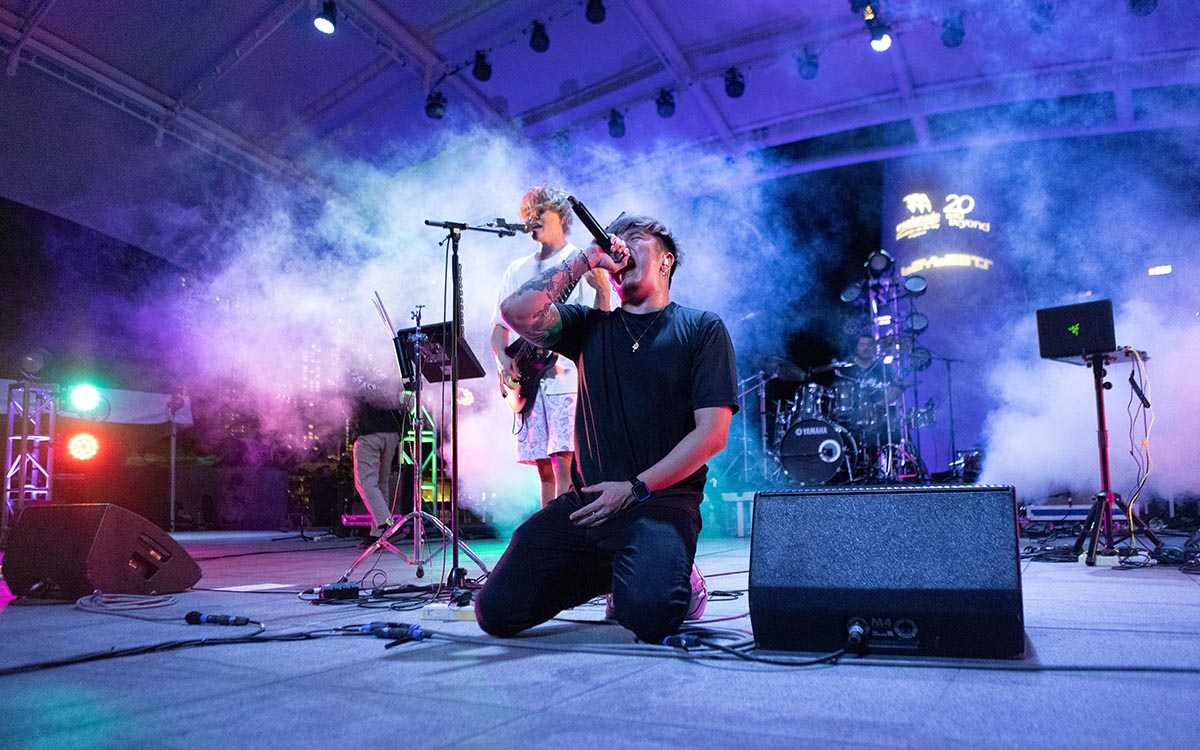
Wormrot live at Spectrum by Philstudio. Photo Credit: Wayne Tan (@xwayne1991x)
Every independent performance venue owner knows the financial risks. All of them know they have to find ways to innovate to stay afloat.
Phil’s model involved subsidising early evening shows and gigs with nightclub revenue later in the night.
“That’s how I cracked the code,” he says. “Because actually [the shows] were losing money, but I was compensating with the nightclub activity.”
Even so, that model collapsed.
If rent was the first wall, the laundry list of licensing required is the maze behind it. Phil summed it up bluntly: “You name it—URA, Compass, IMDA, FSC, SFA. Any single guy can say no, and then it’s over.”
Jonathan Kang, owner of Nineteen Eighty studios, located at 361 Joo Chiat Rd, reaffirmed the need to evolve.
Nineteen Eighty Studios, a live house as well as a recording and rehearsal studio, opened its doors during COVID-19 as “a reaction to seeing quite a lot of places [Jonathan and the founders] loved as musicians going under.”
The space's early days were solely as a rehearsal studio, but Jonathan noted how quickly they realised it was dangerous to rely on a single revenue stream. Rehearsal slots, he says, filled only a fraction of the day’s operational hours.
To stay viable, they diversified by “looking at holding live performances and clinics.” The modus operandi remains retaining the “degree of commercial sensibility coupled with being quite disciplined about [their] expenditure.”
But Singapore’s broader economic context compounds the pressure.
“When life is expensive,” Phil says, “you will prioritise education, health, housing, food—and of course, entertainment is the last thing we consider.”
That shrinking budget means arts venues are often the first to feel the squeeze.

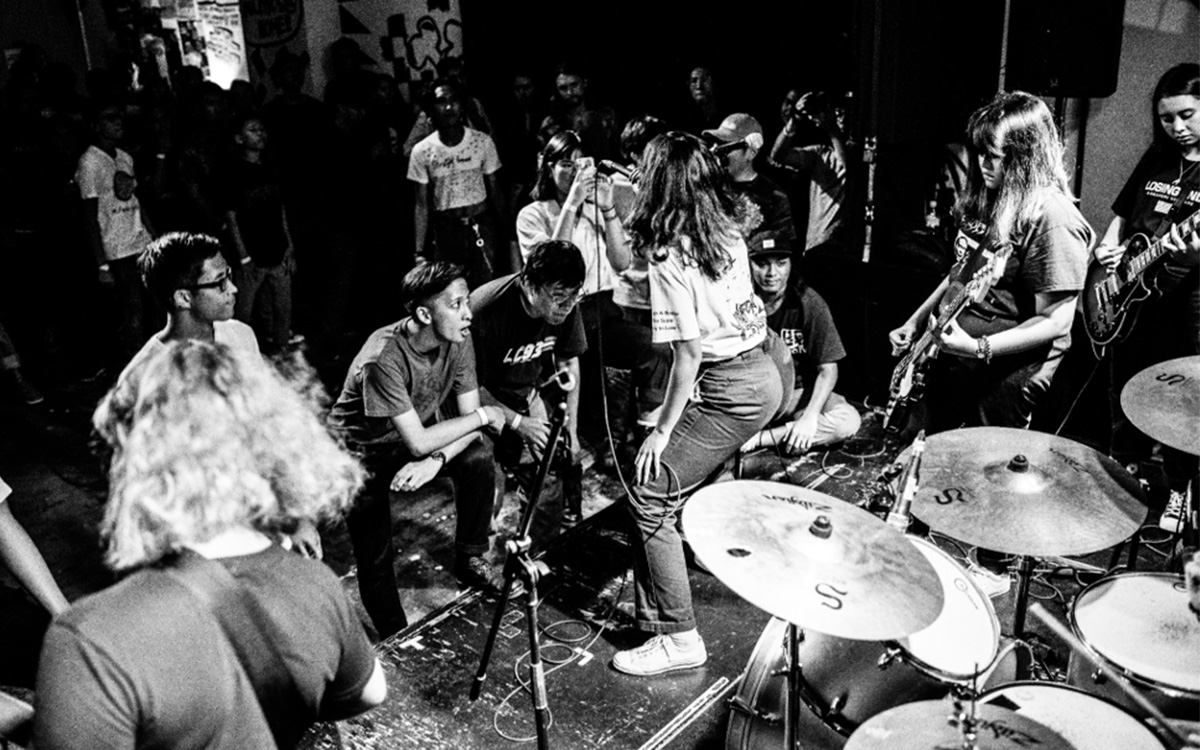
The audience gazing at their shoes at Window To My Soul at Nineteen Eighteen Studios. Photo Credit: Denzel (@denzelong.cr3) courtesy of Rabak Records.
Jonathan affirms that their part in the ecosystem is to function as “places for bands to be able to pay their dues.”
This sentiment resonates throughout each interview. For Phil, his goal is to have “the opportunity to practice and practice and practice and fail and practice and fail and fail and practice and ultimately become stronger and succeed.”
Beyond its four walls, a venue's deeper value lies in being a home for the local independent music community.
“We see commercial risk as a commercial responsibility,” Jonathan aptly notes, “because if we make a wrong call, or we don't manage our finances properly, many hundreds of people lose a space to rehearse or to play.”
It teeters on the level of parental responsibility. “Venues like mine,” Phil says, “are the place where the teenagers, the young adults, can express themselves. They don’t have to hide or pretend.”
He believes that erasing these spaces is the easiest way to breed an unhealthy society.
“You have to maintain room for expression, for craziness so that these youngsters don’t have to hide in basements, in between brackets, hidden like, ‘Oh, we don’t want you.”
That is the quiet urgency behind every venue. To keep the lights on is to keep the scene safe and visible—and to keep the people from having to go underground.
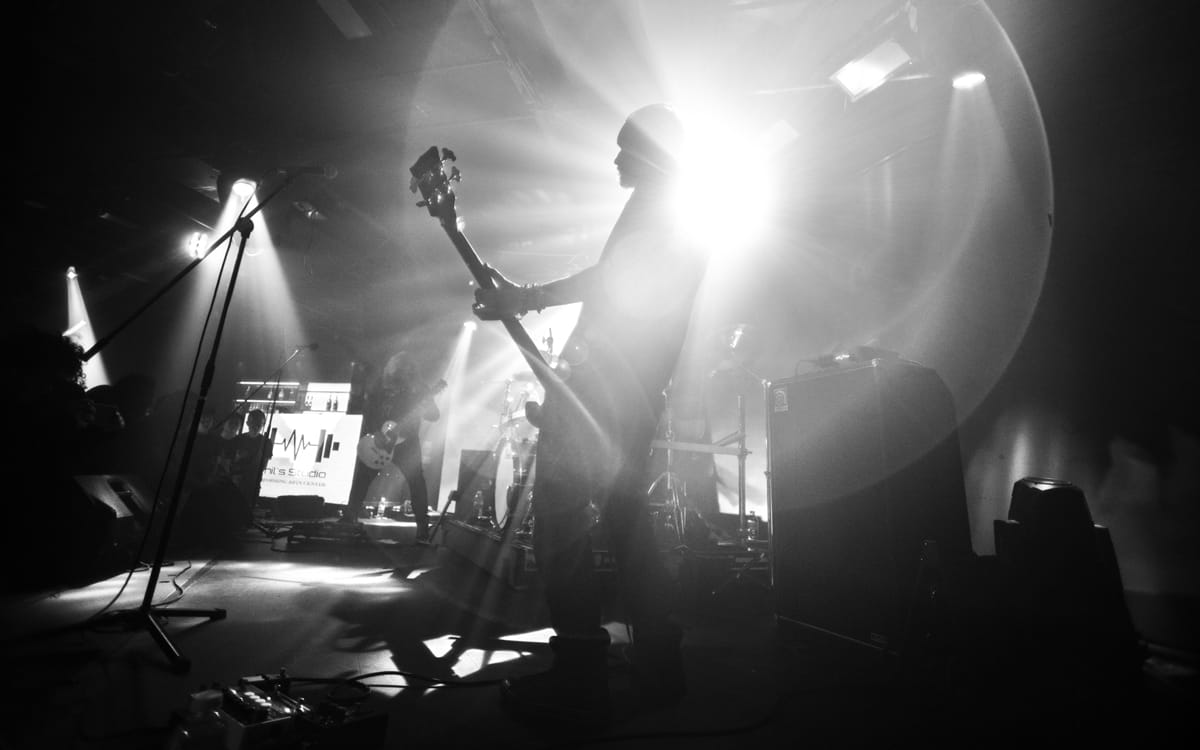
Conan live at Spectrum by Philstudio. Photo Credit: Wayne Tan (@xwayne1991x)
This is no story of doom. People improvise, and new micro-infrastructures emerge. Phil’s cancelled shows got relocated elsewhere; older communities migrate into new rooms.
“Singapore is a society of restarting. It always restarts,” offers Shaiful Risan of Prohibited Projects.
Shaiful, a long time figure in the scene who has been heavily involved since The Substation’s active days, has seen the scene grow since before the 2000s. To him, too many buildings have been torn down and rebuilt, and between these liminal spaces, the scene continually re-finds itself.
But in this constant cycle of death and rebirth, it reinforces the sense that these venues aren’t necessary to the city’s social fabric.
“Think about spaces that have existed in the art scene—a lot of them aren’t standing anymore, and I think maybe that is the problem, but that's also what makes me feel like I don't feel like there's a need for it, just because we've been fine,” Krysta says.
One thread that kept surfacing, however, is that venues don’t need to be islands. They succeed when they are nodes in a wider, cooperative network.
Jonathan is of the opinion that the independent music scene is missing collective bargaining or collective advocacy in the way so many other local interest groups have managed to pull off.
“Without a consolidated ask with demonstrable value, policymakers will never see a need to change anything, and it's not their fault. They're just doing their job.”
Shaiful’s insistence that Singapore “is a society of restarting” carries a paradox: constant demolition makes permanence rare, yet in the same breath, it normalises adaptability. The scene learns to be nimble, and in that nimbleness, there are opportunities for new configurations. What we need is more people willing to join hands and do the work.

Microchip Terror live at Spectrum by Philstudio. Photo Credit: Wayne Tan (@xwayne1991x)
Venues will continue to come and go and come again. If the culture wants to persist, it must protect the practices and the memories that remain when zip codes change. Phil, Krysta, Shaiful, and Jonathan offered different answers to the same question: How do you keep music culture alive in a city that prizes commercial utility instead?
Crucially, the return was to the same final point: venues are not an end in themselves. When a physical space disappears, the core memories and culture built often seed the next one. Proof that the scene never really dies, it just relocates.
Singapore’s alternative music circuit may be trapped in this life-death-rebirth loop, but that’s also what keeps it strong. Every time a new venue is birthed in the graveyard of a former home, the noise gets louder, and the spirit harder to kill.
The work that will determine whether something lasting emerges is not heroic funding, nor the perfect grant. We already have something that lives on even as buildings and structures fall away: a stubborn determination to keep trying.
Contributed by:
Pragya Jha is a multi-instrumentalist with a background in Music and Computer Science. Her previous work includes climbing mountains and writing philosophy critiques on music, literary and film media. In her spare time, she enjoys tech consulting at multinational firms. Follow her on Instagram at @prgyeah.
The Baybeats Budding Writers mentorship programme has been running since 2014, building a community of writers to cover the growing Singapore music scene. Under the guidance and mentorship of Eddino Abdul Hadi, our budding writers learn more about music journalism and how to be a voice for the local music community.