The Long & Short of Angklung Music in Singapore

The Long & Short of Hadrah & Kompang Music

TLDR: The Long and Short of…
The Long & Short of Angklung Music in Singapore
An introduction to the percussion instrument and its music
#1 | Origins of the angklung
To understand the origin and use of the angklung, one must know that it has been said that long ago in the paddy fields of the Sunda empire, the Sundanese struggled with growing their crops. Perplexed and worried, they called upon their leader for help. Their leader meditated and was told by a spirit to cut bamboo and make an instrument. When it was played, Dewi Sri (The Goddess of Paddy/Fertility Goddess) was pleased, and rice began to grow again. Since then, as early as the 7th century, the angklung has been played to honour the goddess and to ask for her blessings for the land and its people.
The angklung, a bamboo rattle from the province of West Java, is central to Sundanese cultural identity. Played during agrarian ceremonies and rites of life passages, it was also used to boost morale during the Bubat War, as recorded in Kidung Sunda.
The word “angklung” comes from the Sundanese phrase angkleung-angkleungan in which “angka” means pitch/tone, and “lung” means broken. The name could also be onomatopoeic, derived from the sound that the instrument makes.
The history of angklung in Singapore
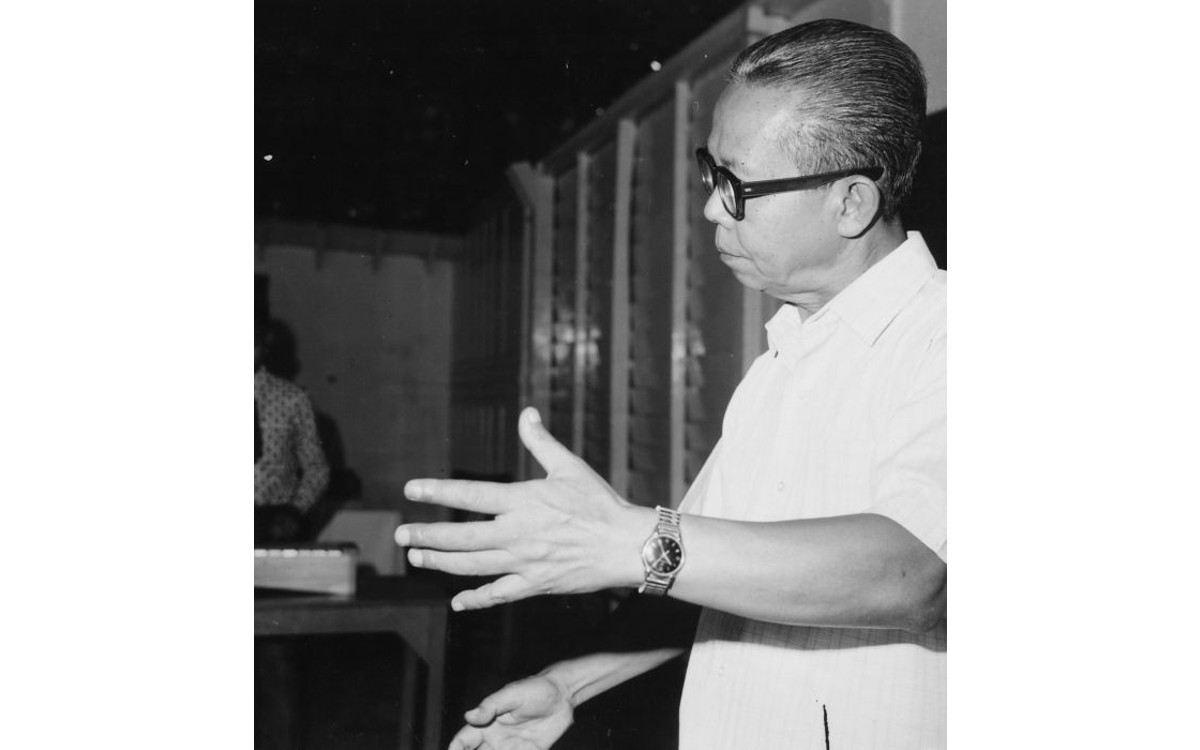
While the angklung is characteristic of the Javanese agrarian culture in Indonesia, it is synonymous with music education in Singapore. In 1959, Soerdjono, or more widely known as Pak Kasur, an acclaimed Indonesian music teacher, came to Singapore as part of the Indonesian cultural mission to teach the angklung. He recorded for Radio Singapura's children's programme and returned the following year, invited by the Singapore government to teach schoolchildren the angklung. His efforts to promote this musical instrument continue today.

#2 | The instrument and its music
Watch how an angklung is made.
An angklung is made up of two to four bamboo tubes suspended in a bamboo frame. Bound with rattan cords, the tubes are carefully whittled and cut by a master craftsperson to produce certain notes when the bamboo frame is shaken or tapped. Each angklung produces a single note or chord. To play a song, several players must collaborate to play melodies.
Parts of the angklung

Angklung music forms
Here are some of the music forms involving the angklung that exist in West Java, Indonesia.
#3 | Deciphering the building blocks
Traditionally, angklung was tuned to tritonic (three-note) or tetratonic (four-note) scales. Over time, it has been tuned to the pentatonic five-tone scales, namely salendro, madenda and degung.
The most common modern angklung has two tubes and produces one pitch, with the longer tube being tuned an octave lower than the shorter tube. Some angklungs have three or four tubes and are tuned to sound a chord.

Single note angklung © Crisco 1492, CC BY-SA 4.0
Angklung is usually played by an ensemble. Like the handbell ensemble, the set of angklung is distributed among the group and the instrument is played in an interlocking fashion, with each musician contributing a single tone to the desired melody. To play a single angklung, the musician suspends it between the index and middle fingers of the left hand and shakes the bottom of the frame from left to right with the right hand.

A musician playing the angklung © Kamillo, CC BY-SA 3.0
Alternatively, a single musician can play on their own if the collection of angklung is hung on a rack and organised into rows.
There are three techniques to playing the angklung:
- Kurulung is the most common technique; the angklung is constantly shaken as long as the length of the note tone is indicated;
- Centok is played by tapping the basic tube once, producing staccato tones; and
- Tengkep is kurulung, holding one of the rattle tubes, thus producing a pure pitch.
To play a song, several angklungs have to be played together. The main melody of the song is usually the highest note, followed by the addition of additional note tones to create harmony.
How to play the angklung
#4 | The who's who

Intangible Cultural Heritage: In Conversation with Faridah Jamal
This video is produced by Malay Heritage Centre (MHC) as part of the Intangible Cultural Heritage conversation series which shines a spotlight on the remarkable talents who shape our cultural landscape. Reproduced with permission from MHC.
Watch
Watch the Angklung Queen in action with her Paya Lebar Methodist Girls School angklung ensemble. The first piece is her own arrangement of Rasa Sayang Eh!, and the second is her original composition titled The Warrior’s Poem.

Listen
Listen to Dzul Rabull on Spotify!

Watch
Watch the video archival of some of the late Mohamed Khamis Selamat’s performances.
Angklung in Singapore today
Despite the efforts of Faridah Jamal, Dzul Rabull, the late Mohamed Khamis Selamat, and many others, angklung continues to be played mainly within schools. Not many have pursued angklung as a professional practice outside of music education. Financial reasons such as the cost of supporting an ensemble of players, owning a full angklung set and its accompanying instruments like the Sulawesi kulintang as well as how it doesn’t pay well to be an angklung musician in Singapore deter musicians from fully building a music practice around the angklung. Angklung also suffers from the image of being a traditional form that doesn’t translate well into contemporary music making or as a hip musical instrument to take on.
Therefore, as of now, until there is a shift in attitude and perception, Faridah and Dzul’s dreams of a professional angklung ensemble and school remain to be in the realm of someday.
Acknowledgement:
Faridah Jamal, Dzul Rabull and friends & family of the late Mohamed Khamis Selamat
The writer would like to express her gratitude to Faridah Jamal, Dzul Rabull and the friends and family of the late Mohamed Khamis Selamat, especially his sister Juliah Selamat, for their time and generosity, without whom this project on the history of angklung in Singapore would not have been possible.
Sources
- UNESCO: Indonesian Angklung
- Kesenian Angklung Bungko Cirebon
- The Indonesian Angklung: From Village Ritual to Soft Power Diplomacy
- Singapore Infopedia: Angklung
- ‘Godfather’ Pak meets Singapore children (1959, August 20). The Singapore Free Press, p. 5. Retrieved from NewspaperSG.
- ‘Bamboo music man’ back in Singapore to see godchildren. (1960, May 7). The Straits Times, p. 9. Retrieved from NewspaperSG.
You May Also Like