
Ritual Noh of Kurokawa – Shojo
Synopsis
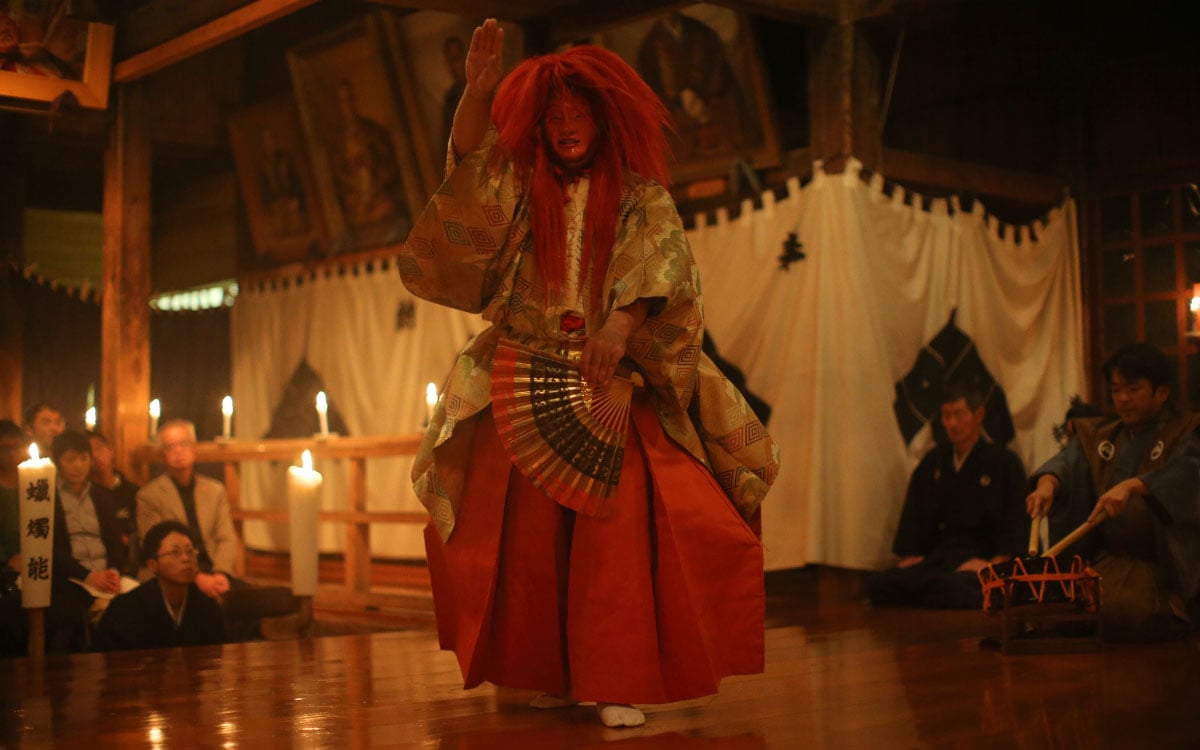
Step into the candlelit hush and be mesmerised as masked performers revive the ancient tale of Shojo (The Sake Sprite), a festive yet reverent offering about an alcohol-loving sea spirit who rewards a wine-seller with boundless sake. Listen closely and be drawn in by the clear, piercing tones of the Japanese noh flute, interwoven with the resonant pulse of the drums, the stylised vocal calls of the performers, and the measured, deliberate stamping of feet. Let every gesture and sound pull you deeper—into an unbroken tradition rooted in this Yamagata community.
What is noh
Mention the word noh and one thinks immediately of the highly refined classical art form: the backdrop of a Japanese pine tree, the musicians and chorus accompanying the slow, controlled movement of a masked noh master.
The origins of noh date back to the 8th century, when court music and dance, along with acrobatics, magic tricks and instrumental music were introduced to Japan from China. Over the next few hundred years, its ancestral form spread both as entertainment offered at shrine and temple festivals and as folk rituals offered to the gods. By the 15th century, Zeami Motokiyo had refined and perfected his practices of noh for the aristocracy and samurai class, Noh evolved into a highly stylised classical art.
A unique noh tradition that retains the ancient styles
On the northwest coast of Japan, the city of Tsuruoka has preserved the sacred roots of noh and its archaic elements. Here, styles and traditions endure that have long vanished from the modern forms of the five major noh schools. This is Kurokawa noh, a form of ritual theatre for the guardian deity of Kasuga shrine. Unlike classical noh, which is practiced and performed only by trained professionals, all members of the community are involved in some way or another.
Within this small village, where nearly every man takes part in performance, farmers, craftsmen, and other village-folk become musicians or actors for the night, embodying deities, demons, spirits, goblins, and female characters. The community maintains a vast repertoire of more than 540 noh pieces and 50 kyōgen (comedic) plays, along with 230 masks and 400 costumes.
The Ogisai festival, a night of ritual theatre
While the city lies deep in snow, the entire community—divided into two rival noh groups called Shimoza and Kamiza—makes preparations for the annual Ogisai festival. Held on the first two days of February as a pre-spring prayer for the coming season’s crops, preparations start as early as December, and include self-purification rituals, rope-making, tofu-grilling, mochi-pounding, and the construction of noh stages in the homes of two chosen families, one from each group.
The festival begins with a procession of the Ogi-sama (an object symbolising the shrine’s deity) to the two homes. In each, a child starts the noh performance by stomping repeatedly on the floor to awaken the earth god and bring blessings to the fields. The stage performances start around six in the evening, illuminated by flickering candlelight. A ritual to welcome the gods to the stage opens the programme, followed by five plays exploring the themes of God, Warrior, Woman, Madness, and Demons. Just before daybreak the entire programme concludes. Both processions then leave the chosen families’ homes for the shrine, where noh is performed again, this time in the deity’s original dwelling place.
This tradition has endured for over 500 years, sustained by the friendly rivalry between the Shimoza and the Kamiza. The two groups learn from one another while striving to out-perform the other, ensuring that the skill and excellence of Kurokawa noh continue to be passed on through generations.
Come experience the candlelit atmosphere of Kurokawa noh up close, and witness this living heritage—an intangible Cultural Asset of Japan—at A Tapestry of Sacred Music.
Ritual Noh of Kurokawa – Shojo is co-produced by The Japan Foundation and Esplanade – Theatres on the Bay, with special thanks to Japan Creative Centre in Singapore.
Date & Time
 Explore Offstage
More to Explore


More to Explore
Frequently Asked Questions
 View All
Frequently Asked Questions
When a show is cancelled, ticket buyers will be duly notified by the event organiser primarily via email. You may also be notified through the event organiser's authorised ticketing agent, media or any other applicable communication channels. Information will be provided on where and when you can get your refund. For postponed performances for which the date of the new performance is known, refunds are optional.
For free programmes, any cancellations or postponements will be updated on the event website and/or relevant official communication channels. As no tickets are issued, refunds do not apply.