
The Bunun of Taiwan: a shimmering vocal harvest

Iwami Kagura: ritual theatre from the "province of the gods"

Dangdut: A Guide to Indonesia’s Most Popular Music

Routes of Asian Music
Iwami Kagura: ritual theatre from the "province of the gods"
Unravelling Japan's most ancient performing art form.
It is the sound that first seizes the attention; the continuous cry of the flute, the incessant beating of the drums and unceasing ring of the cymbals that fill the air with tension and a sense of foreboding.
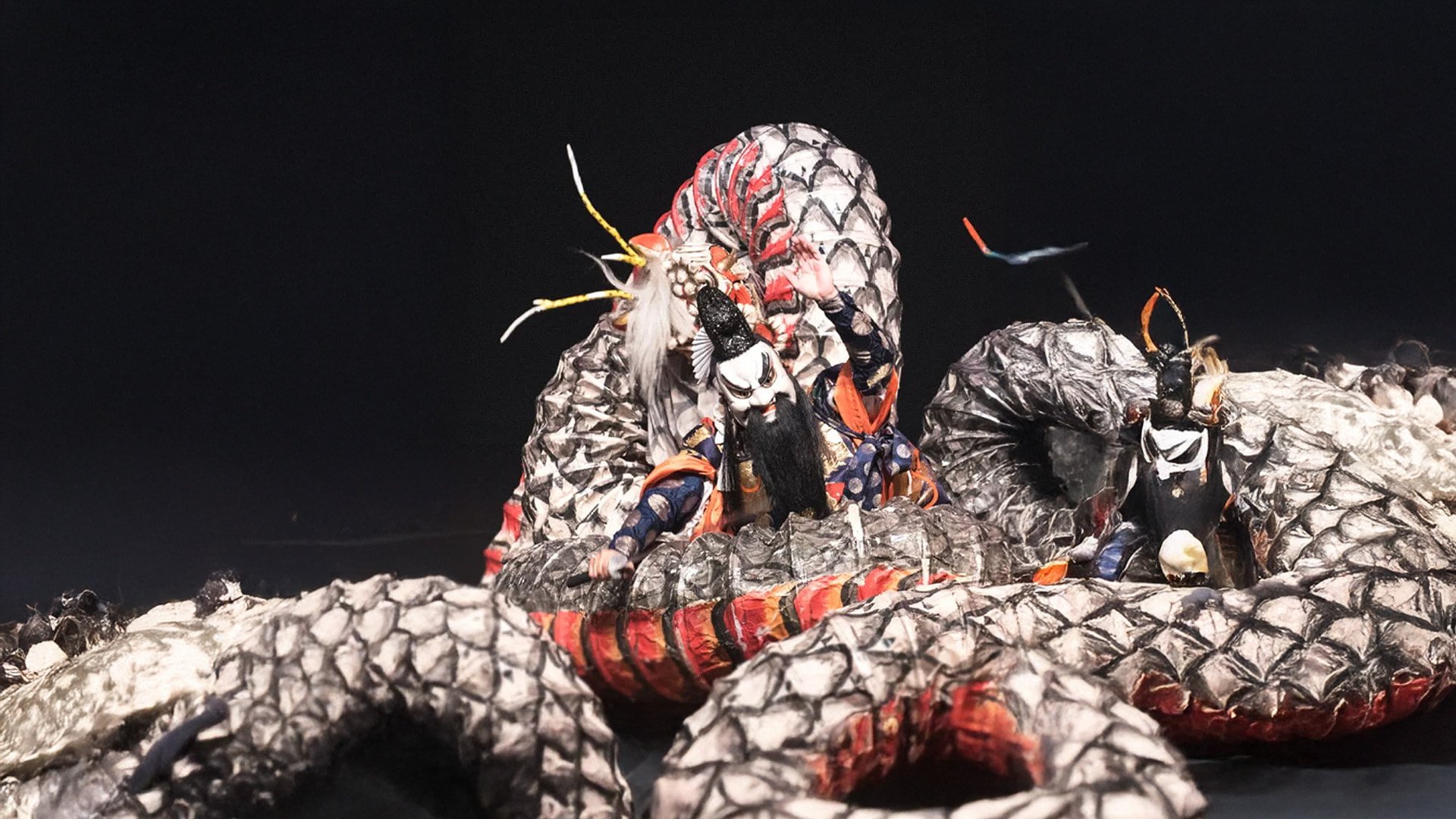
Then they appear; eight horned serpents with thick and garishly coloured scales which twist and turn grotesquely around the stage area. Sometimes, they strike fierce and terrifying poses while at other times, they come together so as to appear as if they were one giant snake.
In one corner, away from the serpents, a masked maiden stands, trembling.
Then, the serpents see what appears to be a wooden vat. They group around the vat and each take turn to touch it after which, their movements gradually slow down.
At this point, the hero appears, dressed in bright yellow, brandishing a long sword. A fierce battle ensues between the hero and the serpents which encircle and attempt to crush him with their vice-like grip.
But, the hero eventually breaks free and “beheads” the serpents, one after another.
Welcome, to the story of Yamata-o-Orochi, the legend of the eight headed serpent, as told through a performance of kagura, Japan’s most ancient ritual and oldest performing art form.1
Palace and countryside
The term kagura generally refers to any performance that is part of the annual festival of a local Shintō shrine—Shintō being the indigenous folk religion of Japan—and it is usually a combination of song, dance and/or theatre.2
While kagura today is presented and appreciated as a performing art form in both Japan and around the world, its original functions were that as a ritual of thanksgiving for the blessings of the kami (the Shintō deities or sacred spirits) and as prayers for their continued favours.3 In this, kagura is both ritual and entertainment: the first part of the kagura being an invocation of the kami while the second part, which is more theatrical, comprises entertainment for the kami.
The actual meaning of the word kagura though has been much discussed.
Mention of kagura first appeared in court records of the 9th century and based on the word being formed from two Chinese characters meaning kami and “music”, kagura could mean “entertainment for the kami”. Scholars however have also said that the word is a contraction of the phrase kami no kura which means “seat of the kami”, implying the presence of a deity in the performance of a kagura and that the performance itself is a dwelling place for the deity.4
Researchers have noted the great diversity and the radically different performances that constitute kagura throughout Japan. As such, for convenience, two types of kagura have been identified: the kagura that is performed in the palace and the shrines related to the palace; the folk kagura that is performed in the countryside.
The style and characteristics of the folk kagura in turn are defined by the locality in which it is practised and performed. Here, for A Tapestry of Sacred Music 2019, the kagura which is presented is Iwami kagura which as its name implies means kagura from the Iwami area.
Remote origins and a new style
Iwami is a region located in the western part of Shimane, a prefecture in southwest Japan that lies between a mountain range on one side and the Sea of Japan on the other.
Shimane is a place is steeped in myth and history; its eastern part is regarded as the birth place of the Shintō deities hence Shimane also being called “the birth place of Japan” and the “province of the gods”5 while the prefecture’s geographical isolation from the rest of the country and it being the second least populated prefecture in the country further adds to its mystique.
The exact origins of kagura in Iwami however are unclear.
While the earliest written text on Iwami kagura dates from the mid-1700s, scholars have been inclined to put its origins back much earlier. This is based on evidence of a preserved mask from the early 1500s that indicates the presence of shrine-related theatrical activities. Researchers have also noted in Iwami kagura the use of a folk music style that is different from that of kagura practised in eastern Shimane which in the 1600s was influenced by music nō theatre.6
That which is certain though is that at least up till the mid-18th century, the practice of Iwami kagura was transmitted orally.
The greatest impact on the development of Iwami kagura (and on other theatrical kagura traditions in general) took place during the beginning of the Meiji period in the late 1860s when priests were banned from performing kagura.7 This was a result of the Meiji government’s attempt to standardise the Shintō ritual. The Meiji saw performances of theatrical pieces unsuitable as shrine activity and regarded it undignified for priests to perform them.
In the Shimane prefecture, the ban was implemented in 1870 and it was from then that the tradition of kagura was taken over by lay people such as farmers and fishermen who formed their own performing groups. The priests however played an active role in teaching kagura to these groups so as to continue the tradition. With revisions subsequently made to the music and dance of kagura in the mid-1880s, a new style emerged and spread.8
Story and spectacle

The kagura repertoire largely comprises myths and stories from two historical Japanese texts, the Kojiki (which means "Record of Ancient Matters" and it is the oldest existing record of Japanese history) and the Nihongi together with medieval epics, ancient Japanese folk tales and stories from local traditions.
Among these myths, one which is commonly seen in kagura performance is the story of Yamata-no-Orochi which tells of how the Shintō storm god Susanoo, kills the eight headed serpent, the Yamata-no-Orochi, by means of luring it to vats of wine.
When the serpent has taken its fill of the wine and is drunk, Susanoo beheads it.
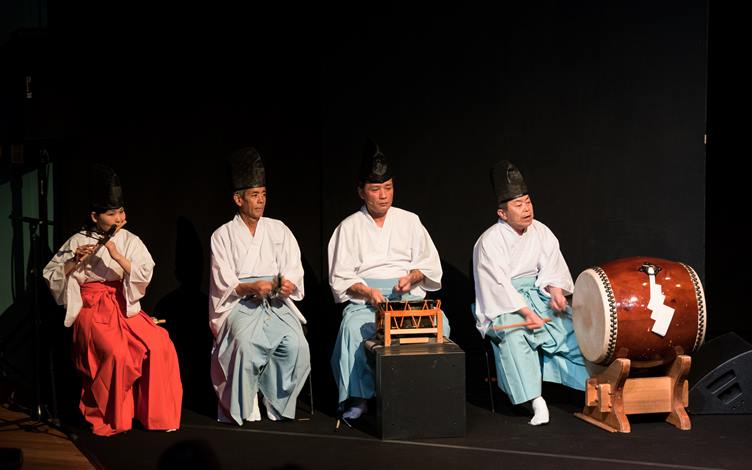
Music-wise, Iwami kagura essentially distinguishes itself through a combination of dynamic drum beating that is accompanied by a melancholic melody on the flute and the use of colourful costumes and masks.
The visual elements of Iwami kagura are indeed unmistakable. Grand, exaggerated and outsized in all areas ranging from the brilliant and intricate costumes decorated with gold and silver threads to the vividly coloured and deformed masks that emphasise the good and evil natures of the characters, Iwami kagura presents a spectacle to behold.
Childhood memories to last a lifetime
The late 1940s: in a small village in the Iwami region, villagers prepare for a Shintō festival that takes place after the year’s harvest. In the nights, kagura performances of the legends and myths of Japan—such as that of the story of Yamata-no-Orochi—are staged.
On these cool autumn nights, a young child watches kagura and is transported by the dances and music, ranging in tenor from dynamic and exciting to slow and calm, transporting one to a faraway world of myths and magic.

The early 2000s: many years later, the child, now an adult, fondly recalls those childhood memories of kagura in a blog online:
“Watching the Iwami kagura … had been one of
the most exciting annual events in the village.
…
Most villagers, young and old, tried to secure
a viewing spot for their family near the
center stage.
However, the closest spots were always
reserved for the village officials, dignitaries
and land owners who donated large amounts
of money for the festivity.
My family spot used to be far from the centre
stage and was different every year, sometimes
we could not see the center because of the
pillars and other large families
…
The excitement of Iwami kagura sometimes
made us forget the penetrating coldness
coming from the ground when the
temperature dropped to near freezing during
the night.11“
References
1 Averbuch, Irit, The Gods Come Dancing: A study of the Japanese Ritual Dance of Yamabushi Kagura (Ithaca, New York: Cornell East Asia Series), p.9
2 from Averbuch, Irit The Gods come Dancing: A study of the Japanese Ritual Dance of Yamabushi Kagura and Lancashire, Terence, ‘Music for the Gods: Musical Transmission and Change in Iwami Kagura’ Asian Music, Fall/Winter 1997/1998 Vol XXIX No. 1
3 Averbuch, The Gods Come Dancing: A study of the Japanese Ritual Dance of Yamabushi Kagura, p.73
4 Averbuch, ibid, p.9
5 http://visitshimane.com/
6 Lancashire, 'Music for the Gods: Musical Transmission and Change in Iwami Kagura' p.88
7 Lancashire, ibid, p.89 - 90
8 Lancashire, ibid
9 Averbuch, The Gods come Dancing: A study of the Japanese Ritual Dance of Yamabushi Kagura, p.86
10 See Lancashire, ‘Music for the Gods: Musical Transmission and Change in Iwami Kagura’, p. 117
11 http://iwami-kagura.com/?page_id=28