
How nanyin music continues to thrive

The Bauls: poets and rebels

Tuvan throat singing: the call of the herdsman

Kirtan: Singing to the Divine

Joget: the popular, ever-evolving music of dance

Routes of Asian Music
Tuvan throat singing: the call of the herdsman
An art form and a way of life.
The man stands with his back to the steep mountain crags and scans the horizon. He sees them, manes tossing as they canter in the plains. Turning his face to the sun, he purses his lips. A low drone fills the air. Suddenly, it breaks into two sounds, the drone and an airy whistle which swirls like wind among the rocks. Then it breaks into three, the newest sound a rhythm that pulses like beating hooves.
In the distance, the horses stop. He knows they hear him.
A unique art
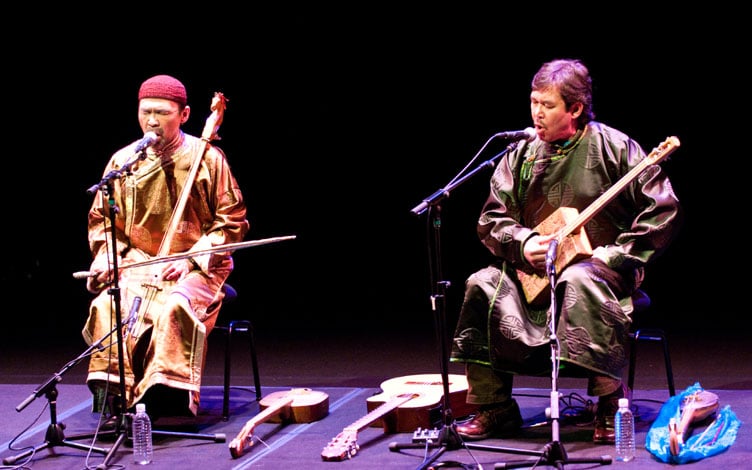
For centuries, the call of the Tuvan throat singer has resounded in the steppes of Tuva. Known as khorekteer or khoomei, Tuvan throat singing comprises a family of multi-voiced, overtone-rich vocal techniques common to several South Siberian and Central Asian cultures such as the Tibetan, Altaian and Mongolian cultures, but virtually unknown to the rest of the world.
A sparsely-populated region between Siberia and Mongolia, Tuva was once fought over by Mongols, Russians, Chinese, Huns and Turks, and ended up a republic in the Russian federation. In the grip of Soviet-era restriction, it remained a mystery, known mainly for its snow leopards, reindeer felt and triangular, collectors’ item stamps. It was this very remoteness that also enabled Tuvan throat singing to exist as an unbroken tradition since ancient times.
It was only with the demise of the Soviet Union that it came to the attention of international audiences. Since then, Tuvan throat singing has fascinated non-Tuvan audiences to no end for one Tuvan throat singer can produce multiple melodic lines simultaneously … all by himself. The sophisticated workings of Tuvan throat singing fits nowhere in Western music theory and it certainly sounds nothing like the kind of singing most of us know.
Sounds of the land
Sometimes it consists of high, fluty whistles like birdsong. Sometimes it is a heavy, croaking chest drone that seems to come from deep within the bowels of the earth. At other times, it howls like a mother camel that has lost her calf. It may trill like a bubbling brook or thrum like galloping horses.
While the sonic repertoire of Tuvan throat singing may seem strange to some, it makes complete sense in a place like Tuva. For Tuva is a place like no other.
It is a land of boundless steppes, fir forests, jagged mountains, glacial lakes and vast meadows, a land fragrant with grasses, sharp with bitter cold, and alive with the whistle of wind, the rush of waters and the call of birdsong.
It is peopled by nomadic hunters and herders of horses, reindeer, camels, cattle, sheep and goats, used to living sparsely, migrating with the seasons and deeply reverent of nature.
Practised by herdsmen, hunters, shamans and everyday people (traditionally men) in the mountains, on the plains, in their yurts – to communicate with the spirits of nature, to establish harmony between man and earth, to tell their stories, to express themselves or simply to pass the time – Tuvan throat singing mimics the sounds of the land, rich with all its deep, sonorous, windswept tones.
In Tuva, nestled between mountains, far away from the great trade routes of world civilisation, it is no surprise that the old ways still live.

Authenticity and preservation
With Russia’s late 20th century capitalism, more and more Tuvan throat singers have been invited to perform at international music festivals and on world stages. But the thing is, Tuvan throat singing was never really a public art.
It is traditionally sung by one person who occasionally may accompany himself on a traditional bowed or plucked string instrument. And it is sung for purposes other than performance and entertainment.
Today, while Tuvan throat singing is still practiced as part of the traditional Tuvan way of life, the younger generation has begun to depart from tradition. Since the 1990s, ensembles have emerged that incorporate non-traditional instrumentation and arrangements into the traditional. There have even been cross-cultural and cross-genre explorations and collaborations such as with Western chamber orchestras and jazz, blues and rock artists.
Purists have decried this trend, calling for authenticity. Others say the changes are part of evolution, that Tuvan throat singing will die out if it is not kept relevant.
Whatever the case, audiences around the world remain mesmerised. Once the Tuvans begin building, layer by layer, their soundscape at once deeply earthy and fey, the listener knows intuitively that he has gotten a peek at something precious…a glimpse of a place where earth, animal, man and sky make a kind of music that reveals another world.
This feature was first published in the programme booklet of A Tapestry of Sacred Music 2010.