Unspoken burdens: reflections on ‘Kavadi’

The People’s Voice: Mohamed Latiff Mohamed

Resolution by Mohamed Latiff Mohamed

Melissa De Silva’s The Gift: Continuing the Thread

Nightswimming in Arthur Yap’s ‘nightjar’

The Art of Detachment

Prophetic Vision of Next Week’s Grain Consumption Patterns, by Samuel Lee

Nightjar by Arthur Yap

The Gift by Melissa De Silva

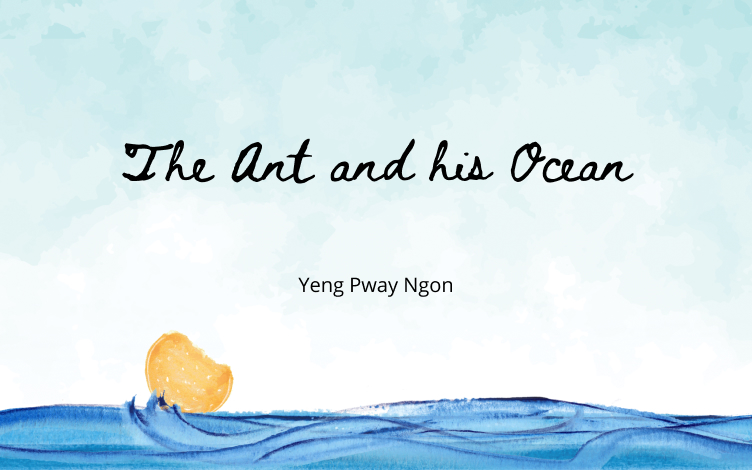
The Ant and His Ocean by Yeng Pway Ngon

little red comma

Kavadi by Latha

little red comma
The Art of Detachment
Neo Hai Bin on Yeng Pway Ngon’s ‘The Ant and His Ocean’
This essay was originally written in Chinese. English translation by Clarissa Oon.
Aloof, yet not a bystander
The story opens with, “There is a drop of water on a small table”; visually, a very arresting image which draws the reader’s focus onto this everyday scene. The writer conjures up an ant – a little thing, a tiny living organism we don’t normally notice, has become the pivot on which the narrative turns.
The story consistently invokes miniscule objects and actions: a small table, a tiny water droplet, a little ant. But because of the size of the ant, seen through his eyes, the table is the world and the water droplet an ocean; faced with this ocean, the solitary ant’s sense of self is enlarged, and he repeatedly appears before the ocean to preen and pose.
The writer guides the reader to spot significance in the miniscule, and what the reader gradually sees, is the tiny ant’s inflated self. However, with a turn of the writer’s pen, he sketches in the biscuit crumb carried by the little ant, “Besides, he always carries a biscuit crumb on his back like a name card that appears to grow bigger and heavier.”
From this point on, it becomes crystal clear that the writer is not talking about the ocean or the ant, but human nature. In focusing on the minute, the flow of the narrative actually brings out the enormity of the subject matter. It’s almost as though we have forgotten the “man sitting by the table” who is glancing at the ant at the start of the story. Instead, without being conscious of it, we are drawn to what this unnamed man is glancing at, the “name card” it is always carrying and the pleasure it so obviously takes in this.
Playing with perspective
The “man sitting by the table” can be variously interpreted as a Creator, divine being or an all-seeing, all-powerful God. However readers who are familiar with Yeng Pway Ngon’s works would have another interpretation. This “man sitting by the table” may not be a figure in contrast to the ant. While the man is looking at the ant next to the water droplet from a certain vantage point, he is in fact projecting himself onto the figure of the ant.
The “man sitting by the table” is a projection of the self. The reader is looking through his gaze; he/she sees him/herself reflected in the ant. When the “man” looks at the self from height, coupled with a clear sense of self-scrutiny, he cannot but feel the absurdity of human behaviour.
There is something comical about the entire story, which is also a little sad. Towards the end, the writer notes, “We do not know how long the ant has remained by the ocean,” and suddenly the gaze turns from the ant, the water droplet, the table surface, the man by the table, to the reader. The reader is conscious of how, as embodied in the man by the table, he can see his own reflection in the “ocean”. Reading this story, is like looking through a prism, and seeing multiple forms and visages, even one’s own face.
By zooming in on the mundanities of everyday life, including fleeting moments that are easily missed, the writer scrutinises the human psyche, using the parable form to draw out man’s self-importance and self-absorption. The tone of the story, while mocking, is not derisive, serving only to let the reader reflect on his place in the vast universe. As we contemplate the ant, we invariably feel a sense of connection to it.