2000
Fix
Rush


The star choreographer on articulating the formless within the form
“You know the second you step over classical it
doesn’t become classical… I just know that [in]
contemporary you have your own voice, but
classical you are speaking with someone else’s
voice. Some mistake there are no boundaries
in contemporary. There are boundaries in
contemporary, but you define your own
rules.“
“We operate in singular form when we express
ourselves. The way I’m talking is aimed at
expressing one particular emotion and each
emotion has multiple emotions…so fear can
have a little bit of joy as well or anger can
have a little bit of joy…Emotions can overlap
so it’s very complex, but what I was interested
was how do you make the body do something
else when your face is doing something else.8“
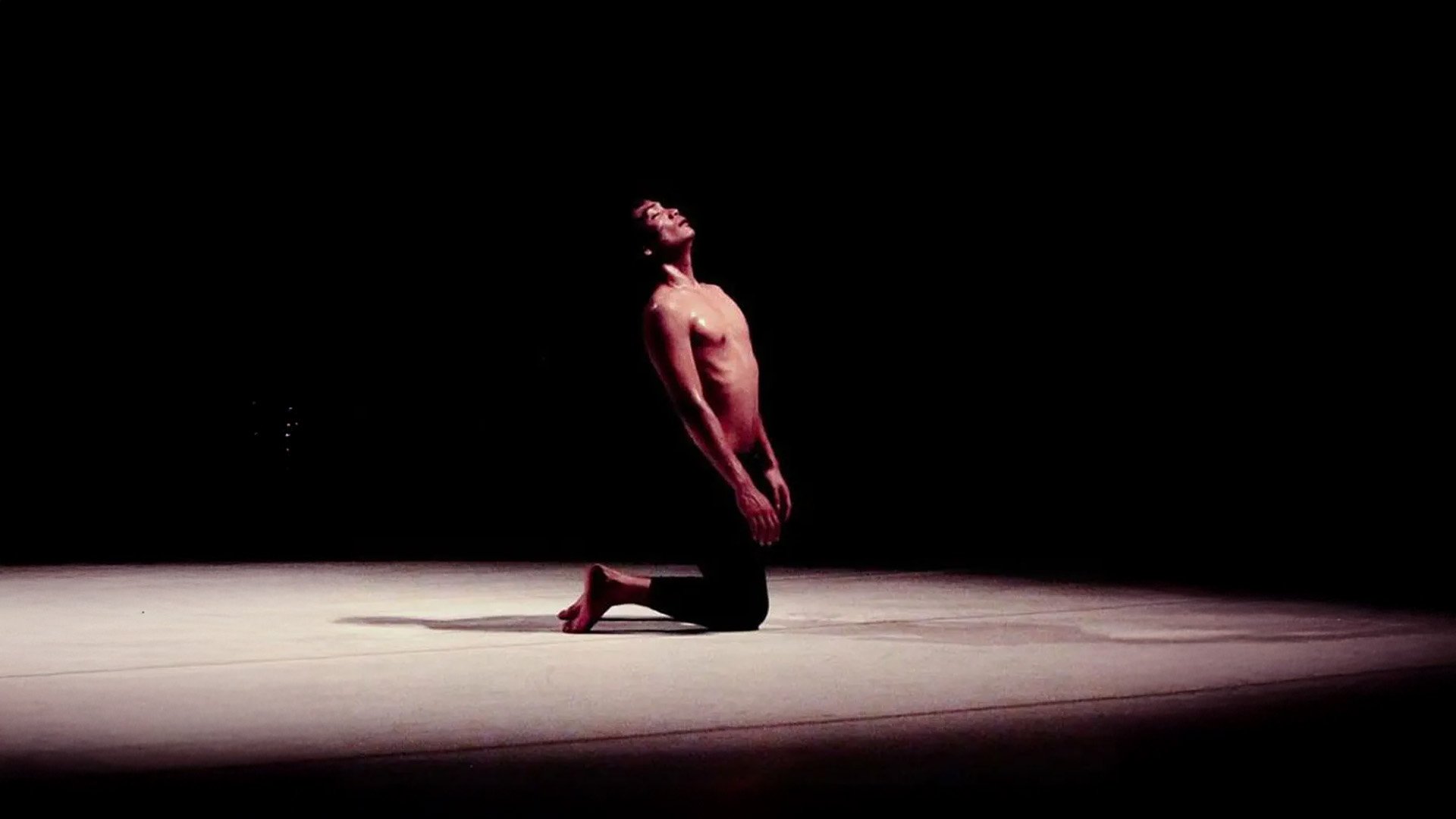
When it comes to marrying classicism with spirituality, Akram Khan is one of the choreographers today ordained to do so in the world of dance.
One of Britain’s most exciting dancemakers, Akram draws from his training in the northern Indian classical dance form of kathak in his contemporary works. For over two decades, he’s pondered the binaries of classic and contemporary, torn them down, and twisted and woven them into threads that resonate for a contemporary artist and his audience.
Rising in the scene first as a dancer and now choreographer, Khan’s artistry is distinct—minimal, intricate and psychical, and at the same time, full of life and epic. His work expresses a spirit willing and powerful flesh.
For Akram, whose family hails from Dhaka, Bangladesh, dance is a form of storytelling and the dancers’ bodies, carriers of language. He draws inspiration from literary texts—Until the Lions (2016) was inspired by one of the characters in poet Karthika Nair’s reinterpretation of the Mahabharata, Until the Lions: Echoes from the Mahabharata—but also works with a dramaturg and writer to develop his own narratives through dance (for example in Xenos, his 2018 solo piece and final performance as a dancer).
Diversity is an identifiable thread that runs through all of his works, from the intangible concepts, themes and stories that transcend cultural barriers and preconceptions, to the tangible—a mixed bag of dancers and musicians from different nationalities, languages and walks of life. His artistic instincts have sparked powerful collaborations with artists of various genres and industries, from ballet legend Sylvie Guillem (Sacred Monsters), Indonesian dancer-choreographer Rianto (Until the Lions) and Spanish flamenco artist Israel Galván (Torobaka) to actress Juliette Binoche, composer Steve Reich and DJ-composer Nitin Sawhney.
Drawing from Akram's post-show talks and masterclasses over the years from Esplanade's archives, we hear from Khan himself: his thoughts on composer Igor Stravinsky who threw the classical/contemporary binary into chaos; how he articulates the formless (spirituality) within the form (human body); and how he brings ritual to the secular.
"What is contemporary and what is classical? Stravinsky is a good example. When he did The Rite of Spring, I mean, you cannot get more chaos than that. He created The Rite of Spring in 1913, and apparently it was classical, but the world thought it was not. He destroyed every understanding of what classical is meant to be."1
As both a disciple in kathak and a student of contemporary dance, Khan believes classical and contemporary are parts of a cycle: the contemporary of today might be the classical of tomorrow. While sometimes the distinctions blur, in its essence, a classical practice holds elements of tradition at its centre, while a contemporary practice provides a platform of expression for an artist’s voice.
One of Khan’s works, Vertical Road, contemplates ideas of serendipity or fate.
In tracing the work’s origin, Khan relates a life-changing incident in Australia in 2009. After a performance at the Sydney Opera House, Khan was hailing a taxi but a couple nonchalantly hijacked and boarded the cab. Affronted by the incident, Khan was somehow inspired to call his father while riding in the next taxi – a highly unusual act for him considering they rarely speak on the phone. After their conversation in Bengali, the taxi driver asked him where his family came from. He then revealed that he was Khan’s father’s long-lost childhood friend and that they had not seen each other for 35 years.
“What was interesting was that when I told the story, an audience member came up to me and said, ‘Do you know that relationship between that rude couple who literally got into that first taxi and you?’, and I said they’re just annoying enemies really…and [he] said maybe they were your angels because if they haven’t gotten onto their first taxi you would never ride the second.” I started to think there has to be something bigger than coincidence.”3

Khan's work has been described as being "profoundly moving, in which his intelligently crafted storytelling is effortlessly intimate and epic" (Akram Khan Company). But narratives are not built in a day.
“The discussions we have [as a creative team] predominantly are based on a language of images…so we bring in poems or images or paintings, visual arts or a film. We bring those in and sometimes we just discuss life, where we are in our lives, because you know my perspective of this bottle is different to maybe 20 years back.”4
Khan layers his narratives by exploring the personal stories that dancers carry with them, teasing out threads that have universal relevance. His works revolve around the formless (spirituality) within the form (human body).
"I find that when I work in Gnosis (another work based on stories in the Mahabharata), I work with [a] Japanese dancer, in the original Gnosis where she was a drummer but when she stood, the way they hold themselves, there is something going on internally that you cannot see, that doesn’t have form and I will call that spiritual."5
Another integral element in Khan’s work is the representation of multi-cultural identities. For this dancemaker, the body is more than a vehicle for movement. The corporal form is an embodiment of national identity and a sense of belonging, and a mutable—perhaps even mercurial—medium through which non-verbal messages are conveyed. Khan's dancers come from myriad nationalies and backgrounds.
Take for instance, Bahok, a collaboration between Khan and the National Ballet of China in 2008 that was set in an airport waiting lounge. It was the first group piece in which the choreographer did not perform. The ensemble comprised eight dancers from diverse cultural backgrounds, Chinese, Korean, Indian, South African and Spanish.
“Bahok is...about different people from different cultures being stuck (in an airport lounge). I remember I gave (the dancers) an exercise, I said I am going to take them to a train station and I said sit here from nine to seven in the evening or something, and I wanted them to observe other people waiting for trains...Basically what I was doing is I wasn’t watching the people that they were watching but I was watching them…. In that sense, their bodies changed, their emotional energy changed, and I was observing them because they were coming out, as people rather than dancers.”6
“I study a lot about him [Igor Stravinsky] and what I realised was he was very methodical and a little bit like being obsessed with patterns and expressing emotions through patterns…not just through emotional passages but through patterns, so the way he constructed patterns reveal a certain emotion, he didn’t push the emotion out.”7
In 2013, Khan created iTMOi (In the mind of Igor), adapting 20th century composer Stravinsky's practice with a twist and exploring the human condition, through an arguably macabre presentation: a woman dances herself to death.
“Stravinsky created patterns to maybe suggest or provoke emotion, he didn’t want to play emotional music the way Debussy did. To do sadness, he didn’t do something sadness. He worked with patterns and in that sense, we’re working with patterns as well and maybe it provokes a certain emotion.”
Khan does this through repetition of rhythm and specific movements, preferring this abstract approach of expressing emotion, as opposed to literal representations of sadness, anger or ecstasy.
Undeterred by the complexity of emotions, Khan toys with the idea of combining movement with a contrasting emotion, and isolating one emotion from another.
1 Post-show talk, Torobaka, da:ns festival, 2015
2 Post-show talk, Torobaka, da:ns festival, 2015
3 Talk, ConversAsians, 2012
4 Talk, ConversAsians, 2012
5 Talk, ConversAsians, 2012
6 Talk, ConversAsians, 2012
7 Myth of Tomorrow masterclass, ConversAsians, 2012
8 Myth of Tomorrow masterclass, ConversAsians, 2012
9 Post-show talk, Torobaka, da:ns festival, 2015