Going onstage (www.esplanade.com).

Music Theatre Dance

When’s the next pandemic for the Performing Arts?

In a crisis, the seeds of hope

Calendar

Published: 30 Apr 2026


Time taken : ~10mins

Co-presented by ArtsEquator and Esplanade – Theatres on the Bay, the ArtsEquator-Esplanade Offstage Fellowship 2026 commissions the development and publication of four opinion pieces that are topical, of the moment and reflect critically on contemporary performing arts in Singapore and Southeast Asia. Selected by both arts organisations, the four fellows are mid-career or emerging Singapore cultural practitioners and writers.
 
In this article, writer Chong Tze Chien reflects on the lasting impact of Covid-19 on the performing arts and what might come next.


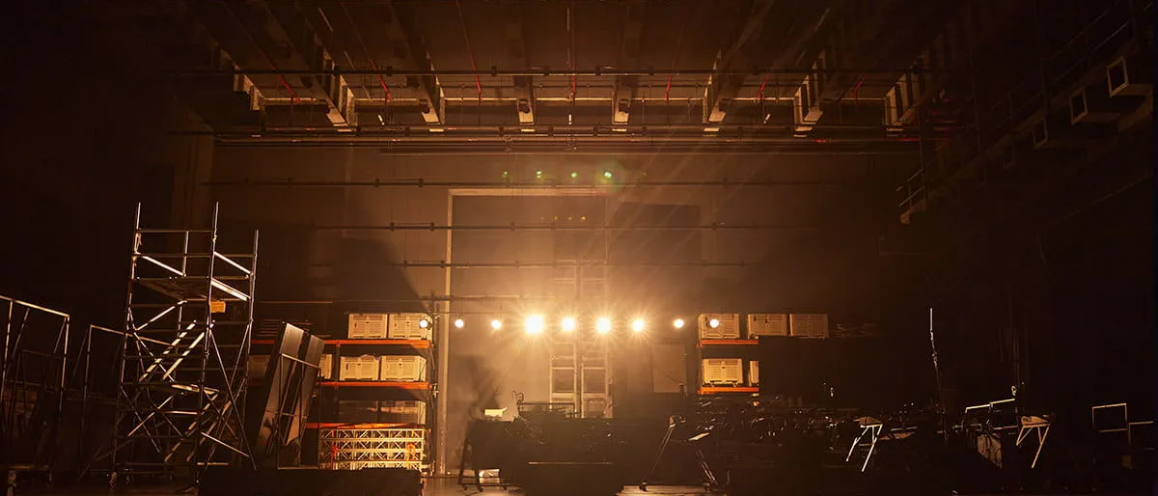
When Covid hit Singapore in early 2020, it did not arrive gently. One moment, theatres were planning seasons years ahead. The next, everything went dark. Rehearsals stopped. Performances were cancelled. International tours were wiped out. Carefully built projects collapsed almost overnight. 

What unfolded in those early months exposed something deeper than a temporary crisis. For many artists, this was not just about cancelled shows or lost income. It triggered something deeper. A quiet, unsettling question emerged. Could what we do actually survive something like this?  

Very quickly, the pandemic stopped feeling like a temporary interruption and started revealing something that had always been there. The performing arts are fragile, not only financially or structurally, but in how they are perceived. When society is under pressure, the arts slip to the margins with alarming ease. 

That became painfully clear when during the pandemic lockdown in Singapore, The Straits Times conducted a poll that asked the public to rank which jobs were most essential. Unsurprisingly, the performing arts came last.

Being labelled “non-essential” at a time when artists were already questioning their livelihood confirmed a suspicion many had quietly held; when things fall apart, the arts are among the first to be let go.

The irony, however, was hard to ignore. During lockdown, people turned en masse to online streaming of TV series and films, books, music, streamed performances and even recorded theatre performances. Festivals and performances pivoted and went online in the form of Zoom theatre and other digital media. Art became a daily companion in isolation. It helped people cope with anxiety, mark time and maintain some sense of connection and humanity while confined to their homes. What was publicly dismissed as non-essential was privately indispensable. Art was consumed and appreciated, but the people making it were treated as expendable.

In truth, what the pandemic exposed was not that the artists are not important, but that their value and presence should always be dependent on extenuating factors, always ranked below bread-and-butter issues, and in the case of the pandemic, public health. The artists are welcomed when we have everything else settled, a proverbial luxury if and when we can afford them to produce their work.

When restrictions eased and venues reopened, there was hope that audiences would return in force. After months of isolation, “live” performances were expected to feel urgent again. There was talk of packed houses and renewed appreciation, as if audiences and artists alike were simply waiting for the moment to gather again. But that optimistic surge never fully arrived.

Slow, uneven recovery

Instead, many companies faced hesitant audiences, slow ticket sales and last-minute buying habits when the world returned to status quo after the pandemic. In the time of Covid, people learned how to stay home, spend less and organise their lives around private routines. It was as though the pandemic made homebodies out of us. Going out became a choice rather than a habit.

Post-pandemic, many arts companies found themselves grappling with new challenges that impeded growth. Singapore groups such as The Necessary Stage and Teater Ekamatra lost their long-time spaces or sponsors, moved out of their premises, and sought crowdfunding to keep their signature programmes alive. Pangdemonium announced its impending closure (by the end of 2026), citing the growing challenges of sustaining its operations, even as personal reasons were also contributing factors. While all these developments could not be directly attributed to the pandemic alone, taken together, they point to a different reality from the anticipated resurgence, suggesting that the post-pandemic landscape has been marked less by a triumphant return and more by a slow, uneven recovery.

This shift was not limited to the performing arts. The F&B industry, including late nights, social gatherings and dining, also saw a decline (although rising rental and labour costs and shortages also contributed) as buying and socialising habits became more discriminating and unpredictable.

But across Singapore, the performing arts felt this change particularly strongly. Different contexts, similar patterns. Audiences became cautious.

It would be too easy to blame everything on the pandemic alone. But it undeniably accelerated a shift that was already underway. Across many parts of the world, arts funding is increasingly reduced as governments respond to economic strain and political uncertainty. Thankfully, Singapore has largely maintained its level of arts funding, and that matters. Subsidies and advocacy in the form of the Culture Pass have reminded the population of the value of the arts. But inflation has quietly eroded its monetary value as well. Behind the scenes, making artwork now costs more, while audiences remain unpredictable.

Alongside this is the rapid rise of AI. While it does not replace “live” performance or arts content creation, it fights for attention by flooding the cultural space with fast and abundant material online and social media. For audiences already comfortable staying home or having more affordable and convenient forms of entertainment and experiences right from the comfort of their phones and other electronic devices, the line between art as a shared experience and content as endless consumption becomes blurred. The question shifts from whether art is valued to whether it is seen as necessary.

Chong Tze Chien in rehearsals with The Finger Players during the Covid pandemic. Photo credit: The Finger Players

Is cross-pollination of ideas and markets borne out of practicality?

As the world becomes more connected through advances in aviation and the acceleration of the information age, the arts have taken on an increasingly global dimension. A work staged locally today can travel further and faster, reaching audiences well beyond its point of origin. One of the largest performing arts platforms, the Edinburgh Festival, was founded as a post-war gesture of reconciliation. In its wake, Europe became a natural hinterland for artistic exchanges, forming an organic touring circuit that would inspire similar festival ecosystems across the world.

This expanded mobility, however, comes with its complications. Global politics now exerts a more immediate influence on the arts. At the height of the war in Ukraine, Russian artists and works were cancelled, postponed or staged amid protest. In such moments, artists can find themselves and their works scrutinised or curtailed, carrying the weight of their national identities regardless of intent or content.

In an increasingly volatile post-pandemic landscape, marked by financial strain and political sensitivities, artists and festivals are compelled to remain nimble. Co-commissioning and co-presenting across borders have emerged not simply as artistic choices, but as pragmatic strategies, as ways and means to share resources, mitigate risk and navigate shifting geopolitical terrains.

Yet it is precisely within this vulnerability that new possibilities emerge.

On a brighter note, these conditions have fostered a greater openness to cross-disciplinary and transnational practices. Festivals are investing in more incubation and developmental programmes to foster collaborations between artists from different regions; dancers collaborate with visual artists and designers; theatre-makers work with technologists and practitioners beyond the arts. The result is a proliferation of hybrid, genre-defying forms that blur conventions and expand the language of performance itself.

History shows that moments which threaten the survival of the arts have often been the conditions under which new artistic languages emerge. The two world wars did not simply interrupt artistic practice. They forced artists to rethink how and why they made work at all.

In Europe, the devastation of the First World War shattered faith in realism and inherited forms. After the Second World War, theatre makers such Bertolt Brecht reshaped theatre itself, rejecting emotional immersion in favour of critical distance, interruption and reflection. These approaches were once seen as disruptive and even antagonistic. Today, they are part of the canon. In Japan, the pressures of modernity, defeat and post-war reconstruction led to deep re-engagements with tradition. Classical forms such as Noh were re-read and re-imagined by Yukio Mishima, the father of modern Noh plays. At the same time, post war trauma gave rise to entirely new forms. Butoh emerged from a landscape shaped by the atomic devastation of Hiroshima and Nagasaki. What began as a radical response later became a global influence on the arts.

Across Asia, Africa and the Global South, the collapse of colonial systems produced similar ruptures. Artists reworked traditional practices while absorbing modern influences, creating hybrid forms that were once contested and unstable. Many of these are now taught, toured and celebrated. 

New post-war technologies such as cinema, television and digital media were perceived as threats, each expecting to replace “live” performance. None of them did. Instead, artists learned to move between forms. Theatre absorbed cinematic ideas, while film borrowed from theatrical conventions and ideas. Rather than ending “live” art, these shifts expanded its possibilities. 

Seen in this light, the current moment feels less like a collapse and more like another turning point. The anxiety around funding, dwindling audience numbers, newfangled technology and relevance fits into a longer historical pattern. The arts have never been static. They survive because they respond to the pressures placed upon them. 

Perhaps the performing arts is not facing another pandemic, but a structural and philosophical shift.  

The arts have always required patronage. This is a historical constant.

Since the dawn of civilisation, art has endured not solely through individual genius, but through an interdependent ecosystem of support: state patronage, audience engagement and its role as a protected vessel of cultural identity. History is filled with enlightened protectors: institutions and individuals who safeguarded masterpieces from war, or offered refuge to artists facing persecution. Just as telling, however, are the countless works and voices lost to circumstance, disappearing precisely because that protective shield was absent.

What is often overlooked is how recent our current language of value truly is. For most of history, patronage was not predicated on “returns” but on belief, one that is in art’s intrinsic worth, its civilisational function, and its ability to be transcendent and timeless. The transition from this ethos to one dominated by economic and commercial metrics is relatively new, yet it has been so rapidly normalised that it now feels inevitable.

In today’s capitalist context, state and market support remain vital forms of patronage, but they increasingly come with conditions. The language of “investment,” “impact” and “returns” reframes how art is understood and evaluated. Success is measured through box office figures, social impact quotas, or economic contribution. While these metrics offer a certain clarity, they also impose a narrow frame: one that struggles to account for ambiguity, experimentation or long-term cultural resonance.

The arts can’t be quantified entirely because its most important contributions can’t be measured. To apply economic and commercial yardsticks as the primary means of assessing the arts is, therefore, to fundamentally undervalue them. It reduces patronage to a transactional one, overlooking the very qualities that have allowed the arts to endure across time: its capacity to imagine, to challenge and to hold meaning beyond the immediate and the measurable.

The more we demand that the arts justify itself through metrics such as box office returns, social impact quotas or economic value, the more we tie its survival to transient conditions. This makes art profoundly vulnerable to political shifts, social volatility, and, as the pandemic brutally revealed, global crises.

When the arts played an indelible role in keeping our wellbeing intact during pandemic lockdown, it proved that it is not a decorative add-on; like health and education, they are a prerequisite for a functioning coherent society. They are how we process our world, connect across divides and imagine our future. 

Until we collectively agree that art is as essential to our survival as air and truth, it will remain precarious. The arts have taught us, provided the language and reflection to express ourselves, articulate the unknown, illuminate the nuances of truth, and highlight the complexities and contradictions of human experience. This is evident in how people have channelled their creativity during the pandemic through social media posts, online musings and renewed artistic pursuits like painting and gardening at home. If we redefine the arts as cultural or national expression, would their value still be seen as non-essential? The right to express ourselves is fundamental to our existence, so we must defend art, ensuring it’s the last to be sacrificed in any crisis. Our humanity depends on it.

As artists, we too must also do our part and embrace and accept the notion of change being a constant, and perhaps a necessary ingredient for innovation. The arts are not monuments to be preserved unchanged. They are living responses to the world around them. Artists are not guardians of permanence, but participants in ongoing transformation. If this moment feels unstable, it may be because it is doing what history has always done. It is forcing the arts to shed old skins, question inherited structures and imagine new ways of being. 

As the Festival Director of a state-funded festival for the next three years, the Singapore International Festival of Arts, I’m acutely aware that I’ll return to my artistic practice afterward. This gives me a personal stake in deepening and expanding a festival’s mandate and reach, one which could fundamentally transform both audiences and artists. Historically, festivals like Edinburgh have played a pivotal role in reshaping perceptions and practices of the arts globally. Our festival could have the same impact. Our critical mass may be small as far as population is concerned, but our works could have a global audience by building a more sustained and consistent festival circuit with our counterparts and fostering cross-national collaborations.

<em>Strangely Familiar</em>《熟悉的陌生》, co-commissioned by Asia+ Festival (Hong Kong) and SIFA, with additional support from the William and Lena Lim Trust. Photo credit: Leisure and Cultural Services Department, HKSAR

A festival could grow its domestic support by inviting diverse audiences to explore works across various price points, from the epics to the intimate, and from reimaginations of classics to the unconventional. Artists could be encouraged to create a wider range of works, unlocking new possibilities within and beyond their disciplines. Beyond presenting ready-made shows, the festival could have dedicated resources to expand and provide different development pipelines for artists at various career stages. This would involve fostering the next generation of arts leaders while supporting established ones, ensuring succession and rejuvenation. By planting the right seeds today, we can secure a thriving future for the arts. And when necessary, discard stubborn and outdated approaches that no longer serve us. We can’t keep regurgitating old ways of thinking and doing to solve the problems of today and the future.

<em>Planet [wanderer]</em> by Damien Jalet (Belgium/France) and Kohei Nawa (Japan) is a dreamlike work that merges and transcends their artistic mediums, staged as both a mobile sculpture and a sculptural performance. Photo credit: Yoshikazu Inoue

So when we ask when the next pandemic for the performing arts will arrive, the answer may already be here. The more important question is whether the arts can recognise this moment for what it is. Another point of pressure. Another demand for reinvention. And perhaps, quietly, another beginning.

Contributed by:

Chong Tze Chien

Tze Chien is an award-winning Singapore playwright and director, core team member of The Finger Players, and Festival Director of the Singapore International Festival of Arts. He has three collections of plays published by Epigram, The Necessary Stage and The Finger Players respectively. A NAC Young Artist Award recipient, he has led major national events and created widely acclaimed theatre, television and film works in Singapore and internationally.


The views and opinions expressed in this article are solely that of the writer and do not necessarily represent the views, position and policies of The Esplanade Co Ltd and ArtsEquator.

ArtsEquator-Esplanade Offstage Fellowship 2026

Co-presented by ArtsEquator and Esplanade – Theatres on the Bay, this initiative commissions the development and publication of four opinion pieces that are topical, of the moment and reflect critically on contemporary performing arts in Singapore and Southeast Asia.