From Spectators to Collaborators
How performers build trust with audiences in real time
When Singaporean actor Dwayne Lau was in primary school, he watched a performance of Crocodile Tears by ACT 3. For the first time, an actor asked for his opinion.
“I was surprised but felt a kind of excitement as I was drawn into the characters' worlds,” he recalls.
Moments like these can transform a performance entirely. When a performer makes eye contact with an unsuspecting audience member, gives a friendly wave to the audience or makes the audience shake hands with each other, they’re essentially making magic in real time. What begins as a fleeting interaction becomes a shared experience shaped by both the performer and audience member.
Trust as the foundation of audience interaction
In more traditional theatre forms, the audience attends the performance and watches the story unfold from a distance. They remain passive observers, and may leave the performance having understood the plot, but not having had the opportunity to shape the experience unfolding before them. However, in street performances, immersive theatre and more hybrid formats, that dynamic becomes more interesting. Audience members get to become active participants—collaborating and creating a shared world with the performers. At the heart of this exchange between the performer and the audience is trust.
“Trust is precarious but it must be the foundation of everything you do”, says Marianne Grove of women’s circus theatre company Circo Rum Ba Ba.
Establishing a strong rapport with the audience involves walking a metaphorical tightrope—a delicate balance and sometimes a never-ending juggling act. For the performer, it’s presenting their narrative, holding on to their choreography and also remaining sensitive to the audience’s needs, insecurities, vulnerabilities and ultimately their enjoyment.

At the heart of it, as Marianne emphasises, is a fundamental awareness that the audience is important, and every choice a performer makes must be guided by how they are received in the moment.
“My trajectory has been never towards communicating from an arrogant, kind of ‘look at me’ ego centric point of view…if you are more important than the audience, as far as I’m concerned, it is disinteresting.” She says this plainly, almost instinctively—heavily rooted in the belief that a performer should never assume they are better or more knowledgeable than their audience.
The first invitation
When a performer enters a space, it’s fascinating to explore how they initiate contact with the audience. What’s surprising is that a series of intentional choices are made to build the bridge between performer and audience.
One of the most intentional choices that a performer can make is to establish eye contact with the audience. By doing so, the performer is able to sense where the audience’s headspace is at, and their willingness to participate in creating a shared world.
According to Dwayne, it is this very action that allows the performer and audience to form an instant bond.

“The moment the actor and audience member locks eyes, there is almost a vulnerability, an exchange of yes, I’m locked in, present and open for you to share with me what you have to say.” It is in this small but important moment that the relationship between performer and audience begins to take shape.
Korean performer and art technician Marine Boy, who will be showcasing his dreamlike object theatre adventure Voyage at Flipside 2026, goes one step further by reading the room and sensing the energy that every audience member brings to the space. For him, this is not a one-sized-fits-all approach and more about relying on his intuition—reading small signals from the audience to gauge who might be willing to step forward.
“Among the audience, there are always people who emit a different kind of energy—people who are already smiling brightly or radiating happiness. When you observe them closely, you can sense that they want to come on stage. When I notice someone like that, I slowly approach them and extend my hand.”
This instinct often pays off during the performance, as those he approaches tend to become highly-responsive scene partners who bring a sense of playfulness and ease onto the stage. From his perspective, this becomes a special moment where both energies from the performer and audience member “interact and move like waves, gradually guiding the direction of the performance.”

The art of turning strangers into a crowd
Beyond those initial moments of contact, the performer-audience relationship becomes something far more fluid and unpredictable. After a performer gains the attention of the audience, the real challenge is to sustain it across a diverse audience profile.
For Marianne, this is where audience work becomes interesting.
“The most exciting aspect is that you never know what you are going to get…You have to give them all (your) attention, you cannot leave anybody out,” she explains.
In the audience there may be vastly different groups of people standing side by side—people of different ages, nationalities and social class. Each group brings their own expectations, hesitations and levels of engagement to the performance. The job of the performer is to navigate these different groups all at once, without leaving any section of the audience feeling excluded from the interaction. When this balance is achieved, people who arrived as strangers to watch the show begin to share a single, collective experience—despite having come from different walks of life.
Connection across cultures and contexts
Connecting with an audience begins by understanding who they are. The performer reads their energy, observes their reactions and senses what they might need in the moment. These needs can range from how attentive or hesitant a crowd is, how willing they are to participate or respond to what is unfolding on stage, and the kind of reassurance or stimulation an audience requires in the moment.
Understanding audience needs becomes especially important when performing in different countries, as responses to a particular performance can vary based on the cultural context.
Marine Boy experienced this firsthand when he brought his work from Korea to Japan.
“In Korea, audiences usually laugh loudly and react actively during the show. In Japan, many people told me personally how much they enjoyed the performance, but during the show they were quieter, perhaps out of consideration for others around them. After performing several times there, I adjusted parts of my performance to better match the audience’s cultural response.”

When navigating different cultural landscapes, the performer has to bear in mind that trust with the audience cannot be established via a single fixed approach. It’s up to the performer to remain flexible and adapt to the cultural nuances of the country they are performing in—adjusting their tone and level of interaction in order to meet audiences where they are.
Rolling with the punches
But trust is fragile. Even with careful observation, live performance remains unpredictable and not every moment goes according to plan. In these instances, performers must think on their feet, adapting quickly while staying in character.
Both Marine Boy and Marianne recalled moments where an audience’s behaviour veered wildly off script, requiring them to respond in real time creatively, with humour and most importantly composure. Rather than stopping the show, they chose to work with these moments, staying in character while keeping the audience engaged.

These moments of unpredictability ultimately reveal something deeper about a performer’s relationship with their audience, and the mindset required to approach the art of audience interaction.
When recalling advice that she would give to new performers in her troupe, Marianne said, “Whatever your audience like, you have to learn to love them. And that’s the only way that they will feel comfortable about everything you present to them.”
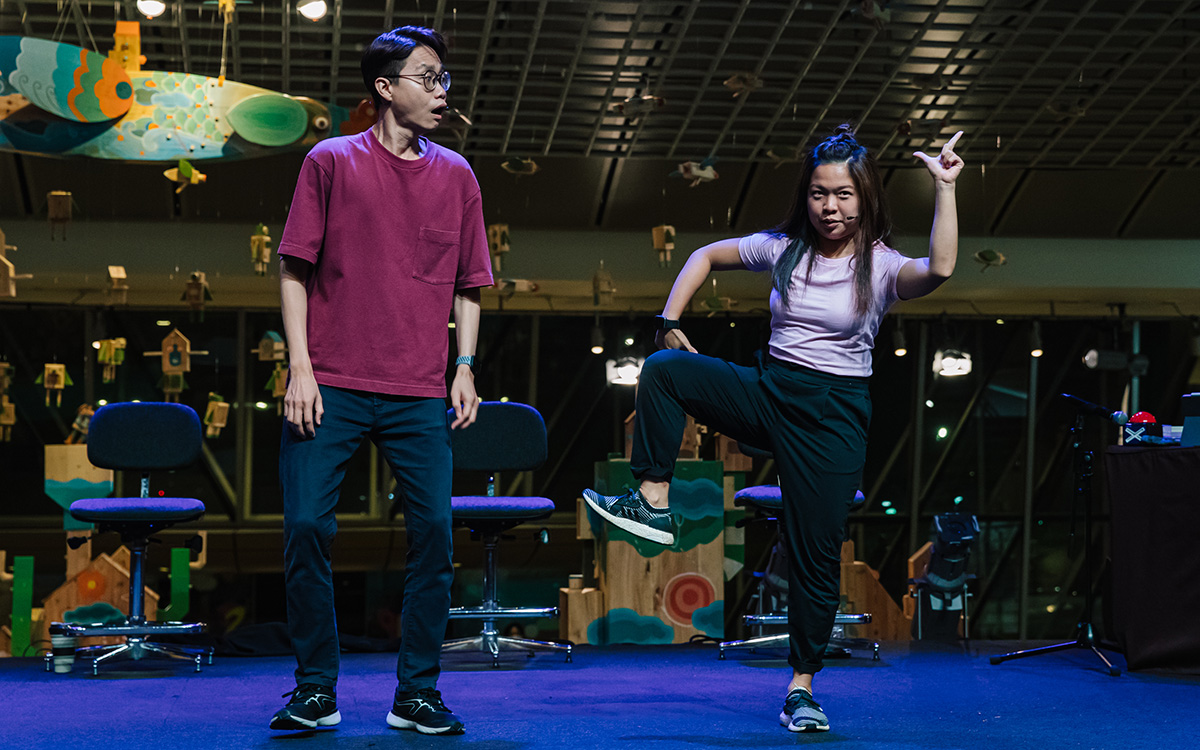
And to deal with unpredictability, actor Dwayne Lau aptly put it by quoting a line from his show Snakes and Ladders! at Flipside 2026.
"The only way to cope with it is to embrace it."
With a dice roll dictating the show, the audience is given lots of power and determines whether Dwayne wins the game or not. Embracing this mindset of rolling with the punches reflects the reality of audience interaction—a space where connection is built, easily dismantled, carefully rebuilt and continuously negotiated.

When audience interaction is carefully designed
Although a direct connection with the audience often emerges organically, it is moments of interaction that are intentionally crafted that create a deeper sense of magic.
Marine Boy’s unique approach to storytelling involves embedding technology seamlessly within the artwork, so that audiences don’t notice it directly.
In developing Grandma’s Cart, he anticipated how audiences might respond to the piece’s quiet, intimate presence of a grandmother pushing a heavy cart on the streets. Knowing that the work would premier in winter, he imagined that someone might reach out to hold the grandmother’s hand. He cleverly installed heating wires inside her hand so that it would feel warm to the touch.
Marine Boy recalls fondly, “During one performance, the first snow of the year fell in Seoul. A woman held the grandmother’s hand, felt the warmth, and quietly wiped tears from her eyes. I still cannot forget that moment.”

By carefully designing these encounters, Marine Boy skillfully uses technology to create the conditions for art to reach audiences organically. This often leads to special moments where audiences encounter the work intimately, leading to a deeply emotional response.
Breaking barriers through absurdist worlds
The abstract and the absurd have a way of drawing audiences in, inviting them to suspend all logic and rationality and engage more instinctively with what has been presented to them.

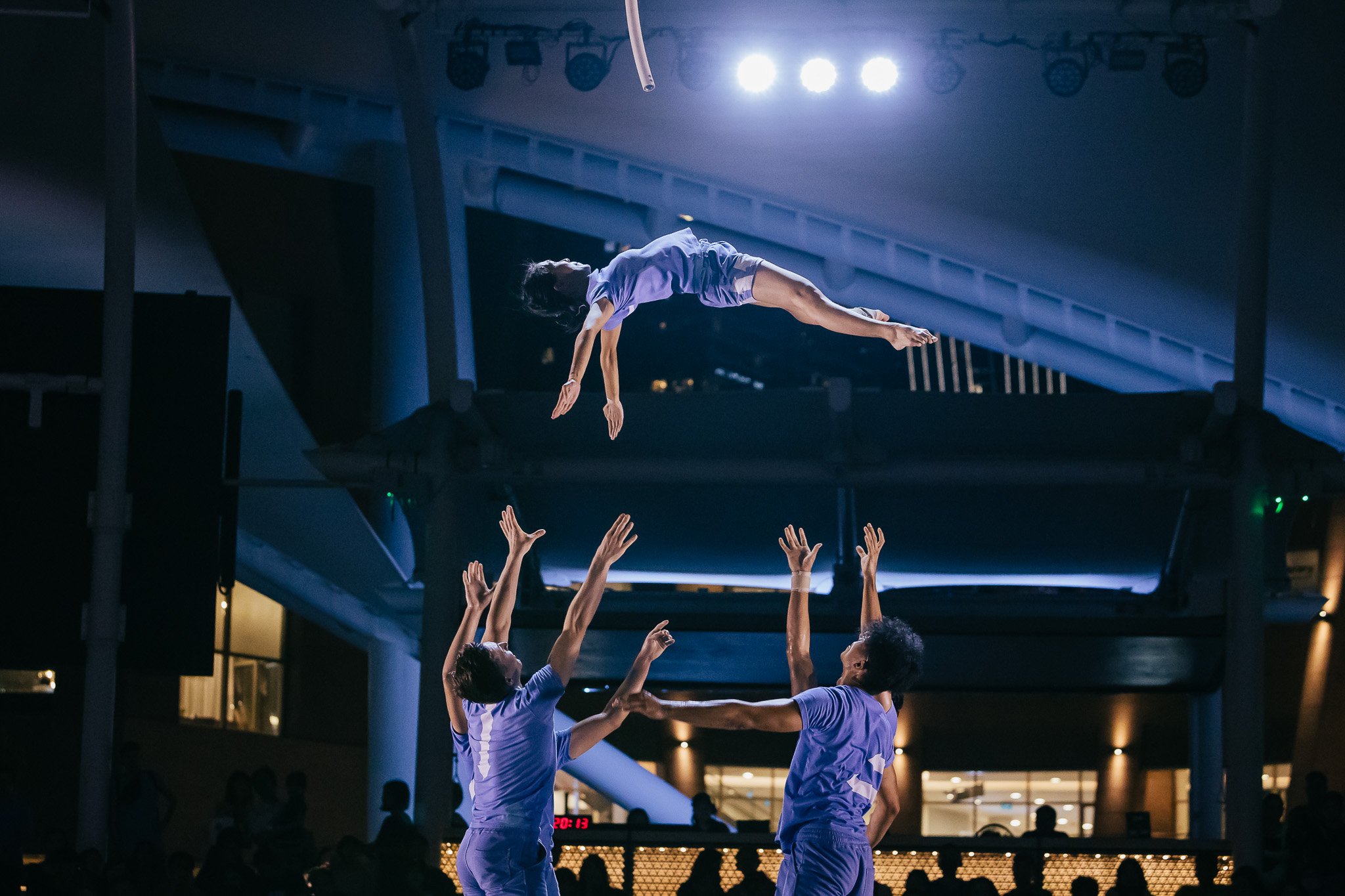
Circo Rum Ba Ba’s BOX explores the question, “How much Hieronymus Bosch can you fit in a box?” Inspired by the early Netherlandish painter’s penchant for highly imaginative and surreal landscapes, Marianne explains that BOX is an invitation for audiences to encounter an unfamiliar, absurd world and to form their own conclusions about what could happen.
“I thought it would be great to tease the audience with little aspects of mystery about what was going to emerge. And for a kind of battle to occur. Not necessarily about good or evil. That’s the audience’s choice. Is it about good or evil? Or is it a power battle? Is it a battle between nature and humanity?”
Sometimes, the creation of whimsical, dream-like worlds draws audiences into a space where logic is dismantled. Such worlds created by the performer can be powerful in disarming audiences, inviting them to let go of all expectations and engage more openly with the performance.
Marine Boy’s Voyage was created in 2021 during the COVID-19 pandemic, when many people around the world were dying in hospital beds. However, the piece is not only about life in a hospital bed. It is about the dreams we sometimes imagine while lying in our own beds—meeting an old friend, flying above the clouds, playing with whales or feeling the wind between our fingers.
“In this work, it is okay if audiences lose their way in the journey. Whenever they wish, they can return to the path that the performance gently guides them along. I want to invite the audience to travel together through this imagined voyage.”
Building the bridge to the audience
There is no one-sized-fits-all approach to audience interaction, as reflected in the practices of these performers. What emerges instead is a shared understanding of audience interaction as a constantly evolving exchange between performer and audience. It’s a mutual act of negotiation, or a beautiful dance, where both sides commit to stepping into new realms together. Whether through eye contact or carefully designed encounters, the performer and audience continue to meet each other in moments that are often unpredictable, yet deeply memorable.
Catch Snakes and Ladders! featuring Dwayne Lau, Voyage by Marine Boy and Circo Rum Ba Ba’s BOX at Flipside 2026, alongside a line-up of playful, fun and gravity-defying performances running from 29 May – 7 Jun 2026.
You May Also Like