My Parents Made Sure Art Never Just Lived Onstage
Joanna & Leslie Wong, Cantonese opera vanguards, by Audrey Wong
One of the most vivid memories from my childhood is crying in the driveway of the apartment building in Bukit Timah where my family lived until I was five years old. It is just after nightfall, and my amah is exasperatedly trying to calm me down. I was crying because my parents had left the house—again!—for rehearsals, and I couldn’t articulate my separation anxiety to my amah. “They’ll be back soon,” she said. “They’ve gone to the Big Clock Building.” That was what the Cantonese called the Victoria Theatre back then, in the 1970s.
This is why my childhood nickname was “crybaby” or in Cantonese, “crying bun”. There is an old photo of me at age one, with a face full of worry, plonked on a seat looking like a chubby bun. I eventually grew out of that phase and became as resilient as my elder sister, who happily entertained herself when our parents were out. My mother later said that we were easy children to manage. She never had to worry about our schoolwork, because we completed our homework on our own, passed our exams and regularly topped our classes.
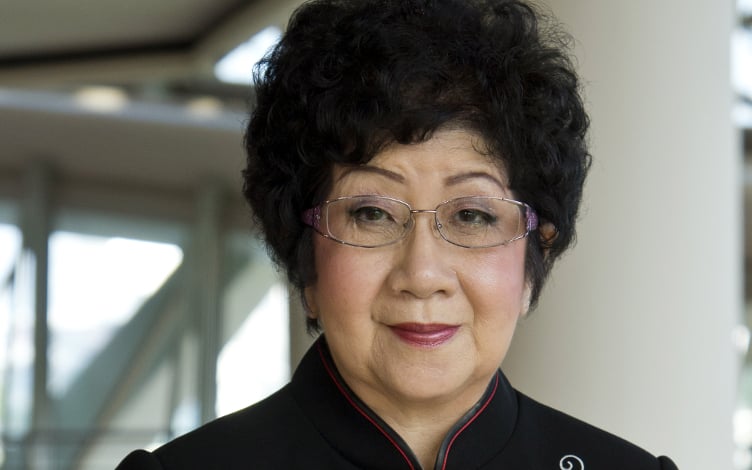
Why were my parents at the Victoria Theatre? They were busy with yet another Cantonese opera performance. My mum is Joanna Wong, probably Singapore’s best-known Cantonese opera artist with a long list of accolades and achievements: Cultural Medallion recipient, a BBM award for public service, a former grassroots leader serving for many years in the Kreta Ayer Community Centre, a Justice of the Peace, inductee into the Hall of Fame of the Singapore Council of Women’s Organisations, and in her day job, the former Registrar of the National University of Singapore. Together with my father Leslie Wong, a former police spokesman and Chinese opera playwright, they were the “power couple” of Cantonese Opera in Singapore. They met in university and discovered that among their English-educated peers, they were the only ones with an interest in Cantonese opera.

Cantonese opera, the “extra family member”
As kids, sometimes my sister and I conspired to stay awake at night and wait for our parents to come home, without the knowledge of our amah or Aunty Jenny, my mother’s cousin from Penang who helped take care of us. Those nights of whispered conversations cemented our sibling bond. From our busy parents, we learnt to multi-task and be self-reliant, leading to workaholic lives with multiple commitments. My sister and I established our own paths in life. She trained as a lawyer and later moved to the United States where she now works for an international organisation. I ended up in contemporary arts, becoming Artistic Co-director of The Substation and now, a lecturer at LASALLE College of the Arts, University of the Arts Singapore.
In their younger days, my parents somehow managed to juggle professional careers, a family, and long days of preparation for Chinese opera shows. Perhaps my own choice of career was influenced by their example of dedication and sense of vocation. My mum had only one employer, the National University of Singapore, where she was Deputy Registrar and then Registrar. Despite her demanding job, she never wavered in her commitment to Chinese opera, amending scripts, directing, training actors, performing, even flying to Hong Kong to train with opera masters. I remember her office at the university, with opera scripts half-hidden under stacks of documents. She would work late in the office, then look at opera scripts before coming home. Recently I asked her, “how did Dad find time to write operas when he was in the police force back in the 1970s?” She said, “you know your dad, he never slept early, he’d be up late writing.” This was a habit of a lifetime—even as an old man, he would remain in their opera company’s office till nearly dawn.
Dad and Mum’s opera interests didn’t end with the clan association in the 1970s—they were also active volunteers with the Kreta Ayer People’s Theatre, playing a part facilitating the performances of famous opera troupes from Hong Kong which kickstarted a wave of interest among young adults. These fans started learning opera from my mother and today are among Singapore’s established Cantonese opera performers.
In those days, my mum was often recognised in public. I didn’t fully understand that she was a public personality until I was older. But she was undoubtedly Number One in the household, and family activities often revolved around her free time—they still do today. Opera was the extra family member in the house, understood as part of our lives. Being in the theatre with the parents could have seemed glamorous to outsiders, but it was normal to us. We had an entertaining childhood: we could play with opera props like wooden swords, imagining ourselves as warriors or fairies; we could meet Hong Kong stars like Nam Hong (南红) and Lee Heung Kum (李香琴), who took us shopping in Orchard Road.
The moment where art happens
The glamour of each stage production, with actors in glittering costumes in front of backdrops depicting far-off Chinese gardens and imperial palaces, was attained through months of hard work. In the 1970s and 1980s, the opera group had to make their own costumes and sets. This was before China fully opened up to the world and opera practitioners could finally buy cheaper costumes from the mainland. As kids, my sister and I were sometimes pressed into service, helping to sew costumes. I remember sewing sequins, a task I enjoyed. We felt proud to see the costumes in the actual production even though our contributions were of course, rather minimal. Perhaps sewing was just one way to keep the kids quiet.
Raised with traditional Chinese values, we were expected to help our parents out, well into my young adulthood. On show days, I would help Mum iron costumes and pack her bags. When they travelled overseas to perform, I often stayed up late to help pack her suitcase. Sometimes this irritated me, but it allowed me to finally understand what being an artist meant. Once, Mum asked me to wait in the wings for an entire scene, on standby with her ginseng drink, ready for her to come offstage to take a sip. She was performing despite a bad cough. On stage, she was completely transformed: there was no sign of illness, no coughing. I realised she had completely inhabited the character she was playing: “that’s not my mum,” I thought. This made me understand what it meant to act, and what being an artist is: the total and absolute focus on the craft, on the moment when art happens and everything that you’ve worked for falls into place.
Being part of history
I recently found an old programme booklet from the early 2000s, listing the CTC contingent to Paris on one of their overseas trips. They have performed in over 25 countries. I was surprised to see my name on the list - my dad had put my name on it without my knowledge. This was the trip when CTC signed a memorandum of understanding with the European Cantonese Opera Association. I was studying in London then, so I hopped on the Eurostar train to Paris to join Dad, Mum and a few other troupe members for what I imagined would be a holiday break, albeit one that included an official visit to the Singapore Embassy where the MOU was signed.
I guess I’ve always been a peripheral member of the troupe. In 1993 and 1994, Dad asked me to go with the troupe to China and Romania where I was given the specific job of English surtitle projectionist. Then, I had a feeling that I was being pressed into service once again, as none of the troupe could be spared to do surtitles projection since everyone had to be on stage. Still, it meant I was part of CTC and Singapore arts history: the performance in Beijing of their signature opera A Costly Impulse was recorded by Chinese national TV and broadcast nationally to an audience of millions. How many arts groups can claim such an honour?

The everyday life of a community
Leslie and Joanna Wong didn’t brag about their many accomplishments, neither did they seek the limelight on their own accord. Although they were experts in Cantonese opera, they were hungry for more knowledge and did research in their own ways. My dad read extensively—Chinese history and literature—before writing his opera songs and scripts. My mum enjoyed watching different forms of opera beyond Cantonese opera, and picked up a lot of tips from those performances, many of which are still preserved on VHS tapes and DVDs in her home.
I think my parents were content to “do” opera, to be in the thick of things, reading scripts, critiquing shows, preparing for productions, training and rehearsing with others. And these others were many: it was an entire community of practitioners, and even a global community because I sometimes heard Mum on phone calls with Cantonese opera friends from Europe or China.
Over the years, I got to know this community, particularly CTC’s troupe members. A few started their lives in opera as teenagers training under Mum in the 1970s. I hung out with the younger troupe members on the overseas trips to China and Romania as Mum and Dad were busy, and witnessed their camaraderie and shared histories. Almost everyone was an amateur performer with a day job but they remained passionate about the art form and committed time to CTC. They typify the best kind of amateur artist, keeping the art form alive and relevant in contemporary life through regular practice. They train, rehearse and perform a couple of times each year, regularly—not just for major productions in the Drama Centre or Esplanade, but also on outdoor stages at community festivals and events in Chinatown. Although they aren’t full-time professionals, they are comfortable acting with opera stars from China. They spend time, effort and even money on Chinese opera—it is obviously something that they find incredibly meaningful, to the extent that it’s practically a habit and not merely a hobby. Artistic practice and life were intertwined and friendships extended beyond the stage and rehearsal studio, as some troupe members became my parents’ social circle and support group.
Recently, I have better understood how Chinese opera today is still kept alive in the community and at the grassroots, despite having been called a “dying art” since the late 1960s. Then, the rapid modernisation of Singapore, the rise of television and pop culture, the official language policy which curbed the use of dialects, and the education system which emphasised STEM subjects were all factors that led to the decline in popularity of Chinese opera. Yet it survives today—in large part because of people like my parents and their troupe members.
While my parents have said that their initiative of “bringing opera to the community centres” in the 1980s was important, it is only recently, when I started to do research on how to better evaluate “impact” in the arts, that I appreciated how their persistent efforts have enabled Cantonese opera to put down new roots in the community. This has allowed opera to survive into the 21st century. In the 1980s and 1990s, my parents were among those who started opera classes at community centres, leading to a wave of people learning Cantonese opera singing. CTC organised formal singing classes, staged regular concerts including a lunchtime series at Dragon Phoenix restaurant, and even organised a competition. Through these platforms, ordinary Chinese Singaporeans found a place and platform to pursue a passion, learn something new, and connect with other enthusiasts as well as their cultural roots. Friendships were forged, as were rivalries. New talents emerged. When we think about arts and culture, we often focus our attention on the creative works that are produced, the completed work, the artists who win awards. However, culture isn’t alive unless there is a connection with people’s everyday lives—unless it exists and is practiced by people in everyday spaces. Being around CTC has allowed me to witness this.

Passion undimmed
My sister and I always had an instinctive sense that we had to share our parents with a larger community: there were students; there was the opera troupe; there were deadlines; there were obligations to sponsors and funders; above all, there was the art itself. Sometimes the house would be full of people on weekends, working on a production. Sometimes we didn’t see our parents for a couple of days—and they didn’t see us either! This was the price to pay for their passion. The artistic and emotional labour that Joanna and Leslie Wong devoted to the art takes on greater significance in the context of Singapore’s cultural development when you look back across the decades. They influenced other lives: producing shows, running training sessions, writing or adapting scripts, giving a platform to new talents and connecting with professionals and academies in China. These were tasks that enabled others to discover their own passions and today a new generation of practitioners sustains Cantonese opera in Singapore. Two of the core creative team of One Love, A Legacy—Christopher Choo and Jaron Leong—started learning opera under my mum in the 1970s. After more than 40 years, their passion for opera is undimmed, their knowledge of opera extensive, and they now impart what they know to others. They aren’t the only ones.
My dad Leslie passed away in 2023 after a long hospital stay. During his last days, while he was in a coma, an unending stream of troupe members and friends came to visit. Only four people could visit the ward at one time, and my sister and I often had to wait our turn. My sister and I discovered that even at this point, we had to share our parents with others. But I understood how big a role my dad had played in other people’s lives, and appreciated the care and concern of this little community.
Dad used to say, “瘦田无人耕”—there is no one to plough the skinny fields—meaning that when Chinese opera was said to be a dying art in Singapore, there were few people willing to labour to bring it back to life. My mum is not certain whether local Cantonese opera will survive in the long run. I think she has made her peace with that. Regardless whether Cantonese and Chinese opera survives here, we cannot deny that Joanna and Leslie Wong lit a fire that sustained opera in Singapore beyond expectations. They did more than keep opera alive: through their devotion and passion, they touched the lives of many others and reached artistic milestones that can be recorded as part of our nation’s cultural history.

You May Also Like