Dikir Barat in Singapore
Tracing traditions in a cosmopolitan realm
Today, we often hear about globalisation. Without realising it, we are carried by the current, influencing culture, thought, philosophy, art, and lifestyle from all over the world. Integration as well as cultural assimilation and technological advancement further encourage the cross-pollination of ideas, resulting in a global tapestry of diversity. Schools of thought and lifestyle develop through exposure to various perspectives while challenging local norms.
Although globalisation fosters the spirit of innovation and connectivity, it also raises concerns about cultural homogenisation and the erosion of local traditions. Balancing the benefits and challenges is important in navigating its complex effects upon our world. One of its effects is cosmopolitanism, a philosophy that supports a particular attitude and approach to this interconnected world—one that values diversity, inclusivity and a shared sense of global citizenship. Traditional art forms are certainly affected by contemporary and cosmopolitan expressions. This essay will discuss the traditional Malay art, dikir barat (dikir)’s potential to be a social and cultural broker to move the current of cosmopolitanism forward especially in Singapore's plural society.

Singapore's Dikir Language
There is much discourse about the origins of dikir barat. Some say that it originated from Kelantan, while others argue it originated from southern Thailand. Discourses like these are relevant for its historical value, but should not revolve solely around the topic of cultural ownership. This is because it can lead to the tendencies of exclusivism or separatism which does not bring any benefits, especially for the society. Preferably, the development of dikir barat should take into account the milieu of the places and contexts this form of art has travelled to. Each territory has its own language that is influenced by different social and political realities. Therefore, discussions on language must not be separated from its cultural contexts. Language must also not be seen as mere tools for communication. Ngugi stressed: “Culture is almost indistinguishable from the language that makes possible its genesis, growth, banking, articulation and indeed its transmission from one generation to the next.”1 For example, in Kelantan, the art of dikir has become ingrained in the entire community that it became their way of life. It has developed its own culture and history. It is impossible to study Kelantan culture without paying attention to the art of dikir alongside other arts such as wayang kulit, mak yong and main puteri. The art of dikir encompasses moral, ethical and aesthetic values, spirituality, where activists and fans see their personality and place in the world: “How people perceive themselves affects how they look at their culture, at their politics and at the social production of wealth, at their entire relationship to nature and to other beings."2

When dikir was absorbed into Singapore, its features evolved. The language pattern presented in this art form changed to suit the culture of the people. For example, dikir Singapura introduced and emphasised written language in the performance. It is different in Kelantan which still focuses on spontaneous performances through the oral language. This reform happened because most of the pioneers and cultural elites of dikir Singapura were Malay language teachers who were educated in the field of literature. Both literary forms, classical and modern, were utilised especially during competitions, so much so that it became a component that is evaluated. This boosted the mastery of language and creative writing among the activists. At the same time, the audience were also exposed to the quality of language and critical thinking and were in line with local issues. Unfortunately, there are some parties3 who tend to veer away from this innovation because it is considered as a deviation from the 'authenticity' of the dikir which supposedly uses simpler language in its lyrics. These observations reflect apolitical, ahistorical and even anti-intellectual perspectives. These views also disregard the realities of a society that experienced rapid development and modernisation. The preservation of the dikir in Singapore had shifted from merely being ‘authentic’ to one that is revolving the thoughts and ideas of the dikir lyricists. Their perspectives cover the topics on identity reform, the spirit of pluralism, and universal humanitarian ethics. However, generally, this is rarely found in dikir performances in Kelantan, which still struggle with religious rhetoric, the seeds of feudalism, or the 'crisis' of Malay etiquette. In a nutshell, the dikir language of Singapore was moving away from conventional wisdom.
Creativity in Singapore Dikir
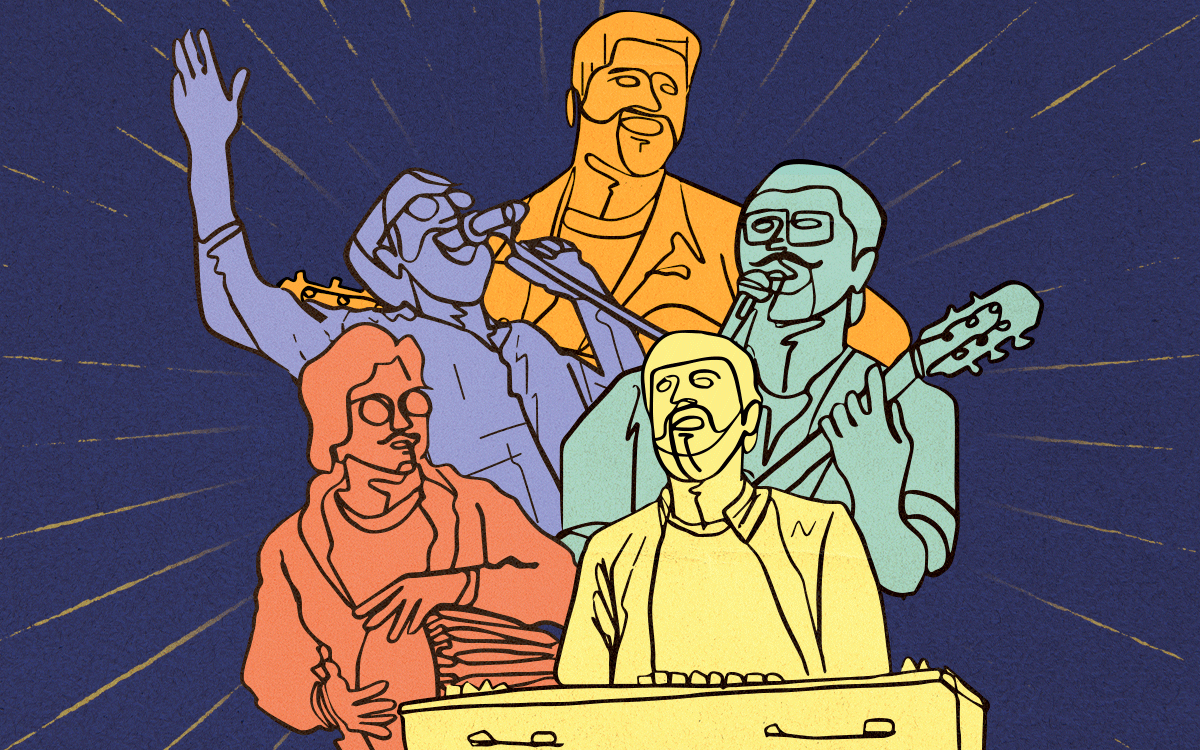
Like other Malay art forms, dikir's journey in Singapore went through innovation. Dikir in Singapore was more open to change in terms of its dance moves, music arrangement, voice, song repertoire, fashion and staging. For example, dikir Singapura songs would be complemented with traditional sounds such as zapin, asli, and joget with a wider corpus of music such as African, jazz, reggae and pop. The activists here would constantly try to put forward their creativity to compose an original, different, and mind-blowing song. Their creativity in adapting foreign elements must be seen as an effort to find a definition of a culture that fits the times and how to achieve social empowerment among the community. This could be achieved if the emphasis on technical matters was done alongside ethical and aesthetic matters that lead to larger humanitarian issues. This should be the main struggle of dikir Singapura activists. The reflections of a well-established Indonesian intellectual, Soedjatmoko, on human creativity itself can explain this matter:
“It feels as if the majority of our society, especially its leaders, have lost their feelings for values (waarden)....There is hardly any exchange of thoughts or national debate, that is, that covers the whole society, about the main problems that will determine our destiny.....There are no new thoughts...there are only tendencies, only trends...The result is bound to be a sterilised cultural life...Belief and self-sufficiency as well as revolutionary elan which was born from it, have vanished. The complete reliance on the individual (totale inzet van het individu) in the struggle will also disappear; what remains are the half-hearted nature and actions, the cynicism born of no faith, and the actions of small souls, who are not willing to rise above and break free from their own personal limits and grow in devotion to which that is greater than himself.”4
Since 1980, the development experienced by dikir barat in Singapore can be said to be a process of modernisation towards a genuine universality5. In fact, dikir Singapura is the best reflection of how a culture can become modern without violating tradition. Its ethos has been heavily influenced by the urban lifestyle. For example, in Kelantan a performance can drag on for hours until late in the morning, on the other hand, this does not happen in Singapore due to certain limits. Fortunately, this does not directly hinder the participation and vitality of dikir Singapura. It shows that the dikir field here does encourage its activists to “always dig and immerse and recreate from our past and from the sources of our old culture6”. This, inevitably, must be carried out with creative adaptation in order to find answers to the basic questions about man and his society. Without creativity, that said culture will be at a standstill. Only through creation can it bloom and fight its death7. Thus, modernity is not the antithesis of tradition. It is the continuation of efforts borne out of traditional elements and influences, that in fact must be built upon.

This video is produced by Malay Heritage Centre (MHC) as part of the Intangible Cultural Heritage conversation series which shines a spotlight on the remarkable talents who shape our cultural landscape. Reproduced with permission from MHC.
In this episode, find out from Cikju Djohan Abdul Rahman, a multi-award-winning tukang karut (jester) and lyricist, about dikir barat in Singapore as he shares his expertise and guidance, inspiring the next generation of performers.
The Search for Relevance and Hope
In essence, in today's global world, local culture will be exposed to various external elements. Dikir Singapura is one example that is a mirror of this truth. The benefits or harm of this exposure depends on the ability and willingness of the activists, especially the leaders, to generate a new language—which is historically literate, politically literate, morally literate, and intellectually stable. This must be done so that it is able to attract the interest of the next generation who will become the future leaders, who have a social responsibility. It should be remembered that the search for the relevance of Dikir Singapura does not have to abandon traditional values or apply influences from the West only. Modernisation does not mean westernisation. But a mental attitude that is always ready to rethink tradition seriously in order to seek improvement, development and social empowerment so that the presence of dikir Singapura in history is more meaningful. At a time when people are fear the issue of artistic contamination, the fighters of Singapore dikir must stand up bravely because, “could a fearful human be able to create in a world that is also living in fear?8" Going forward, the discourse of dikir barat in Singapore should be wide open beyond its entertainment and performative aspects. It is hoped that the language and creativity of dikir Singapura will be the torch in the exploration of tradition in the middle of the cosmopolitan world.
In this episode of the Intangible Cultural Heritage Conversation Series, Cikgu Djohan Abdul Rahman continues sharing about the art of dikir barat, a Malay performing art heritage which we should continue to cherish.