Making Music on Borrowed Time

The Multi-Band Hustle

Graphics And Ink: Texturing A Scene Through Local Music Zines

Baybeats Ever After: Beyond the Ending

Baybeats Budding Writers
Making Music on Borrowed Time
Singapore runs on productivity, while its music scene runs on whatever time it can borrow
There's a running tally on my phone I never meant to keep—gigs I said I'd go to and didn't. A hardcore show cancelled two days out; a Baybeats set I never left the office in time for.
None of it was a real refusal to attend. It could have been a meeting that ran long or an evening swallowed by the next day's brief. It could have been the small, ordinary erosion of a Friday night I used to keep free without thinking about it.
As someone who's always admired the people who play music seriously, and a believer in supporting the scene, I'd usually find myself at shows, vibing near the back with my buddies.
It was easier to fulfil during my college days. But somewhere in the last few years, coincidentally after starting my full-time job, even that became one of the first things to slip when the rest of the week got loud.
It got me curious about the people who never let that room, that energy, that spirit disappear. People who are, by every measure, busier than I am and still show up.
I went into this curiosity with an assumption I didn't examine closely enough: that musicians like this had something to give up in a city where practicality always seems to win. That somewhere between the day job and the setlist, there'd be a cost: a tour not taken, a sound softened, a version of themselves left on the studio floor because Monday came around again.
Syukri changed my mind on the first conversation.
The one thing he won't sell
Hafiz Syukri, 35, is a senior art director at an agency building brand campaigns for a living, and guitarist for four-piece instrumental band Nagetto. On the side, he's also part of the creative team promoting Offtrack, a music-centric bar ranked 16th in Asia's 50 Best Bars in 2026.
Nagetto was formed when one of Syukri’s friends from the skating fraternity gave up on skating and decided to learn drums instead. What began as a way to fill time slowly turned into real songs, then a recording, and eventually a streaming platform upload that happened almost without anyone deciding to make it official.
There was no pressure to make it big—Syukri believes that's exactly why it worked. With no other commitment weighing on them, he says, the band would be "more eternal”.
That's also why turning down a slot at last year's 100 Bands Festival—right after one band member got married—was such an easy call to make. It came down to a simple “Sorry guys, we’re busy”.

That same instinct shapes the boundary he holds now. Branding things for a living is literally what he does at work, yet he deliberately keeps Nagetto outside that logic.
"[Music] shouldn't be a career... it's an outlet."
Even in a hypothetical scenario where the band broke through and had opportunities to play in festivals abroad like Coachella, Syukri says he'd keep the day job regardless.
The band taught him something that carries over anyway, a two-way kind of listening, "not you listen to me, but I listen to you," which he's noticed is changing how he manages people at work, especially under the pressure of deadlines.
That’s the quiet design behind everything that Syukri does. He spends his working hours turning things into brands but Nagetto is the one thing he won’t do that to—not because the band wouldn’t be able to handle it, but because he needs at least one thing left that doesn’t have to perform for anyone but the four of them.
Setting the boundary between a career and a life in music isn’t a gap in his ambition. Rather, that’s the point of it.

Wired for it. trained for it
Syukri's clearest theory for why this shape of musician exists starts with a phrase he uses himself: nature and nurture. Singapore's nature, he argues, is creative. The instinct is there, but its nurture—how school treats the arts as electives and CCAs as half-period afterthoughts next to ‘pragmatic’ subjects like English, mathematics, and science—trains that instinct out from an institutional level.
He contrasts this with cities where nurture reinforces nature: Barcelona and skateboarding, Brazil and football, Japan and its anime and manga industry—places where a niche passion has an actual pipeline into a livelihood.
He’s seen with his very own eyes what happens without that pipeline. A friend of his spent years training in traditional Javanese art abroad, mastered the skill but came home to Singapore to become a hotel receptionist.
“I think that's sad, right, you spend your four years," he says. "Which sucks, ah."
It isn't a story about a lack of talent, but one about a city with nowhere to put that particular kind of skill, the same gap every musician in this piece has had to find a way around, but perhaps not as starkly as his friend did.
Which raises the obvious question: Why does the scene keep going at all?
Both at once
The scene isn't just surviving the pressure of busy, demanding lives. It's partly built out of it, both an escape and an unusual kind of solidarity. Creatives share a common struggle to make room for their craft, and that shared struggle becomes its own relief.
The country’s small size accelerates the effect. Genre lines blur—indie, punk, and hardcore audiences converge, and everyone ends up interacting with everyone else, rather than staying siloed the way they might in a larger scene.
The story of SyafIqah Rashid, 30, plays out most clearly here. She spent five years on the backend of a social service agency's youth programmes, interviewing students and researching what actually motivates them to stay in school.
It was in those same years when Syaf was in school that she was already entrenched in the hardcore scene, not one chapter after the other, but both running at once. Now, she’s on the verge of kickstarting her Master’s degree in Sociology in Glasgow, Scotland.
She didn’t choose hardcore deliberately. It was the vocalist of Fuse, a five-piece hardcore outfit now part of this year's Baybeats lineup, who pulled her in after years of posting covers solo on YouTube. She’s been playing guitar for them since 2016, while also fronting Mystique, another hardcore act since 2023.
That commitment has only grown heavier in recent years, with Fuse expanding its horizons internationally—they’re playing shows in Tokyo, across Europe and the UK, and in Australia.
It's the kind of touring schedule that doesn't fit neatly around a five-day work week. Some of it came down to timing, annual leave "rolled over from COVID years, when they weren't of much use," as she puts it.
The rest came down to "an understanding boss" and her own care to avoid touring during her workplace's busiest periods. Unlike Syukri, who's kept Nagetto deliberately small enough to never test his employer's patience, Syaf has had to find out exactly what hers will bend for.

A curriculum nobody assigned
At Syaf’s workplace, mentoring was quota-based, defined by a fixed number of 90-minute sessions a month, an assigned mentee, and scheduled check-ins. In the scene, it runs the opposite way, built entirely on who chooses to show up for whom, the same way she herself was pulled in.
That difference plays out in something small and specific. One of the younger gig-goers had been skipping religious classes on Friday nights for shows. Rather than telling him to stop, she nudged him with a different question: ”Why don’t we go for the shows that aren’t on Fridays instead?” she recalls suggesting a workaround. “Although I understand that he really loves music, but the shows he wants to see are always on Fridays.” It’s a way of making room for both, without treating either as disposable.
That quiet mentorship matters in a scene where, by her own account, there weren’t as many girls as there are now. She's part of why that's changed through the small-scale, unscheduled mentorship and dedication to the community she’s been describing all along. At her farewell gig before leaving Glasgow, the turnout was a room full of people she'd quietly made space for, and they were returning the favour before she left.

That sense of duty runs deeper than what happened on stage that night. It's part of why she's pursuing the sociology master's in the first place—another way of getting better at something she's already been doing informally for a decade.
"Full-time music was never really the aim in Singapore," Syaf affirms. A practical approach has always simply been the price of staying in it.
Friendship as instrument
Marielle Solano, 28, arrives at something similar from a completely different angle.
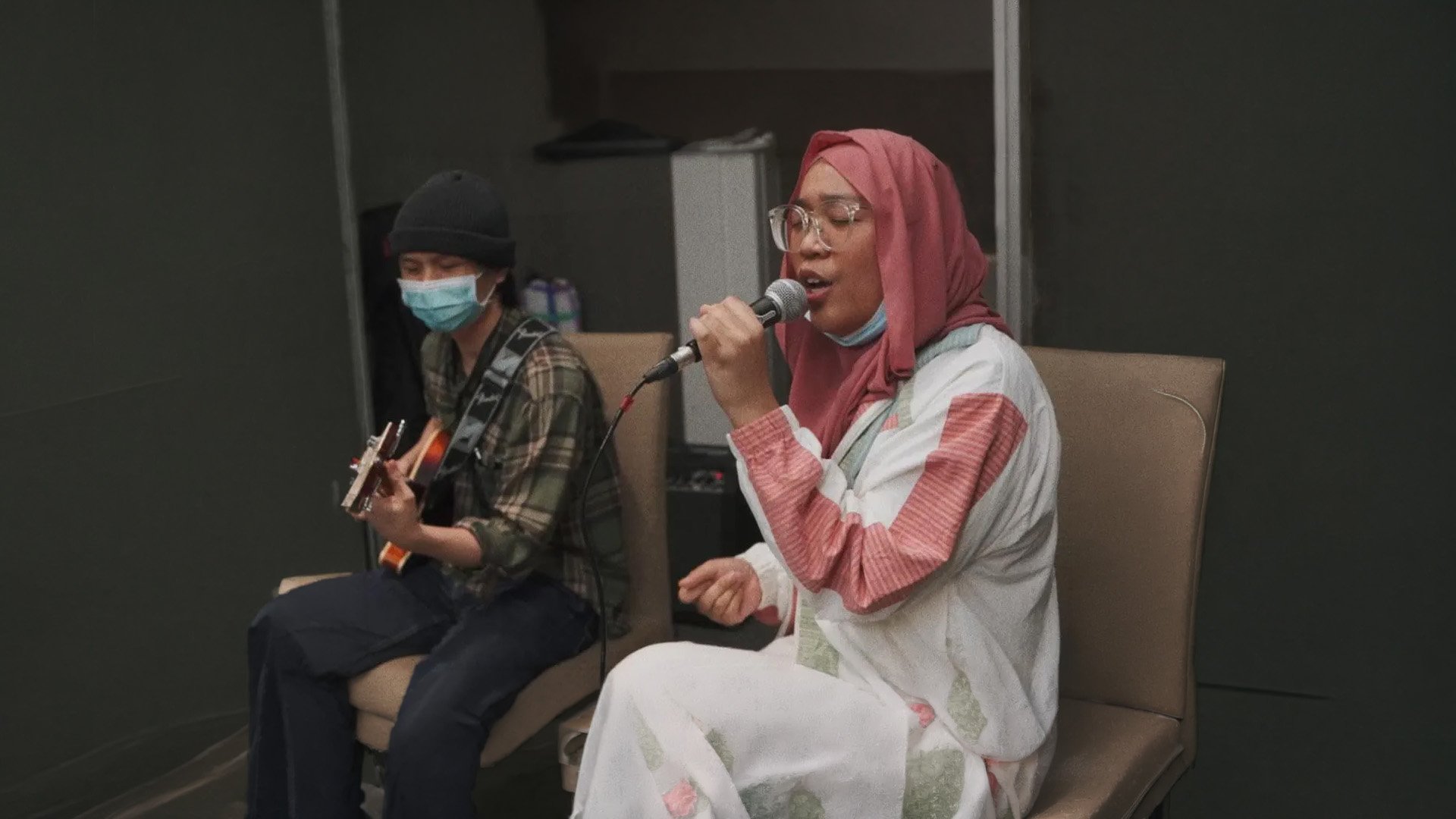
By day, she's a public relations manager; by night, she juggles three creative outlets, a rhythm that traces back to her time at the National University of Singapore’s Jazz Band from 2017 to 2021, where she was mentored by local heroes of the genre such as Alemay Fernandez and Chok Kerong, and to a fond memory of performing at Esplanade's Singtel Waterfront Theatre.
A public relations manager by day, Marielle juggles three creative outlets by night, a rhythm that traces back where she was mentored by local heroes of the genre such as Alemay Fernandez and Chok Kerong. She recalls fond memories of performing at the DBS Foundation Esplanade Outdoor Theatre.
Ask her what drives her through three overlapping commitments, and the answer is the same whether she's talking about a mentor or her own bandmates: "mad respect for the art.” Craft and friendship, for her, are the same instinct. It’s about "celebrating the mastery of [her] friends, because [they] are great friends."
That instinct runs across three musical projects, each asking something different of her.
With The Sugar Bees, a jazz close-harmony trio she co-writes and co-arranges every song for, she's a full creative partner. "Our music career is like a manifestation of our friendship," she says of a group that's run for eight years. In Clementi Soul Unit, she's one of the vocalists bringing someone else’s ideas to life rather than authoring them herself. On her own, she leans further into musical theatre, closer to a personal focus than something either group is built around.

It's The Sugar Bees that best explains how she keeps all three running at once. The trio meets most often when they're preparing for a gig, and Marielle is candid about why that matters: "Gigs force us out of our rat race, our corporate race. Because otherwise, it gets quite out of hand."
Even under a tight pre-gig crunch, it doesn't tip into tension. "Ultimately it still feels like a safe space, because all of us are very gracious with each other," she says.
If someone's coming straight from a long day, they'll start later so there's time to eat first. If a part isn't ready, they'll learn it on the spot, in 15 minutes, then move on. None of it derails the session, but it's built around the fact that everyone here also has somewhere else to be all day.
That same grace extends to how she thinks about the trade-off running underneath all three projects. Practicality is necessary, she says, "especially to earn money and stuff, for your livelihood," but it was never meant to be the whole answer.
"Make sure you choose something that keeps the integrity of that creative soul alive," is how she puts it, wary of a job so disconnected from who you actually are that it quietly wears you down, however sensible it looks on paper.
For Marielle, her three creative projects aren’t a compromise squeezed into a crowded week, but rather, they are what happens when you refuse to let practicality be the only thing deciding your choices, built out of whatever hours the week happens to leave over.
Whatever room is left
None of them solved the trade-off I’d gone in expecting to find.
Syukri built a deliberate wall with the same instinct he uses at work to build brands for other people, refusing, on principle, to touch the one thing that isn't for sale.
Syaf, in contrast, lets the two worlds lean into each other instead, quietly and unofficially. A workplace’s quote becomes a scene's open door, and a decade of small, unscheduled mentorship becomes a master's she's chasing on purpose.
Marielle didn't build a wall or a bridge. She built something to stand on, three projects and one friendship underneath all of them, sturdy enough that none of it has to carry the weight alone.
The tally on my phone hasn't gotten any shorter. But I think I finally understand why theirs has, not because they found more hours in the week than I did, but because each of them decided, in their own way, that the room was worth keeping open.
No one made space for this scene. The people in it did, out of whatever the week left over.