An essay for Choy Ka Fai’s SoftMachine: The Return

Published: 25 Sep 2025

By: Yon Natalie Mik

SoftMachine: The Return is a project that weaves together a decade of experiments in dance-making through the critical lens of five Asian artists: Rianto (Banyumas, Indonesia), Surjit Nongmeikapam (Manipur, India), Xiao Ke x Zihan (Shanghai, China), and Yuya Tsukahara (Osaka, Japan). The presentation is envisioned as a performance that manifests in the form of dance, incorporating lecture, demonstration, and documentary. Commissioned by Esplanade – Theatres on the Bay and making its world premiere in Singapore, this production is presented as part of da:ns focus – Connect Asia Now (CAN) 2025.
The SoftMachine project was originally initiated in 2012 as an independent survey of the choreographic landscape in Asia, with a focus on the ecologies of independent dance makers, in response to the persistence of exoticism in the cultural production of contemporary dance. It culminated in the original production of SoftMachine, which was commissioned and presented as part of the da:ns festival in 2015 at Esplanade. The project subsequently toured and was performed in more than 60 shows internationally until the pandemic struck in 2020.
In this essay, writer Yon Natalie Mik explores Choy Ka Fai's newest work, SoftMachine: The Return, and ruminates on the movement of return.
Let’s look at a body that returns: it is never the same. Its tissues accumulate the weight of time, memory, failure—perhaps also a few bruises along the way. The movement of return—on both a choreographic and visceral level—presents repetition with difference, folding the past into the present without the illusion of recovery. Choy Ka Fai’s new project SoftMachine: The Return inhabits this orientation and carries with it an unpretentious temporality. It revisits his earlier project SoftMachine, which, in the artist’s own words, explored “the ecologies of independent dance makers in response to the persistence of exoticism in the cultural production of contemporary dance.” At the centre of this work, which began in 2012, were four performance portraits. In each, the artist documented an encounter with one Asian dance maker (Rianto, Surjit Nongmeikapam, XiaoKe x ZiHan, Yuya Tsukahara), attempting to learn how to move like them while asking what “contemporary dance” meant in their specific context. It is in this sense that the new project SoftMachine: The Return stages duration and a desire to “grow old together”—repeating with difference and collaboratively turning to earlier questions in order to open them anew.
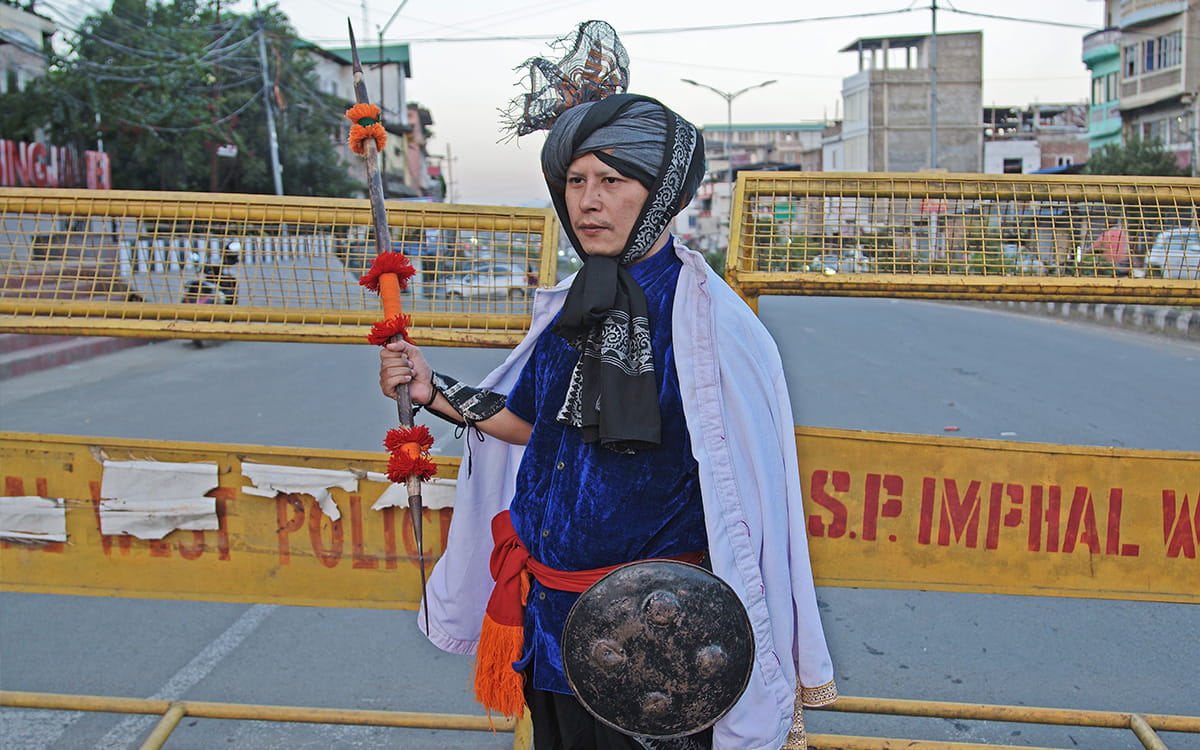
Surjit Nongmeikapam, artist and collaborator of the <em>SoftMachine</em> project.
To think of return in this way requires us to shift our sense of what dance does. If we look at dance not as a metaphor but as a cellular intelligence of survival, the movement of return is not to restore but to persist. Here, bodily movement is not standing for something else, but it is the mode of thought itself—no metaphor for freedom or struggle, but an embodied practice of navigating and sustaining life under power. Moving with such spirit of persistence appears to be the pulse of the return in this new project and it interestingly connects back to one of the performance portraits from 2015, when Yuya Tsukuhara remarked: “Boredom is important. Usually we do this for one hour. We do it until we get bored.” Teaching Ka Fai to push and punch repeatedly against each other, hovering between aggression and play, resistance and surrender, Yuya framed boredom as a desired threshold. A moment when repetition thickens into duration—when persistence becomes palpable, and the body learns to take it as the condition of return.
This insistence on repetition as both wearying and generative points to another register of “soft machinery” wherein the word itself recalls William S. Burroughs’s novel The Soft Machine, in which the body is figured as a programmable organism, porous to invasion by drugs, viruses, and systems of control. The novel’s cut-up technique—literally slicing apart and recombining texts—reveals fragility inherent to language, producing unexpected constellations through fracture. Meaning arises provisionally and fragments meeting across difference to form networks resist the fantasy of a seamless unity or the pure beginning of a sentence. Seen through this lens, the returning body as a soft machine—fragile yet holding up—similarly points to the myth of origins, to the fact that all beginnings may themselves be belated, inventions already haunted by repetition.
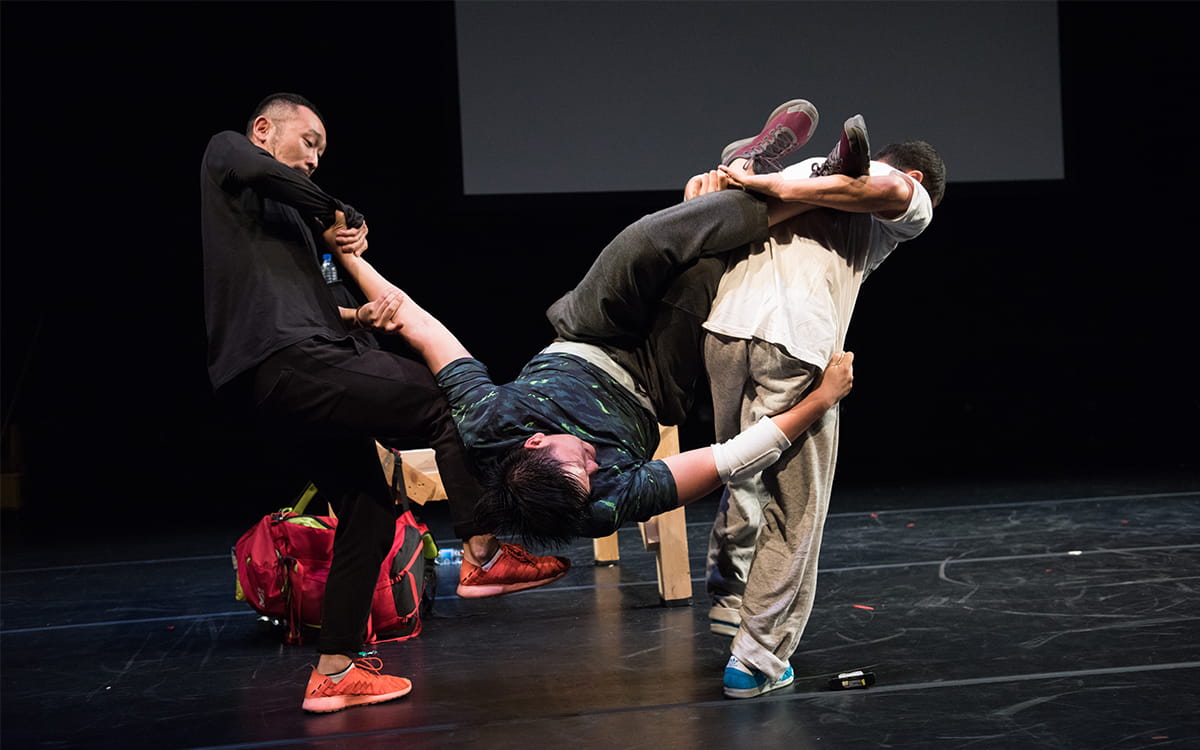
Yuya Tsukahara, <em>SoftMachine</em>, 2015.
It is this fragility that resurfaces from the previous performance portraits and now continues to act as a fuel for rehearsing the dissolution of geneses and lineages. In the practice of XiaoKe and ZiHan from 2015, for example, the notion of return had been already haunted by historical cuts. Their documentary had exhibited genealogies of Chinese dance fractured by the Cultural Revolution, while the dancers circled back to these fragments not to restore a lost continuity but to reassemble with what remained—imitating, distorting and exaggerating movements until their instability was laid bare. Ka Fai announces that the returning project will situate their dance within the “shifting social realities of China and its emergence as a global superpower”. The contours of this new work remain to be seen, and within the broader logic of SoftMachine we could read it as continuing the fragile strength of persistence: a body that carries its breaks, accumulates its wounds and insists on returning nonetheless.
Does not each movement of return alter not only the body but also the ground it revisits? The body—a ‘homeless artist’ body as Ka Fai self-describes—seems to have no same place to return to, no intact origin to secure. It is always displaced by its own difference while stubbornly creating further displacements with its own movement. Homelessness as a condition recurs throughout the artist’s body of work and seems to frame both his practice and its dilemmas. The idea recalls Yuk Hui’s planetary notion of Heimatlosigkeit, where homelessness is diagnosed as the condition of modern life under globalisation. But unlike Yuk Hui, Ka Fai’s homelessness is less a philosophical abstraction than a lived method. Residencies are strung across continents, provisional collaborations and survival strategies within the late-capitalist art market, paired with the desire to share this precariousness with friends who, too, have left home—not always by crossing borders, but sometimes by departing from the very traditions and norms that once defined their place.
“
”
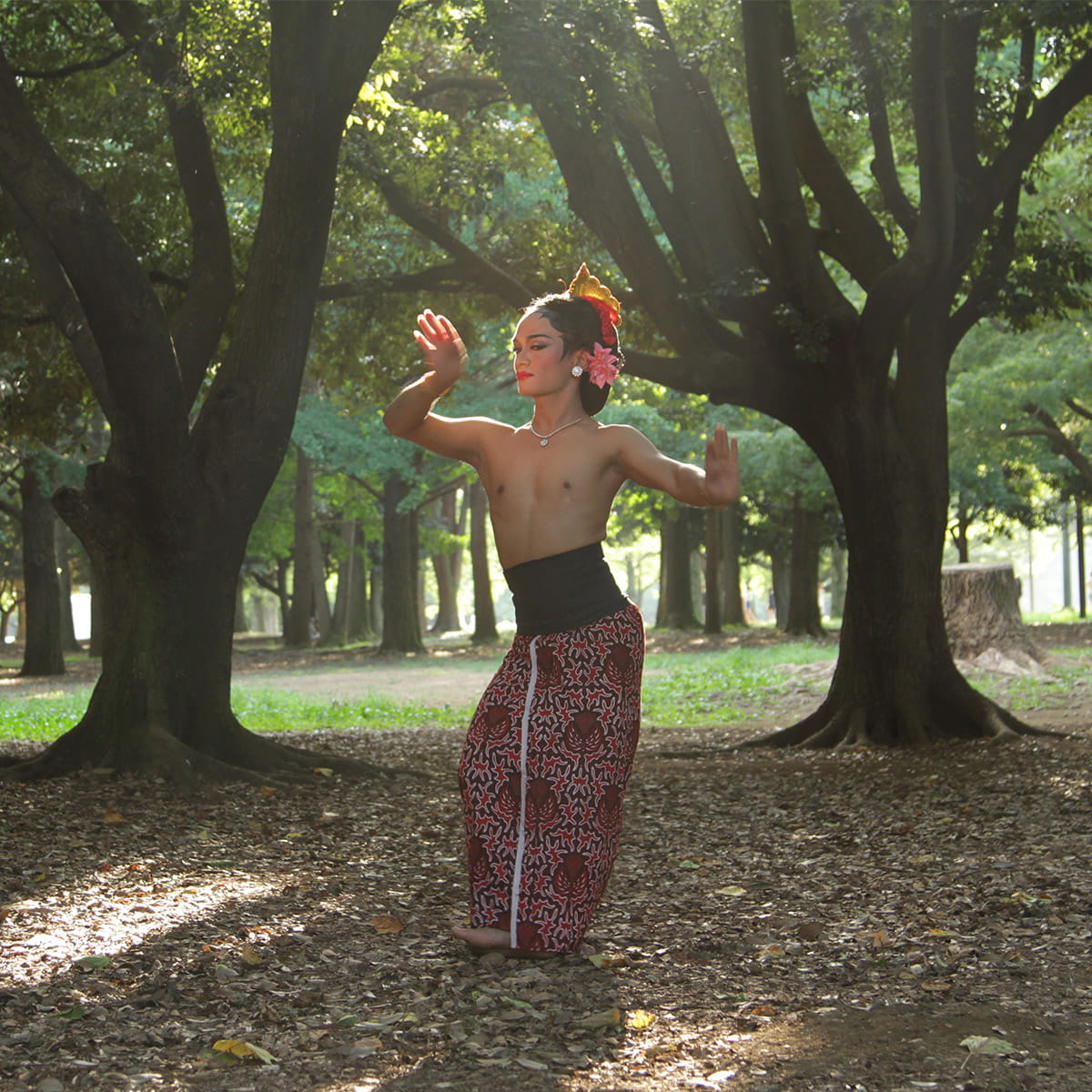
This impossibility also reverberates in the earlier portraits of Rianto and Surjit. For Rianto, lengger lanang (a Central Javanese cross-gender dance form historically performed by men in feminine roles) is not a tradition left behind but one he continues to carry, expand and renew. It is a form already marked by its own in-betweenness—oscillating between gender, devotion and desire—and it is precisely this tension that gives it vitality. Ka Fai shares that Rianto’s returning project shows his “search for love in-between the spectrum of dance, gender and tradition in Indonesia.” This search, however, seems to have no fixed resolution. It stages the impossibility of ever arriving at a stable “home”—whether in tradition, identity or desire—while insisting that endurance lies in continuing the search itself. Rianto’s practice inhabits this homelessness not as loss but as movement: an art of remaining in-between, where what persists is the fragile strength of a body that keeps bending norms, sustaining love and form alike through continual transformation.
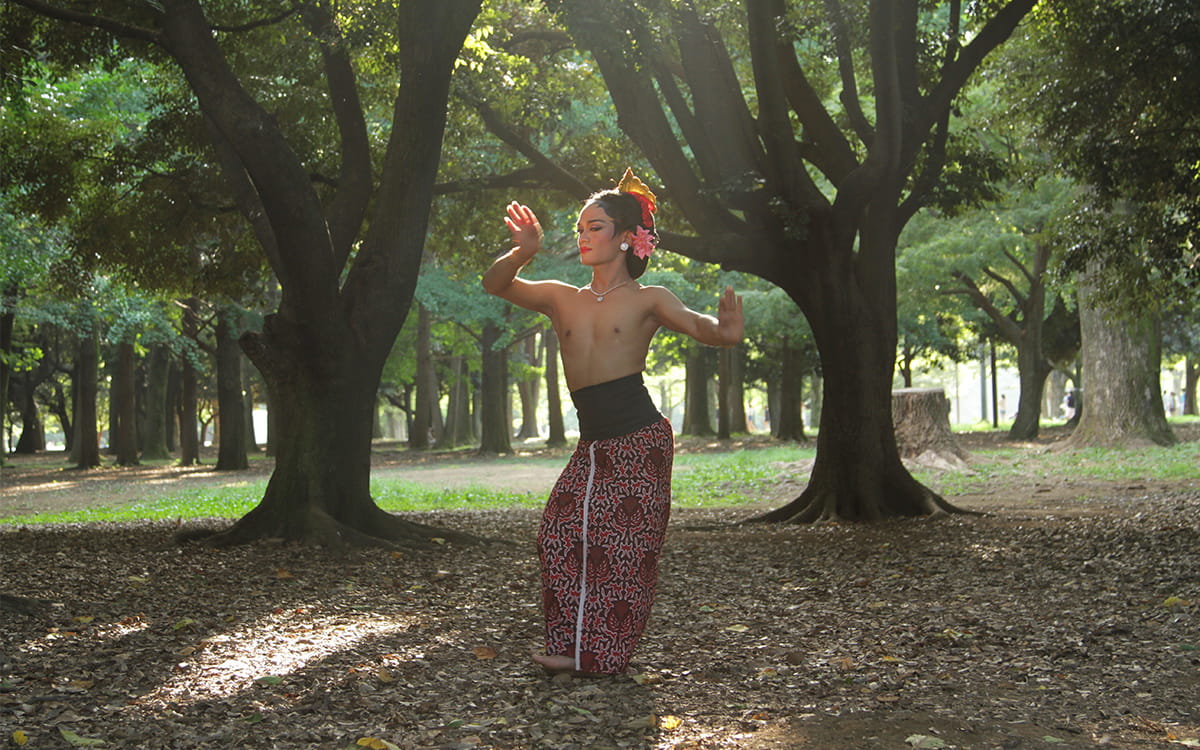
Rianto, artist and collaborator of the <em>SoftMachine</em> project.
Surjit Nongmeikapam’s portrait turns the motif of homelessness more directly toward the problem of impossibility. The previous collaboration with Ka Fai had staged misalignment: movements fell out of sync, intentions failed to meet and choreographic attempts slipped into misunderstanding. What emerged was not resolution but a choreography of failure and compromise, a performance of how cultural encounter is always fractured. In The Return, this trajectory is reframed as the journey of a body shifting from the marginal to the political, a dance of resilience that gestures beyond the histories of Manipur’s ethnic conflicts. The framing hints that the fractures of 2015 will not be mended. They are likely to resurface in new configurations wherein impossibility does not foreclose choreography, but generates it—and failure becomes food for endurance.
What, then, does it mean to archive and re-stage such practices under conditions of homelessness or the impossibility of returning to an intact beginning? The collaborative structure of SoftMachine has not been immune to critique. Some observers have questioned whether its format risks exoticising or exploiting the very artists it seeks to engage, framing Ka Fai as the privileged documenter and others as the documented. While this critique deserves recognition, it also risks flattening the complexity of what unfolds in these long-term collaborations. Following Diana Taylor's approach to the notion of transculturation, such encounters are always asymmetrical, marked by negotiation and displacement. Yet to describe them solely through the lens of privilege and subordination risks reproducing the very colonial logic the project seeks to unsettle, casting the “weak” only as objects of appropriation.
In practice, the dynamics are more unstable and reciprocal. Rianto, Surjit and others do not simply get archived; they redirect, resist, negotiate and reshape the collaboration itself. Their practices refract into Ka Fai’s, altering not only the portraits but also his authorship. The archive that emerges is thus not a neutral container but a living witness of fragile interdependence, where visibility, knowledge and survival circulate across uneven relations. Rather than stabilizing cultural essences or preserving intact origins, it performs an ongoing negotiation in which the so-called margins exert their own force. In this sense, the archive itself becomes homeless: porous, unstable, marked by the impossibility of seamless unity. It records not only choreographies but also loneliness, attempts at proximity, fragile solidarities and the impossibility of complete understanding.
SoftMachine: The Return operates within global circuits where difference risks being commodified, yet it foregrounds fragility and impossibility as strategies of resistance. The portraits are shaped not only by the artists’ practices but also by economies of presentation that can render cultural specificity into consumable surplus. Rather than offering closure, the work insists on incompleteness, staging unfinished traces of relation—precarious yet enduring. Within this frame, it repeatedly turns to the motif of friendship. Not intimacy or affinity alone, but a fragile labour that sustains proximity across asymmetry. The question is not how to resolve difference, but how to remain near it: What does it mean to rehearse another body’s rhythms, to inhabit its movements, while knowing that assimilation is neither possible nor desirable? Friendship here is less about sameness than about persisting in relation despite misalignment.
This orientation is choreographic as much as ethical. To rehearse another’s movement until it alters one’s own is not only documentation but ultimately relational embodiment. The impossibility of “becoming the other” is never concealed; it becomes a structuring tension. Solidarity is reframed not as full understanding but as proximity that accepts dissonance. Gloria Anzaldúa’s notion of spiritual pedagogy offers one way of grasping this logic. Knowledge, for her, is not accumulation but recursive practice across spirit, intellect and body. In SoftMachine: The Return, knowledge circulates through translation, rehearsal and failure. Ka Fai functions less as transmitter than as conduit, where knowledge passes provisionally, subject to transformation. It is a return to the body, where the body itself becomes the archive—circulating contingently and vulnerably, rather than preserving intact forms.
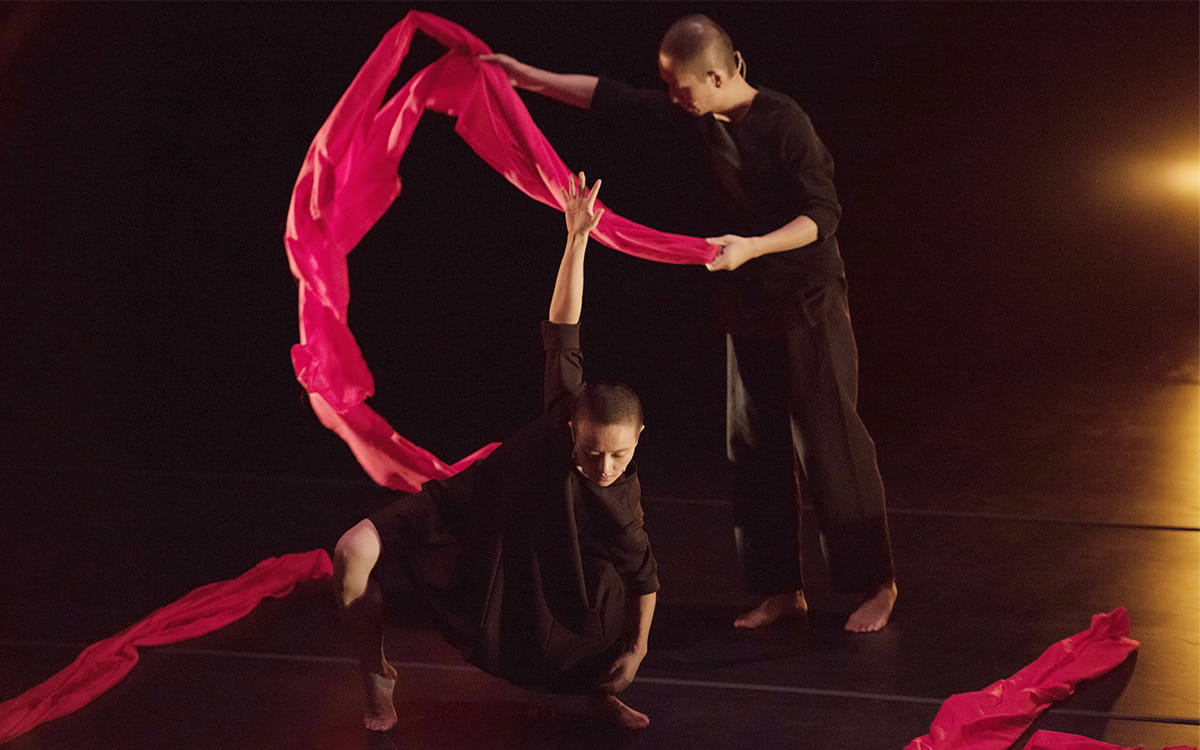
Xiao Ke and Zihan, artists and collaborators of the <em>SoftMachine</em> project.
Writing this essay was guided by the desire to become a closer friend to Ka Fai, to attune to his rhythm, his concerns and his questions. The text leans toward him, and in doing so becomes vulnerable, aware that full alignment will not be possible. It is as if my words build another soft machine, porous to his influence—contingent by the traces of his movements while generating new ones of its own. For years, I have followed his practice closely, yet this is the first time I write in anticipation of what has not yet appeared, returning to earlier works as a ground for rehearsal. The risk of such writing—speculative and unfinished—makes the text fragile, but it is carried by trust, by the support structures we as friends seek to build together in order to sustain life under power. I place this text within Ka Fai’s wish to persist together, as a fragment that may, one day and in some provisional form, become material for a rehearsal of proximity and care. To write about return without having yet witnessed it is, perhaps, to return already.
Contributed by:
Yon Natalie Mik is an artist, dancer, and writer who creates expanded choreographies and performance exhibitions. She is the co-founder of the publishing project The Invisible Archive and the author of Studies on Squats (2025, published by Archive Books). She is currently a Guest Professor of Contemporary Dance at the Korean National University of Arts in Seoul.
What's On
da:ns focus 2025/26 continues with CAN – Connect Asia Now from 25 – 28 Sep 2025, which spotlights contemporary dance works by or in collaboration with Asian artists, focusing on distinct voices and creative impulses from the region.