Looking back on The Studios 2023–2025: Tending the vanishing point of land

Published: 27 Apr 2026

By: Shawn Chua

Time taken : ~10mins

"We're sitting on land that used to be sea, and this is in itself a very Singaporean thing. We often don't pay attention to the notion of land as highly urbanised people; we have a very rare and strange connection to land… So how do we take that on, and what do we do with it? And how does art help us to figure out something meaningful, something challenging, and something beautiful?"
– Charlene Rajendran, Salon: Art and Dialogue, Art is Dialogue – A Look Back on The Studios 2023–2025
"As the Singtel Waterfront Theatre was being built, we found photos of the Marina Bay area that showed how dramatically the landscape here had changed over the last 20 years. Between this visual reminder and the current local and global discourse, it felt urgent and fitting to look at land as our thematic focus for the next three editions."
– Lynn Yang, Producer's Message from The Studios 2023: Landings
The photograph that sowed the Land Trilogy shows Marina Bay before Marina Bay existed: flat fill, open water, an edge the city had not yet drawn. The skyline visible from that same spot today arrived in living memory, engineered from sea. The horizon that looks permanent is, in fact, tended.
This is not a metaphor the photograph offers gently. It is the plain condition of a city that has made land-making a form of governance, where the ground beneath you is a policy outcome, and the coastline is an argument never quite settled. Esplanade itself sits on reclaimed land, a fact we file away like humidity until someone names it plainly, as Charlene Rajendran does in the closing salon of the Land Trilogy in September 2025: we are sitting on land that used to be sea. The seamlessness of that skyline is what tending looks like when it has worked long enough to resemble nature. It tells you nothing about the labour involved or what had to be held open for the transformation to take place.
This is also, in miniature, a description of what The Studios' Land Trilogy set out to do. Across three years from 2023 to 2025, producers Lynn Yang and Shireen Abdullah wagered that a constructed curatorial horizon, maintained with enough care and enough time, could shift the vanishing point for land in a national arts centre: drawing something that had receded from our perception back into view, and in doing so, expanding what a season of theatre could hold.
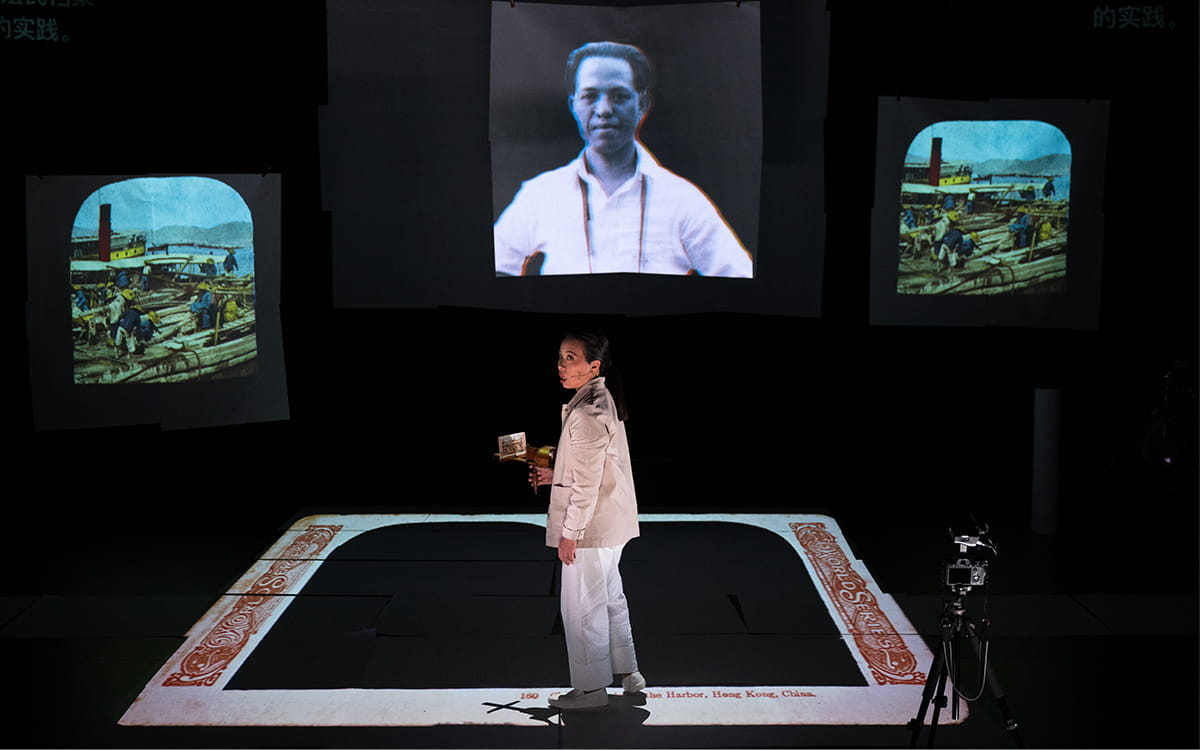
<em>One Day We’ll Understand 有那么一天</em>, <em>The Studios 2024</em>. Photo credit: Joseph Nair
The Studios has been Esplanade's annual contemporary theatre season for over two decades, a concentrated run for about two months each year featuring local works at the more experimental end of the spectrum. At its best, it is where Singapore theatre audiences encounter work they would not otherwise see, and where local artists find their work placed in conversation with the broader currents of international contemporary performance. The season has accumulated a core audience, a reputation, and a set of expectations over the past twenty years, including among the companies and artists that have grown alongside it.
The dominant logic of such a season is the annual reset. Each year is its own curatorial argument, and the blank slate is both freedom and constraint: freedom to respond to what feels urgent now, constraint in that you tend, as Lynn puts it, to stop at a surface level and move on to the next thing. This is not a failure of ambition so much as a structural consequence of the rhythms by which institutions and artists work together: funding cycles, ticketing windows, and the calendar pressure of producing one season while planning the next. Good work gets made, and then the ground is turned over.
A thematic trilogy cuts deliberately across those rhythms. Committing to Land across Landings in 2023, Fault Lines in 2024, and Sustenance in 2025, Lynn and Shireen were insisting that certain kinds of growth require more than one season to become visible. The first year is the heaviest: building vocabulary, relationships, and the initial frame. Years two and three begin to yield what the first year planted: accumulated resonance, a developing community of attention, the ability to go deeper because the groundwork has been prepared and the terms of the conversation have been established.
This is a structural claim as much as a thematic one, and it changes what a season can hold. The trilogy is less a sequence of curated highlights than an attempt to construct what the programmers describe as a thick, curated horizon: a line of sight along which different land-stories, land-histories and land-futures can be placed in perspective together, even when they would never meet in the wild. Landings looked inward, asking what we know of the ground on which we reside and what we have given up in exchange for progress. Fault Lines opened outward, using individual and community histories as the sites where global forces erupt into the personal. Sustenance turned to the most fundamental questions of what keeps us alive and connected: food, fermentation, memory, grief, and the things we pass on to those who come after us. The arc is not a tidy argument. It is an expanding field of attention, each year finding the theme has grown wider than the previous year had been able to see.
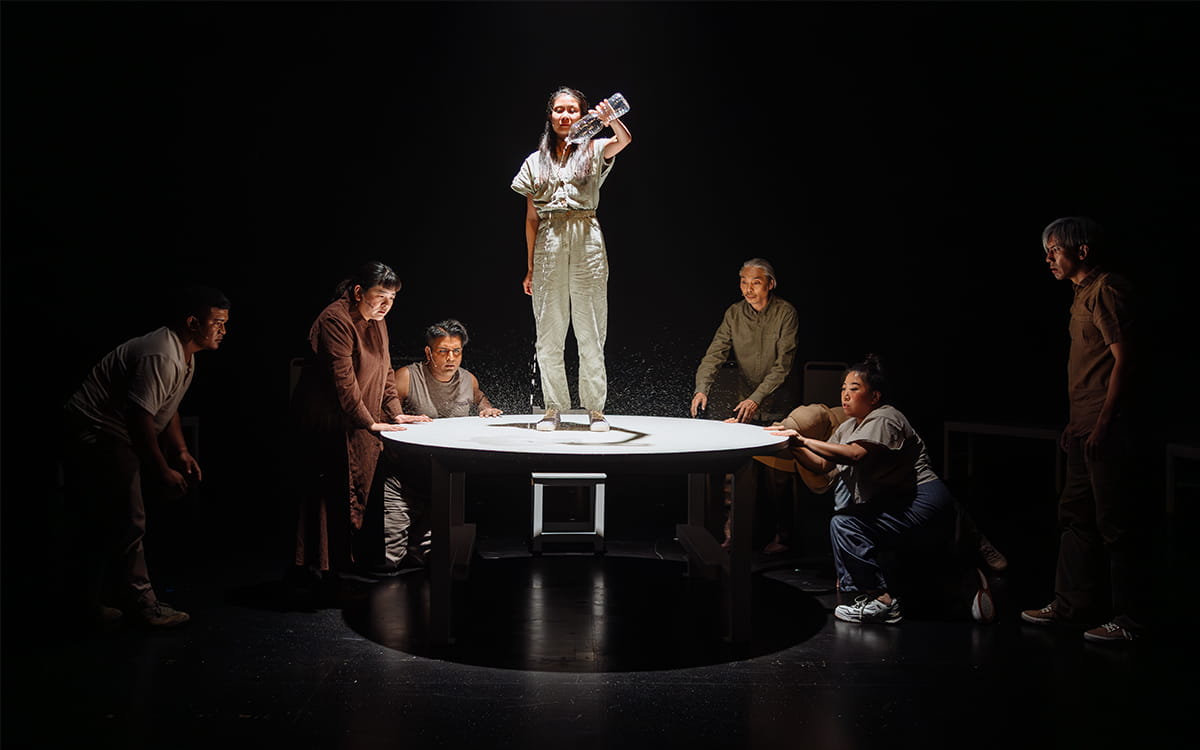
<em>Scenes from the Climate Era</em>, <em>The Studios 2025</em>. Photo credit: Crispian Chan
Asked to describe the season she had been building, Shireen reached for a botanical structure. A terrarium, she said. Like the Flower Dome, an artificial one. She paused at the qualifier and kept it, because it captured something essential: the sense of seeding particular conversations and relationships not yet visible in the current ecosystem, of tending a climate for experiments that might not survive outside. A dome is not fake nature. It is an engineered ecology that makes certain forms of life possible in an otherwise inhospitable context. The artificial is not the absence of care. It is care made structural.
This framing carries an implicit argument about what art itself does. In the 2024 season note, Lynn quotes Jon Fosse on what distinguishes good art: that it always contains something alien, something we cannot completely understand and yet at the same time do understand, something that pushes us beyond our limits. The Land Trilogy was designed to produce exactly that experience, not only inside individual works but at the level of the season itself. Works placed in proximity that had no natural reason to be near each other, held long enough in that proximity for the friction to become generative.
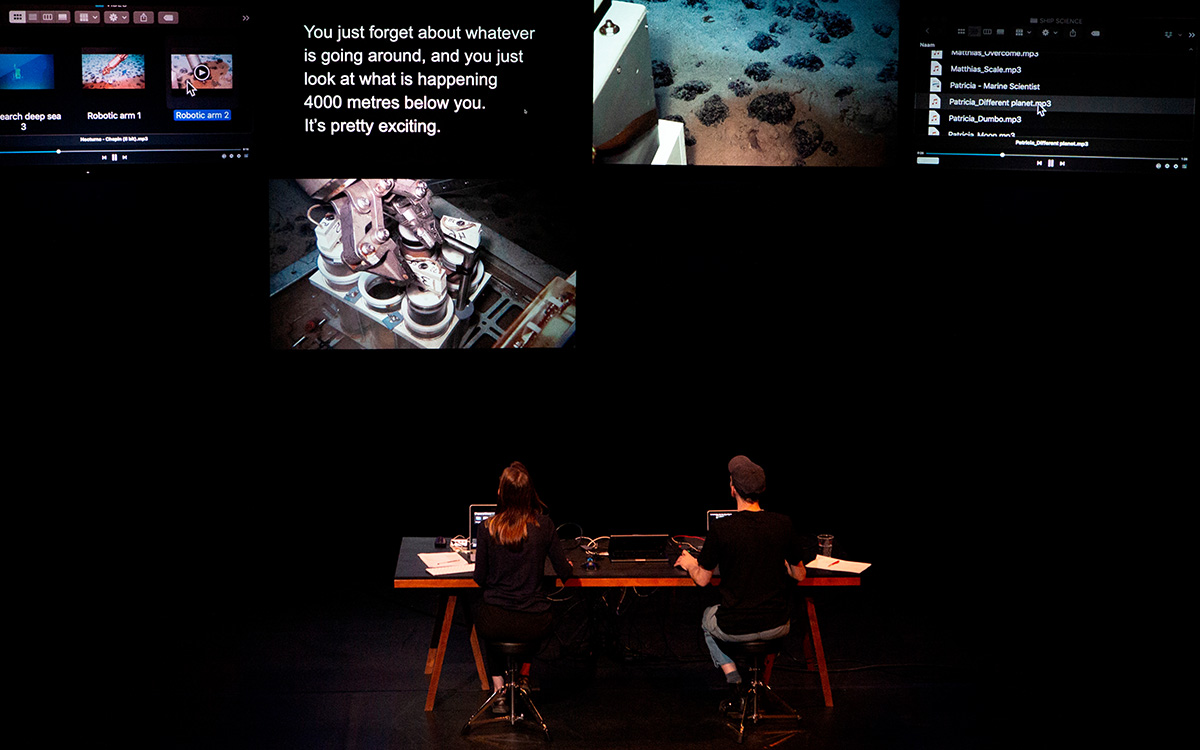
Inside the dome, adjacencies became possible that had no natural precedent. A Belgian documentary trilogy tracking mining disasters from Brazil to Nauru to the deep Pacific placed alongside a restaging of a Singapore family drama first performed in 1994. A verbatim play carrying the authentic voices of the Orang Seletar placed in conversation with a lecture performance staging US-China Cold War relations as a ping-pong piano concerto. A multimedia performance excavating the Malayan Emergency placed beside a Thai kitchen that loops three days in May across different calendar years, folding political history into the most banal domestic repetitions.
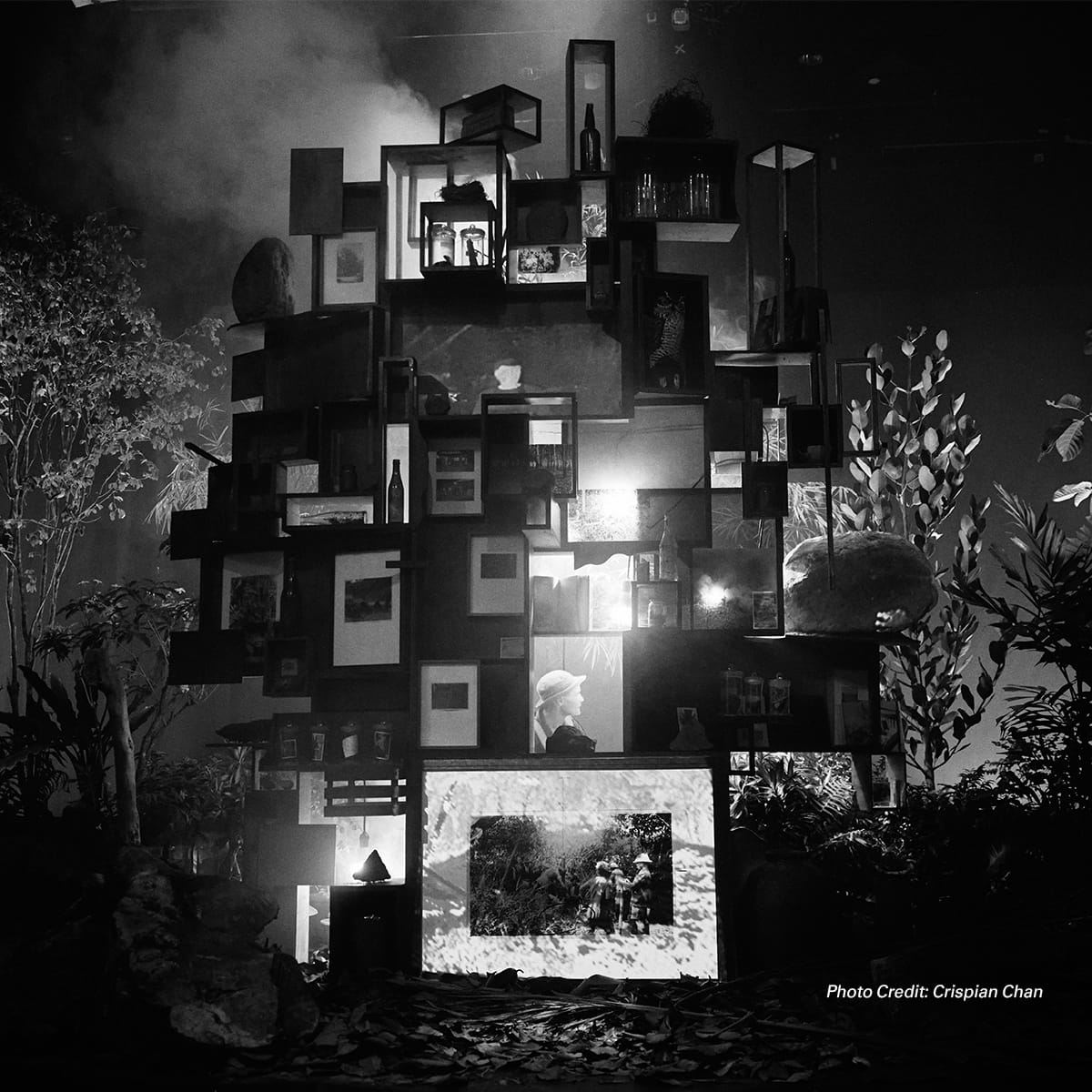
These adjacencies extended across time as well as space. In the closing salon where a panel of artists reflected on the Land Trilogy, Haresh Sharma made an observation that quietly reframed the whole ecology. Returning to Three Years in the Life and Death of Land after nearly thirty years, he noted, was only possible because the work had survived long enough to be returned to. That sounds obvious until you consider that Singapore's theatre scene does not have a strong culture of restaging, of tending its own repertoire as something that deepens rather than dates. We stage foreign plays from thirty years ago without calling them period pieces, but our own work from the same era is more often left behind. To bring back a work from 1994 is an act of deliberate cultivation, a decision to hold the past in proximity to the present when nothing in the ordinary rhythms of the scene would require it.
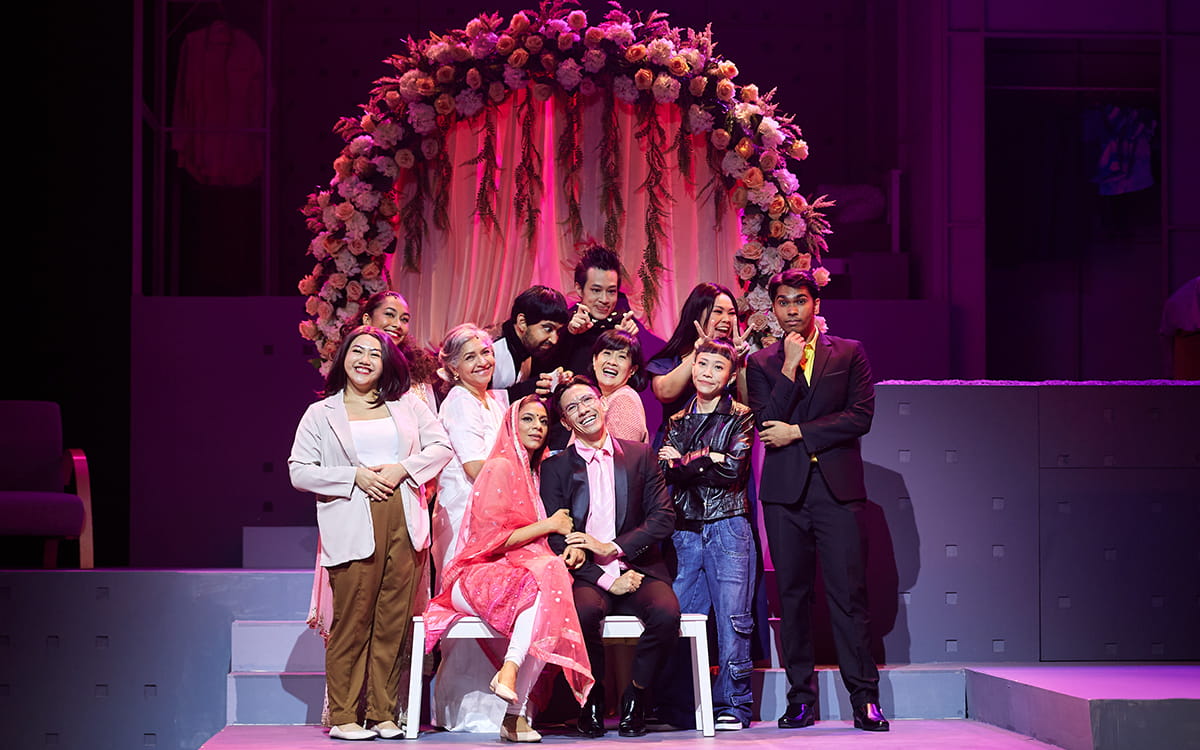
<em>Three Years in the Life and Death of Land</em>, <em>The Studios 2023</em>. Photo credit: Crispian Chan
What the tending revealed, when it came, was how much time had done to the material. Julius Foo, who had played Lionel Lim in the original production, was now genuinely Lionel Lim's age. The Necessary Stage had just lost the Marine Parade space it had occupied for twenty-one years. The land the play circles around, as property and commerce on one side, as memory and belonging on the other, had only become more contested, more layered, more urgently itself. Drama Box's Air, developed from the earlier Tanah•Air, returned to the Orang Seletar's stories: years of relationship, a community's history handled with care across multiple iterations, deepened rather than replaced. These were not archival gestures. They were acts of reactivation, of asking what a work means when the ground beneath it has shifted.
The artificial biome was never intended to displace the local ecology from which it drew. The trilogy's reach outward, internationally, across disciplines, beyond the usual theatre-going community, was always also a reach inward: toward the specificity of this landscape and these histories, toward the local repertoire as something worth returning to, toward the question of what Singapore theatre can mean when held against a wider frame. The unnatural horizon is not an imported skyline erected over unfamiliar ground. It is a constructed vantage point that makes familiar ground newly visible.
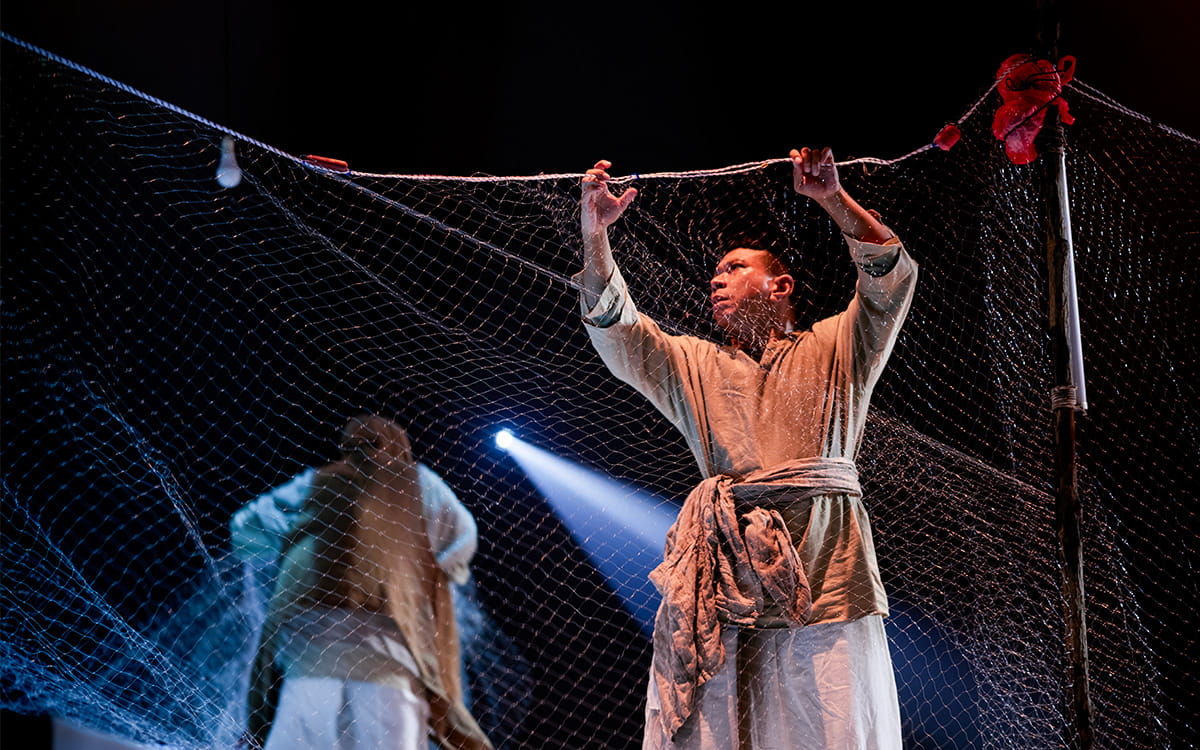
<em>Air</em>, <em>The Studios 2024</em>. Photo credit: Crispian Chan
The work of programming for the trilogy goes beyond the commissioning of the various productions. What is less visible is the pulling-together of works, the weaving of narratives, the shaping of arcs and relationships. Instead of creating the world inside a piece, the programmer tends the frame within which these worlds sit. The framing matters because it names something the local theatre ecology knows well without often discussing directly. Artists and companies arrive at a season with their own frameworks, their own institutional rhythms and accumulated sense of what a commission asks and gives. The relationship between programmer and artist is not adversarial, but it is not symmetrical either, and seasons can default toward the transactional when the structures around them reward delivery over dialogue. What the trilogy reached toward, at its most ambitious, was a different kind of exchange: one where the season was a shared inquiry rather than a context for presenting finished work, where the programmers were as much researchers and interlocutors as commissioners, and where artists understood themselves as participants in a conversation that exceeded any single production.
Whether that was achieved consistently, across three years and a wide range of relationships with very different histories, is a question the trilogy leaves open honestly. What is clear is that when it worked, it changed what was possible inside the works themselves. The more interesting challenge for future iterations is how those conditions of mutual tending can be created by design rather than depending on individual openness to the risk.
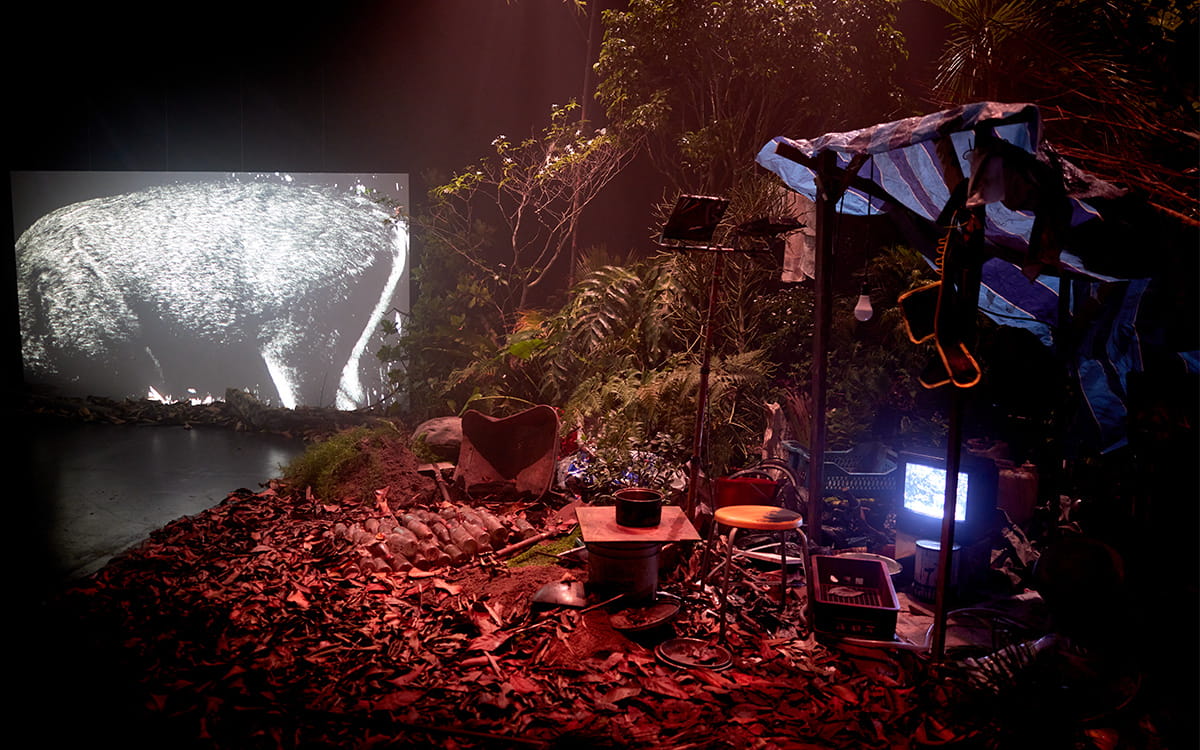
<em>ALBIZIA – An Immersive Performance Installation</em>, commissioned by Esplanade – Theatres on the Bay as part of <em>The Studios 2023</em>. Photo credit: Crispian Chan
The companion programmes are the clearest expression of the trilogy's tending logic. Shireen is explicit that they were intended to be as significant as the productions. They constitute a kind of understorey operating on a different layer under the canopy of productions within the dome, adapting to the contexts created by the shows, and creating conditions that nourish the audience’s experiences beyond the theatre. They fill the gaps that individual works could not cover and extending the season's themes into modes of attention that theatre alone cannot produce. Seasons can reduce companions to outreach dressed as conversation, events that signal engagement without producing it. The trilogy pushed back against that reduction by insisting that companionship is not garnish. It is structure.
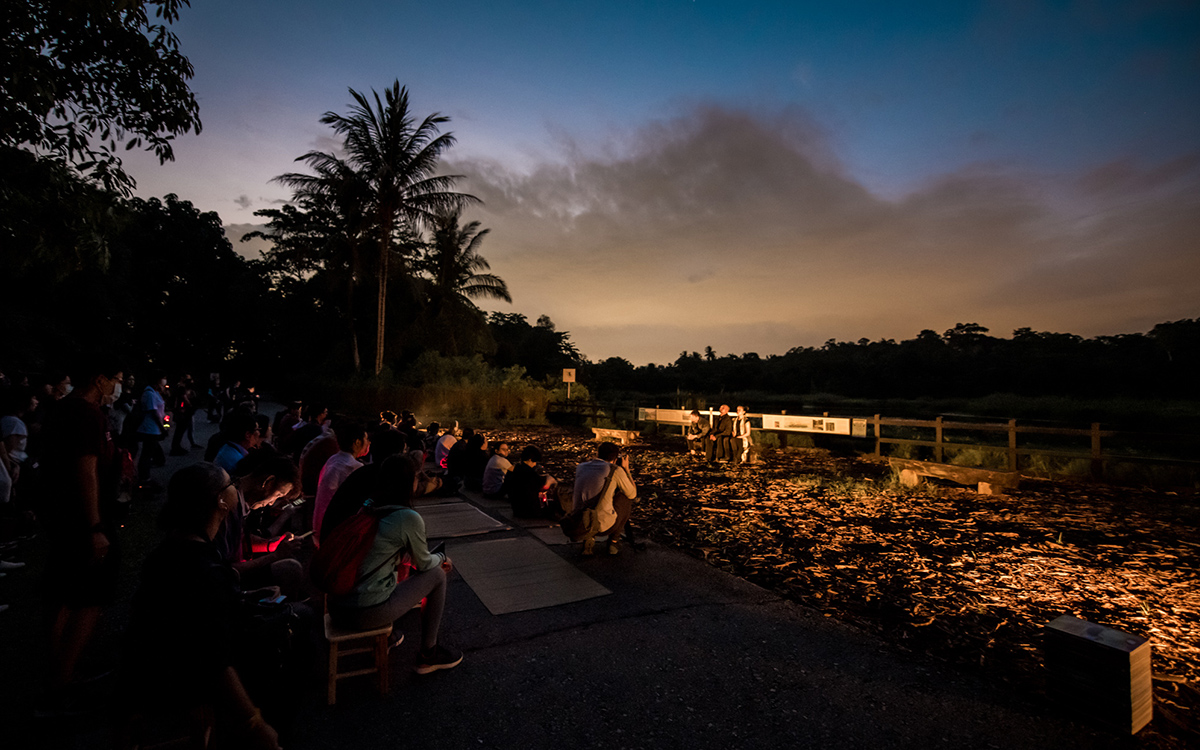
In 2023, this ambition generated a multifarious set of companion programmes that extended the horizon of each production: a foraging tour of Sungei Tengah countryside, a secondary forest walk at Gillman Barracks, a promenade writing workshop around Marina Bay, and a birdwatching session at Choa Chu Kang at 6.30pm on a Saturday to watch long-tailed parakeets roost. The last of these is worth dwelling on. It is, on its face, a strange offering for a theatre season: audiences paying to stand in a suburban residential precinct without any guarantee of a curtain call. What Robert Zhao offered, guiding the group, was a frame. The long-tailed parakeet has been roosting in these trees since the British colonial period, experienced by most residents as noise, understood by a visual artist researching secondary forests as evidence of a co-existence the city rarely names. At some point, a tree is just full of green parrots. Without someone who is simultaneously an artist and a researcher, it remains exactly that. With one, the suburb crowds the foreground, the background falls away, and land becomes present again not as property but as relation.
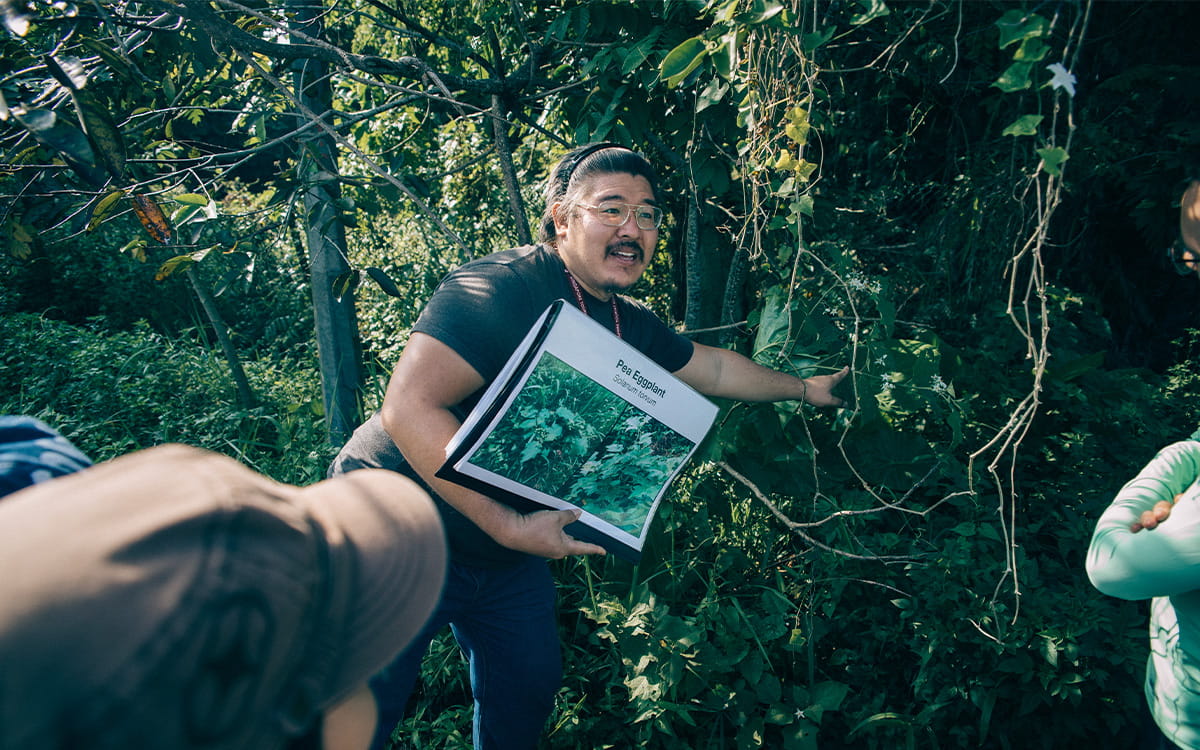
<em>Walking Tour with Esmonde Luo: An Introduction to local wild edibles</em>, <em>The Studios 2023</em>. Photo credit: Danial Halim
This is what the companion programmes at their best were doing: tending attention. Not attention as consumption, where an audience receives information about a subject, but attention as a practice of care, a willingness to stay with what is ordinarily managed into invisibility. The ink-making workshop at Pasir Ris Beach in 2025 asked participants to forage ethically for earth pigments, to make something from the site and return it. The Orang Laut coastal walk placed descendants of the Southern islanders on ground that carries their family memory and very little by way of official recognition. The pickling workshops for Pickle Party asked participants to handle live culture, to consider fermentation as a form of preservation that works with rather than against the organic world. When you have stood in a secondary forest as someone explains tropical succession, the word biodiversity in a press release means something different. When you have foraged for pigment at a beach, the phrase "human relationship to land" has a smell.
These are curated experiences, designed and intentional, artificial in precisely the sense that Shireen's terrarium was artificial. But artifice, thoughtfully tended, can produce a quality of presence that neither performance nor panel discussion alone can reach. The point is not to pretend otherwise. It is to understand that the constructed horizon, held open with enough care, can shift what becomes visible from inside it.
In the closing salon of September 2025, held in a room built on reclaimed ground, the gathered artists, producers and audience were asked to look back across three years and account for what had accumulated. Lynn described the experience of seeing all three years' worth of flyers on a wall: every title, every image, every name thrown onto one surface at once. What might otherwise be remembered as two dozen disconnected events became visible as a constellation, works orbiting the word Land at different distances and in different registers, drawing lines of relation that individual productions could not draw alone.
A constellation is a pattern recognised across distance, dependent on repeated looking, which is to say, dependent on time. Some of those relations were invisible to any single audience member, living in the season's meta-structure, in the programmers' heads, in conversations between artists who attended each other's work. But some became visible through accumulation. The Orang Seletar's understanding of homeland as including the surrounding water, which, by Fault Lines, had become a prism for the season's expanding geography. Koh Heng Leun's observation that a scene in Air, almost comic in its original 2019 staging, a woman casting a net across a maritime border and a police boat telling her to stop, had become by 2024 a scene of separation so raw it could barely be looked at directly. The season did not produce that shift. But it had tended the conditions under which the shift could be felt.
Charlene asks, with the particular honesty of someone who has moderated enough salon conversations to distrust easy answers, whether the hoped-for thickening of attention and meaning that a multi-year season promises actually happens or remains an assumption. The trilogy does not answer this definitively. The season traveller, Lynn's phrase for the ideal audience member who follows the full arc and understands the parrot walk and the panel and the production as facets of a single inquiry, remains a figure more aspired to than counted. The challenge of discoverability is real. Even a well-tended constellation is invisible at the ticketing interface if the infrastructure does not make adjacency legible at the point of entry.
But perhaps the vanishing point has already shifted in ways that are hard to count. The season's lines of inquiry do not end at the closing salon or the final curtain. They continue in the artists who watched each other's work and found their own practice altered by the proximity. In the audience members who stood at Choa Chu Kang at dusk, and can no longer look at a suburban tree quite the same way. In the questions the trilogy has seeded in the ecology it drew from: about what a season can be, about how the local repertoire might be tended over time, about what kinds of attention are possible when a programme commits to the depth that a single year cannot produce. These are not findings. They are the living matter that the artificial biome has been cultivating, now loose in the broader ecosystem.
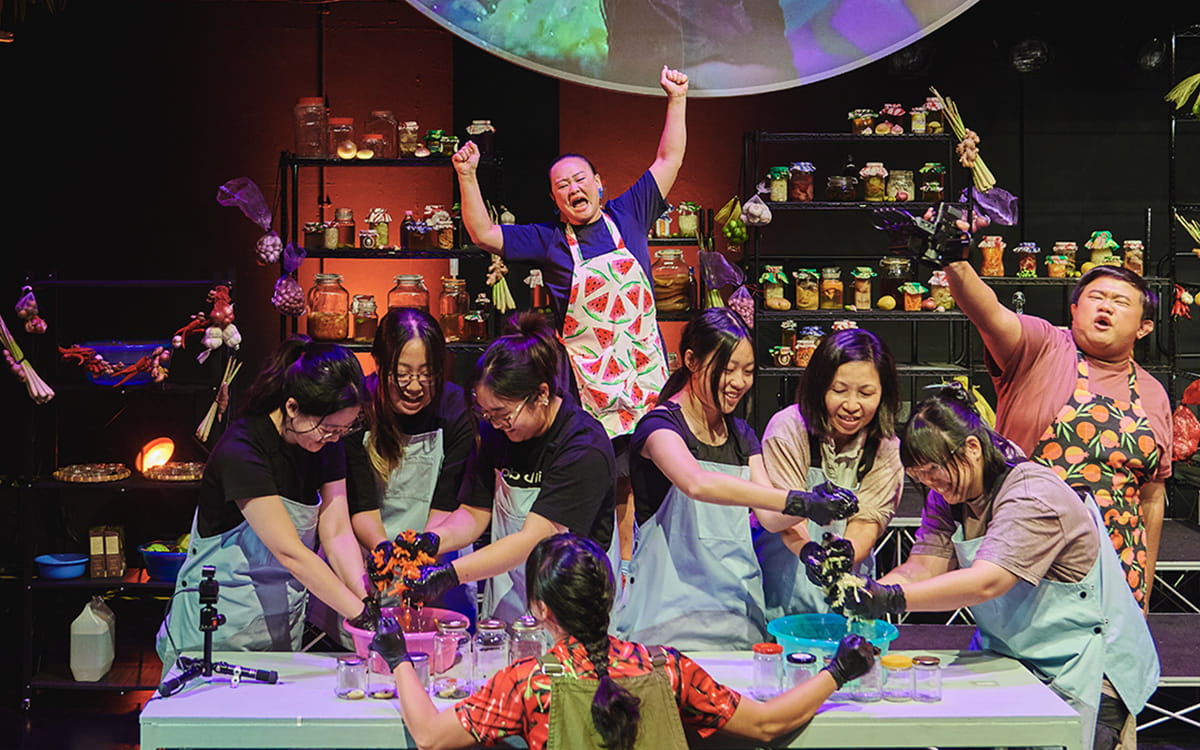
<em>Pickle Party 泡泡菜狂欢也!</em>, <em>The Studios 2025</em>. Photo by Tuckys Photography, courtesy of The Theatre Practice.
What the trilogy leaves, at its conclusion, is less an archive than a changed ground: a vocabulary grown across three years of shared inquiry, relationships prepared for further cultivation, a demonstrated willingness to hold the local and the international, the new commission and the thirty-year-old play, the theatre and the forest, in genuine proximity to each other. The seasons that follow will begin with different soil under their feet. The horizon, already unnatural, is already being tended again.
Contributed by:
Shawn is a dramaturg whose interdisciplinary practice moves across performance, play and critical speculation, attending to how artistic forms might recompose perception, relation, and futurity.