National identity through spectacle and song

Published: 18 Nov 2025

By: Woo Yu Ning

Time taken : ~10mins

Many Gen-Zs would be familiar with Lin-Manuel Miranda’s Hamilton (2015)—which celebrates 10 years on Broadway this year—known for reimagining America’s founding story by spotlighting immigrant narratives and contemporary hip hop influences.
But did you know that there is also a Singaporean musical just as iconic, and even older? That is none other than Dick Lee’s Fried Rice Paradise (1991), which was reimagined by Singapore Repertory Theatre from August to September this year as Fried Rice Paradise – The Makan Party.
At first glance, it appears that Hamilton and Fried Rice Paradise, musicals from two vastly different places, have nothing in common. However, both musicals fundamentally explore the definitions of national identity—defiantly, yet tenderly. This then begs the question: why is it that Broadway or West End productions linger more in our consciousness, than our homegrown productions?
Perhaps it’s the differing domestic market demands, the runways for production available or policies that influence our attitudes towards Singaporean work. But as a young Singaporean, I have long been intrigued by my country’s vibrant histories, the stories I have not yet heard and the people I would never meet.
Local musicals bring them to life for me. From glitzy cabaret singers and the homely fried rice connoisseur to young adults from generations before discerning their life purpose, Singapore musicals are a gateway for us to understand our becoming. Every number captures emotions we have felt before but perhaps haven’t been able to articulate until we witness them on stage, alive through song and dance.
A testament to the longevity of these musicals, the tight-knit theatre community has been lovingly restaging them over the years, imbuing them with renewed cultural significance each time. Some of these stagings are available to watch from now until 31 March 2026, as part of Replay: Screenings from the Esplanade Archives.
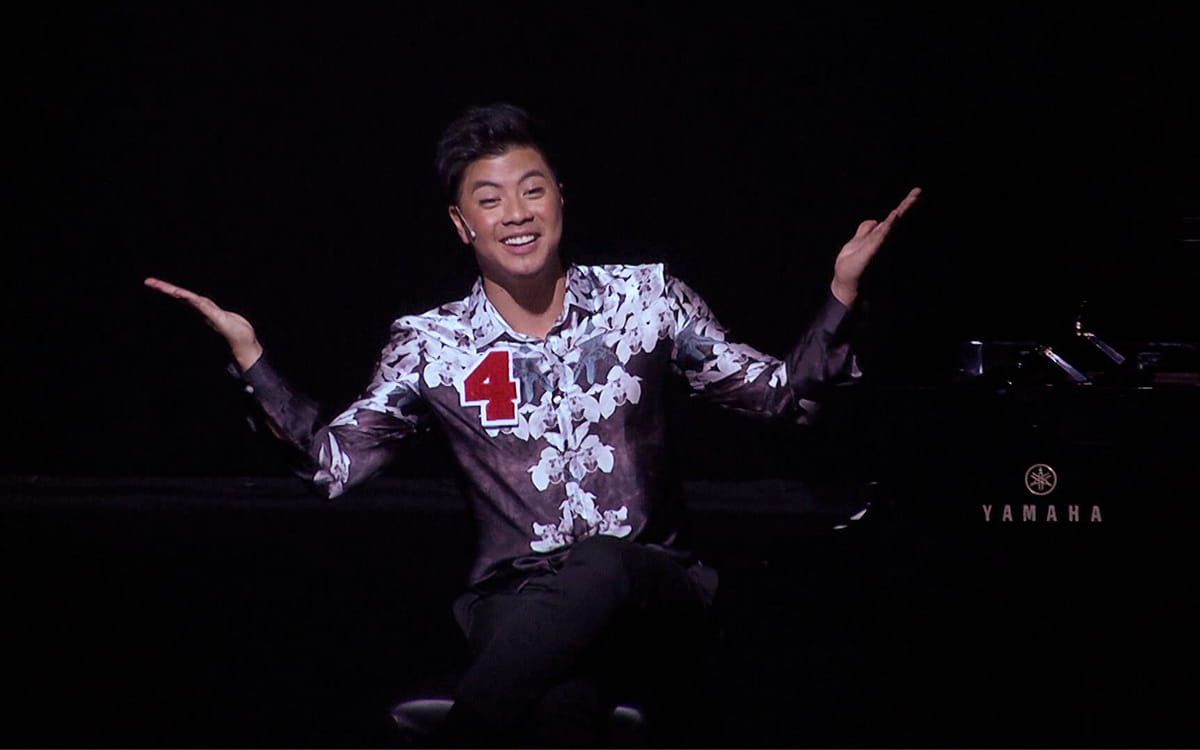
<em>National Broadway Company</em>, 2012 staging, available as part of <em>Replay: Screenings from the Esplanade Archives</em>
In honour of Singapore’s 60th year of independence, here are six of the country’s most significant musicals (according to a Gen-Z theatre lover) that explore what it means to be Singaporean and show how theatremakers have developed their unique expressions of national identity.
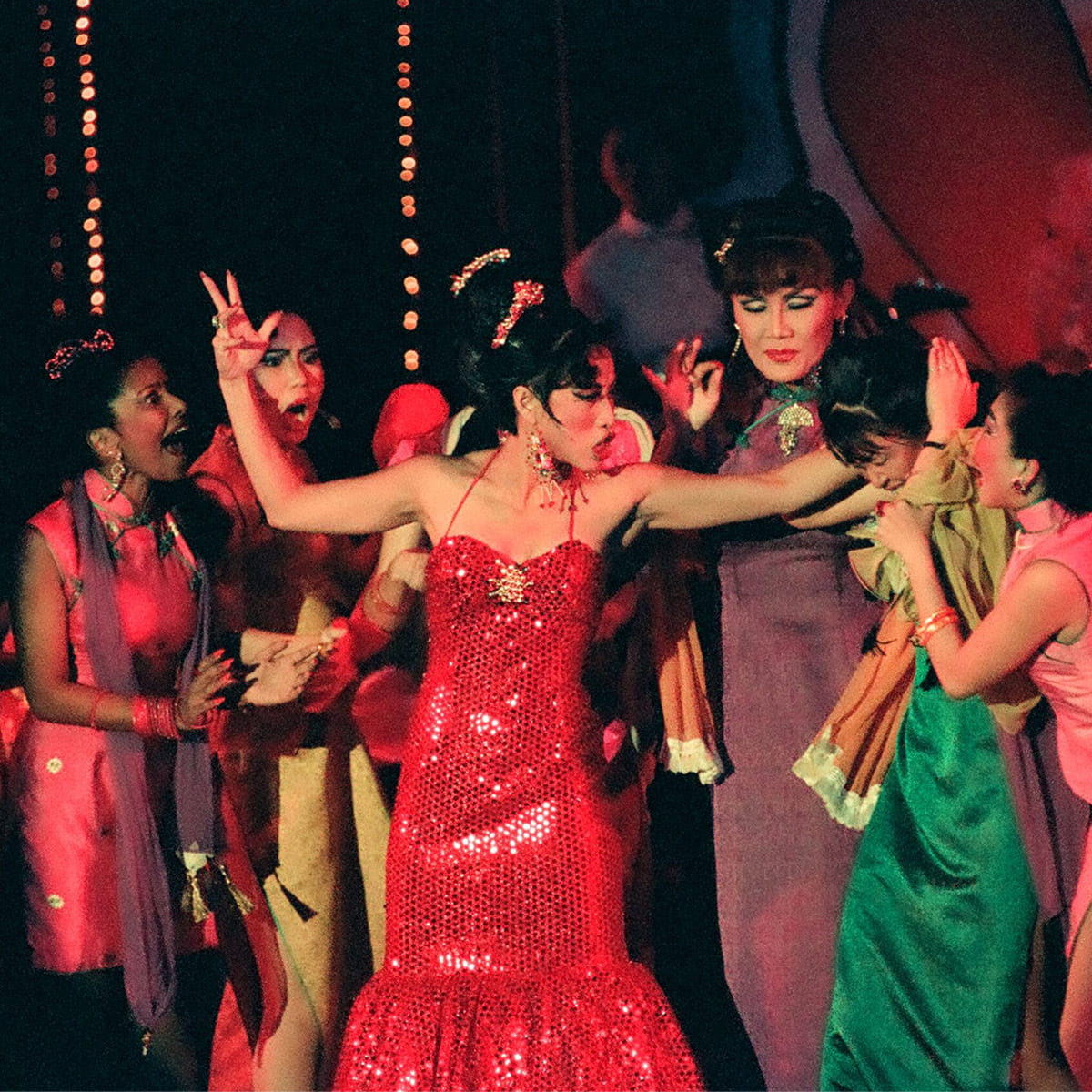
One of the first musicals in Singapore, T:>Works’ (TheatreWorks) Beauty World was written in 1988 by Michael Chiang, directed by Ong Keng Sen, with music composed by Dick Lee. Its reach has been far and wide, with Singapore restagings in 1992, 1998, 2008 and 2015, tours in Japan and amateur stagings by drama clubs in overseas and local universities.
Beauty World is set in a now-forgotten era of 1960s revelry, where go-go dancing and bustling trade fairs abounded. When playwright Michael Chiang was grappling with the question of what a Singaporean musical would look like, he turned to the art form prevalent in the nation’s early years of independence: the black-and-white Cantonese melodramas of the 1960s. Incorporating influences from the East and the West, Beauty World encompasses a melange of styles and harnesses the soul of a vivacious period in Singapore’s history.
A small-town girl from Malaysia, Ivy Chan finds herself in Singapore searching for her long-lost father, with only a jade pendant as a clue. Ivy sets off on a whirlwind journey of multiple revelations, crossing paths with her pen pal Rosemary, various cabaret members and workers at Beauty World, and the vicious yet beautiful main star Lulu.
Despite our distance from this fascinating world, parts of this era still speak to Singapore today: in essence, we are a pastiche of cultural influences, an amalgamation of people and histories, just in a new generation. In revisiting our past, we may find resonance with the narratives of people whose lives we may never live.
And of course, it’s the music that transports us. The opening number, Beauty World (Cha-Cha-Cha), immediately immerses us into the lively, campy spirit of the cabaret company. Even decades after its first staging, this number was performed again at the 2022 National Day Parade, showing its long-standing cultural resonance.
Other favourites include Nothing Gets in My Way, in which Lulu declares a single-minded pursuit of money and glory; No Class, a catty debate between Lulu and Rosemary about the social status of a cabaret singer; and Welcome to Beauty World, featuring the whole cast.
Relive the fun by listening to these numbers in excerpts of Ong Keng Sen’s National Broadway Company (2012), a jaunt through the songs and stories behind early Singapore musicals, released through Replay: Screenings from the Esplanade Archives.
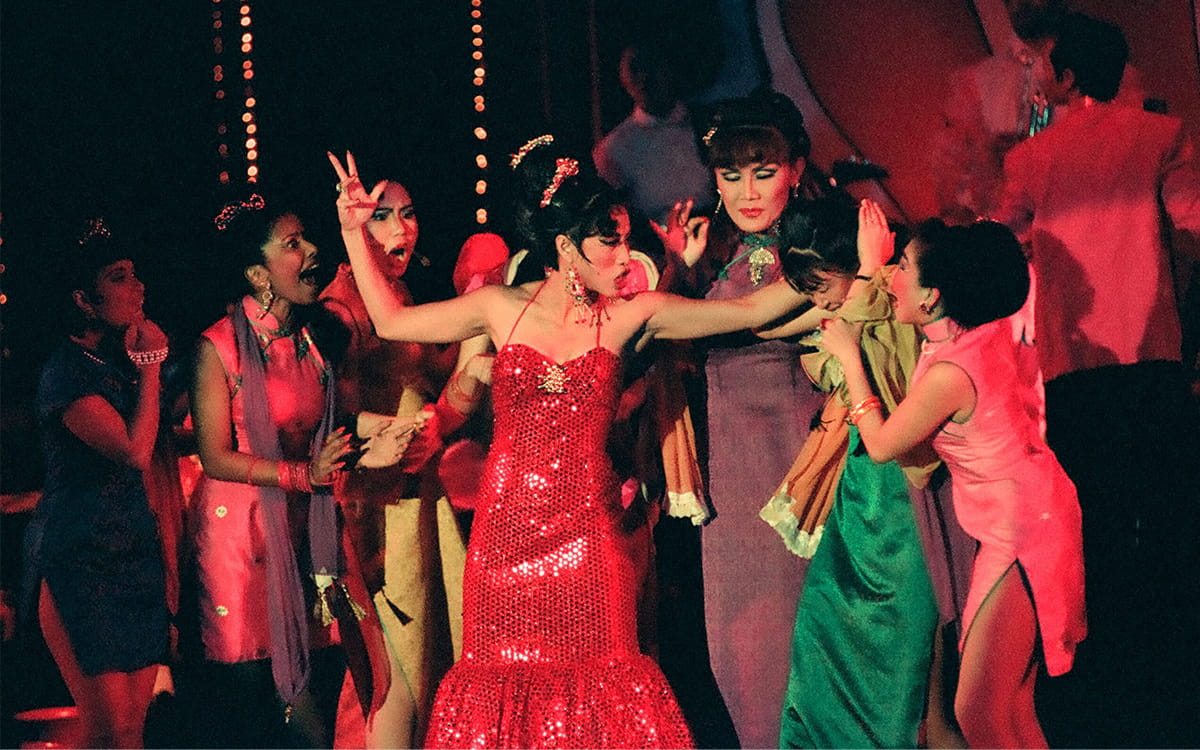
<em>Beauty World</em>, 1992 staging, T:>Works Archive
T:>Works’ Fried Rice Paradise—directed by Ong Keng Sen and composed by Dick Lee—was first staged in 1991 and restaged in 2010. In August and September this year, it was reimagined by Singapore Repertory Theatre as an immersive performance and dining experience titled Fried Rice Paradise – The Makan Party, written by Thomas Lim and directed by Danny Yeo.
The journey of Fried Rice Paradise’s cultural recognition has been an intriguing one. Initially conceived as a song by Dick Lee in 1974, it was banned upon release due to its copious use of Singlish and associations with discotheque culture, which the government wanted to curb in the 1970s. Over the years, Fried Rice Paradise has been reclaimed as a kind of “rebellion anthem”, a demonstration of Singaporeanness as resilience and pride. The history of Fried Rice Paradise will appeal to those of us keen to understand how changing social policies in Singapore have impacted the development of our national identity and theatre scene.
The plot of the musical has also undergone revamps to fit the changing concerns of each decade. In the 1991 staging, Bee Lean, the owner of her fried rice chain, is looking for her successor between her two daughters, and a culinary fight ensues. In 2010, the anxieties of modernisation looms over the plot, and Bee Lean is now faced with the race to save her small, homegrown business, amidst the threats of fast-paced urbanisation.
Possibly the most memorable number is Fried Rice Paradise, an upbeat, sizzling track peppered with familiar Singlish slang. Watch Benjamin Kheng as Dick Lee perform the song in National Broadway Company.
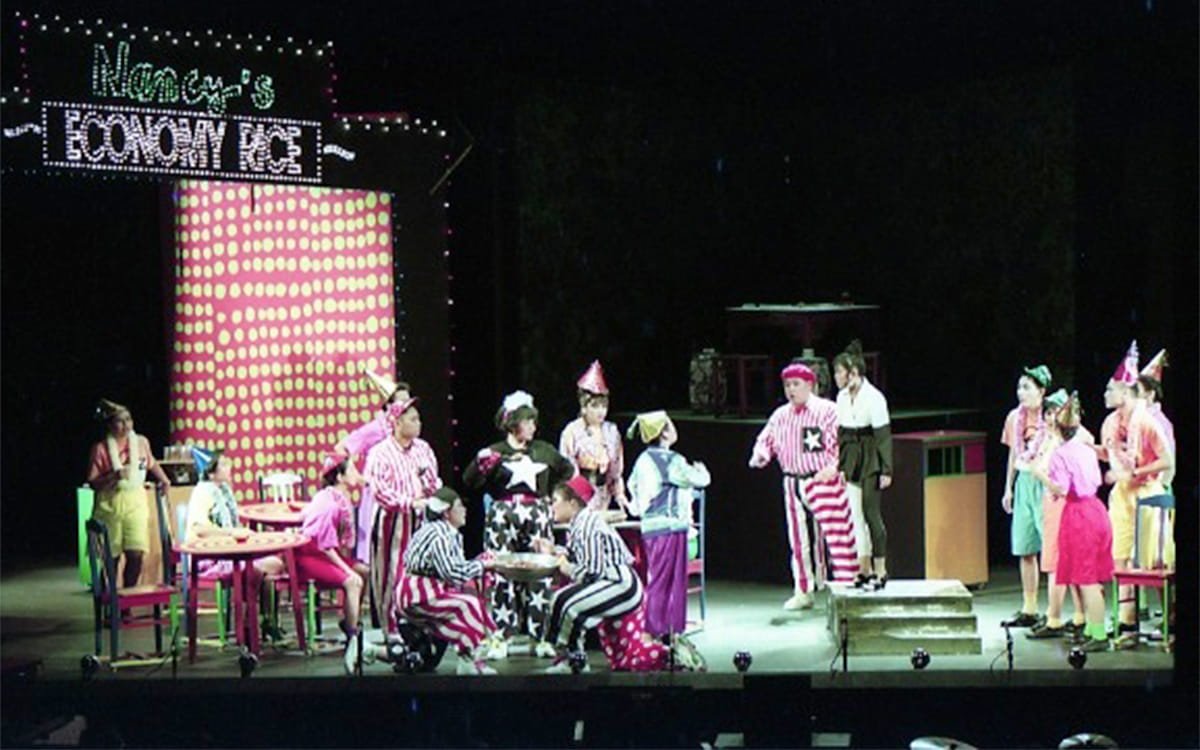
<em>Fried Rice Paradise</em>, 1991 staging, T:>Works Archive
December Rains《雨季》was the first Broadway-style Chinese musical in Singapore, staged by Brink Creative Company in 1996 and directed by Alec Tok. It was restaged by Toy Factory Productions later in 2010 and 2015 at the Esplanade Theatre, under the direction of Goh Boon Teck.
Written by Liang Wern Fook, one of the pioneers of xinyao (Singaporean Chinese folk songs), and Jimmy Ye, December Rains follows protagonists Ying Xiong and Li Qing’s romance across time, set against the 1950s backdrop of student political activism and social unrest post-Japanese Occupation. It’s especially a poignant reminder to the youth of any generation that their voice has power.
Its most memorable and moving number has to be《请你告诉他》(Please Tell Him), a soaring duet between Ying Xiong and Li Qing that reveals their feelings for each other. When we hear this song, we bear witness to their missed years and opportunities, against the veil of soft, misty rains.
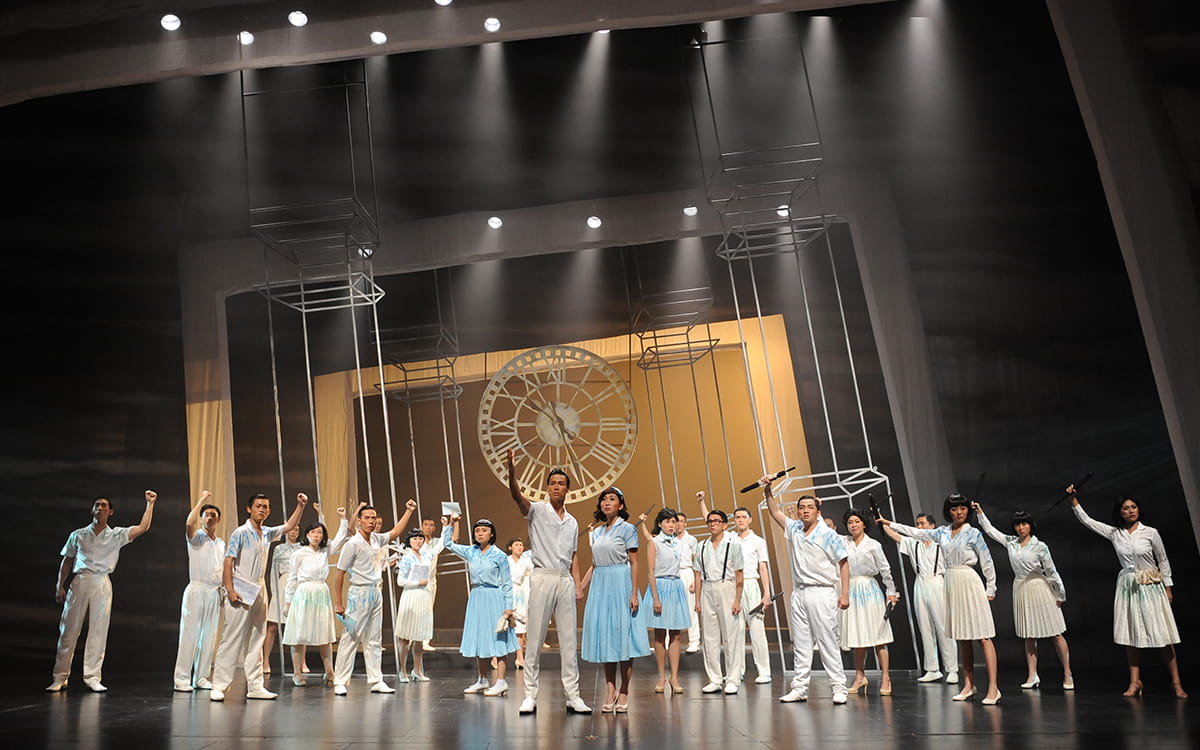
<em>December Rains</em>, 2015 staging, Toy Factory Productions
This is an example of a Singaporean musical which does not root itself in an explicitly Singaporean subject matter. It was first staged in 1997 by ACTION Theatre and directed by Ekachai Uekrongtham, with music by Ken Low. It was subsequently restaged every year between 1997 and 2002.
It represents a feature of Singaporean musicals, in which subject matters are diverse and resonate beyond nationality. It was also the first English-language musical to be performed in China, which speaks to its universal quality.
The musical follows Chang and Eng Bunker, a pair of Siamese twins, and opens in 1829, when the twins are taken to New York to be exhibited as a spectacle. Accompanied by flashbacks to their childhoods, the twins navigate experiences of alienation due to their physical condition, and the conflict between their homeland and assimilation into America.
The song Mai Phen Rai (Never Mind) has been a crowd favourite since its first staging. Sung by the twins’ mother to comfort her sons, the song is a gentle, soothing ballad of reassurance which has prevailed through the years.
Another Singapore production that explores a foreign subject, Forbidden City: Portrait of an Empress by Singapore Repertory Theatre depicts the life of the Empress Dowager Cixi. The play was commissioned by Esplanade and performed at its Opening Festival in 2002. Forbidden City was developed by director Steven Dexter, with music by Dick Lee and Stephen Clark, and restaged in 2003, 2006 and 2017.
Having been subjected to scrutiny and controversy her whole life, Empress Cixi commissions Kate Carl, an American painter, to complete her royal portrait. The two women unexpectedly find a connection across their different backgrounds as they deal with love, loss and betrayal.
Kit Chan has starred as Cixi across all restagings, exuding a cool, regal charm balanced with moments of vulnerability and humanity. The 2017 restaging also brought in names like Earl Carpenter (West End) and Steffanie Leigh (Broadway), which made for a truly East-West fusion of musicality and storytelling.
Forbidden City is for anyone who loves a good drama and iconic women in history—you’ll understand the enduring impact of the Empress Dowager to this day.
The music of Forbidden City ranges from the energetic opening Dragon Lady, laden with gossip about who Cixi really is, to the emotional number My Only Chance, revealing young Cixi’s plea to be seen and loved.
Watch Julia Abueva as Emma Yong perform her rendition of My Only Chance on National Broadway Company too.
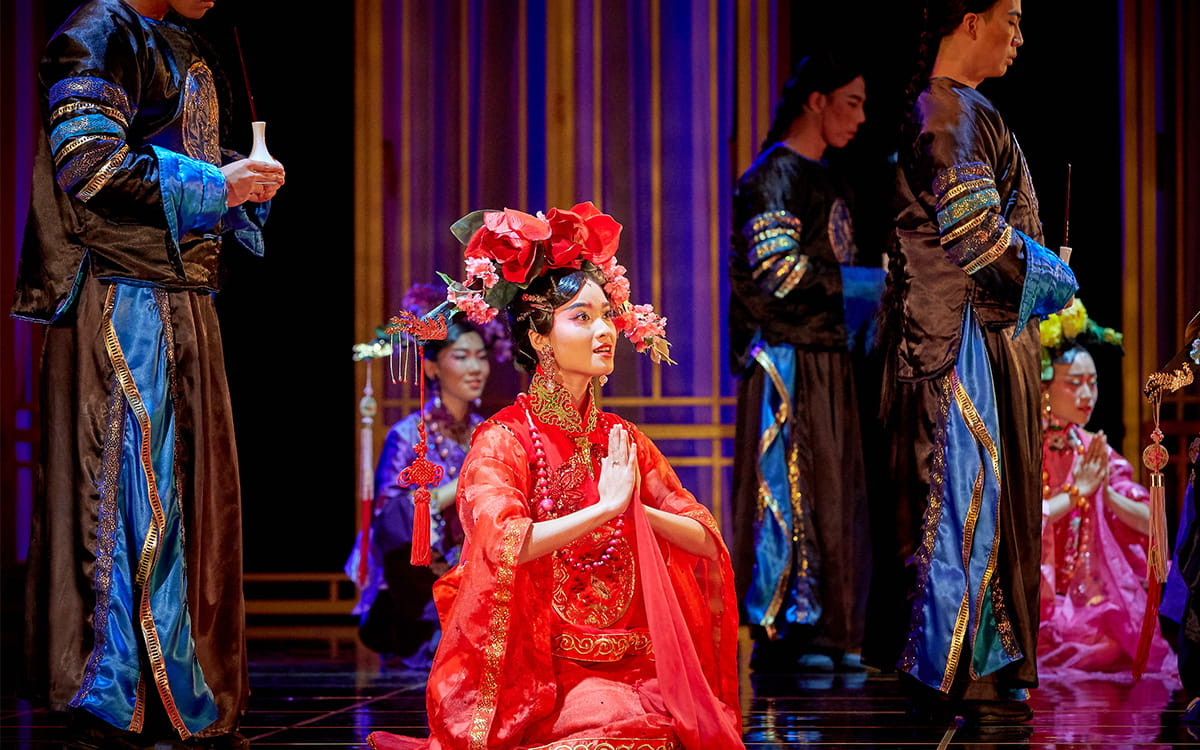
<em>Forbidden City</em>, 2017 staging, Singapore Repertory Theatre
Written first as a play by theatre veteran Kuo Pao Kun, Lao Jiu was adapted into a musical in 2005, 2012 and 2017 by The Theatre Practice. It was directed by Kuo Jian Hong, with music by Mandopop composers Xiaohan and Eric Ng.
Lao Jiu translates to being the ninth-born in the family. Here, the titular protagonist is caught between taking up a prestigious scholarship to lessen the financial burden on his family and pursuing his aspirations of traditional puppet making.
The themes continue to resonate today: an age-old conflict between the head and the heart, practicality versus passion. In the fast-paced, rat race of Singapore, success is often a narrow and rigid ideal, and the musical is a balm for fretted youth anxious over life decisions that lie before them.
Lao Jiu: The Musical will be restaged by The Theatre Practice in April 2026. You can also take a peek at Lao Jiu’s musical highlights, a wonderful medley of beloved musical numbers from the 2017 staging.
Singapore musicals hold a mirror up to the country’s development and the changing concerns of our people. Their many restagings over the years is a marker of the immense reception to these timeless productions.
As a young person navigating my own life, watching these productions connects me to both a Singapore I’ll never live and a Singapore that is still becoming. It’s heartening to know that I can always look back on these musicals for a sense of belonging and hope for the future.
If you’ve caught the musical bug, check out Homegrown to the World and Musical Theatre Open Mic, part of Voices – A Festival of Song 2025 happening 4–7 December.
Contributed by:
Woo Yu Ning is an English Literature major at Nanyang Technological University. When she’s not tackling her never-ending reading list, she can be found biking through Singapore.
Warm up your vocal cords
Journey with song as we connect with one another through the beauty of vocal music!