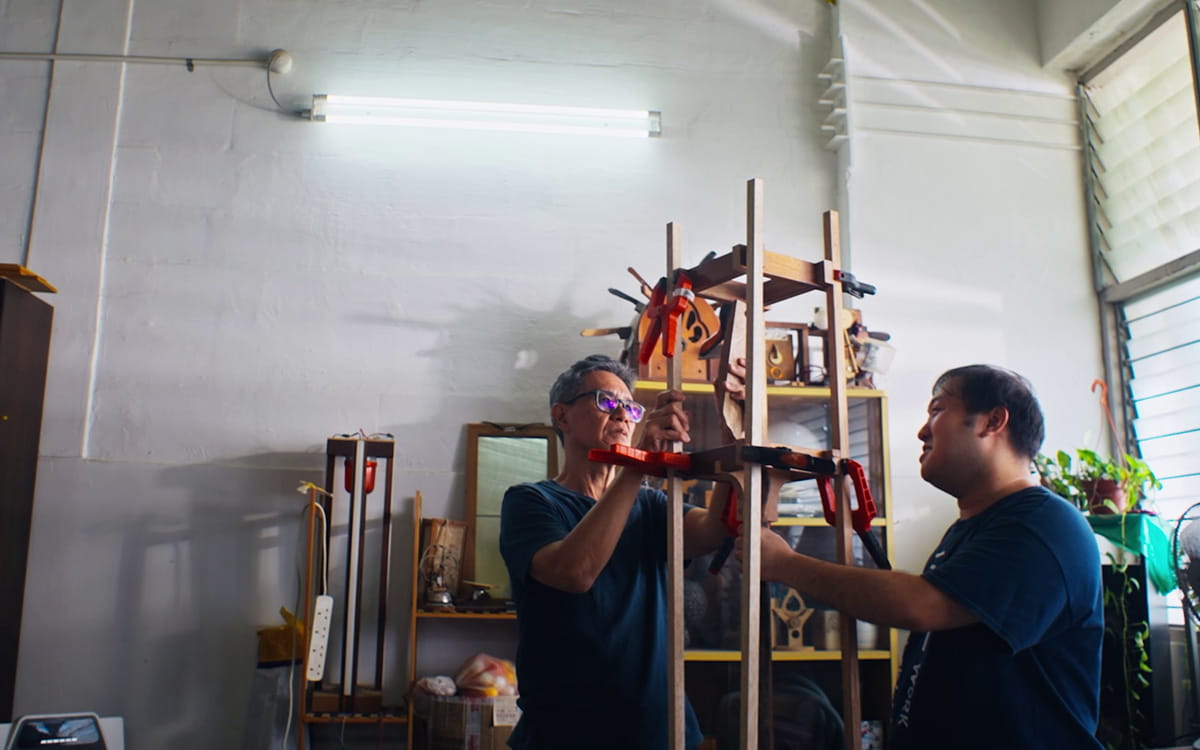
Small steps towards sustainable art-making

Published: 11 Jul 2025

Time taken : ~10mins

We feel the heat. We’ve seen the headlines. It is easy to relegate the climate crisis to background noise, just because it seems so overwhelming.
The amount of information available on rising global temperatures and environmental issues is daunting and continues to grow each day. However, as Timothy Morton writes in his book All Art is Ecological, “The problem with ecological awareness and action isn’t that it is horribly difficult. It is that it is too easy."
“
”
Timothy Morton
As a writer and theatre-maker, I believe there is a need to consider the ecological impact of the process of art-making in general. Many sets, costumes and other design elements are effectively single-use. They are made specifically for one production, and are discarded or kept in storage when the show closes. Likewise, few theatre practitioners consider the cost and carbon footprint of the electricity a production requires.
Sustainable theatre-making becomes more of a priority when the content of the production is themed around the environment or the climate. Hence, reviewing this genre of productions allows practitioners to find actionable steps for all theatre to move forward.
One cannot implement what one does not know or does not understand. It can be challenging for practitioners who do not feel well-versed in the subject matter to navigate through the data and the jargon.
Yet, credit must be given for those who try. When Ellison Tan was asked to direct Scenes from the Climate Era, she had her reservations. “Climate-related artistic work can be quite alienating, even more so when it takes on a moralising tone,” says Tan. “When I first read the script, I found that I couldn’t really feel for it.”
David Finnigan’s script follows ordinary people dealing with the fallout of the climate crisis—from conversations between a couple on having children to scientists implementing environmental stopgap measures. Working with Tan to adapt it for a Singapore audience, Finnigan creates a new edition of Scenes from the Climate Era that distils large challenging ideas into everyday moments with urgency and sensitivity.
Tan looked up various terms and jargon in the script and went down online rabbit holes, reading various books and watching several documentaries, especially if they were repeatedly referenced across sources. “I wanted to collect as many voices as I could,” she adds.
Indeed, to write the play, Finnigan himself had conversations with everyone from disaster risk specialists to green investors to climate deniers. In a Substack post, he says that he wrote it in the form of “a script of choruses speaking from all the disparate corners of the climate sphere”, with over 60 snapshot scenes.
Prior to writing Playing with Fire (2024), my debut play and an intimate look into Singapore’s petrochemical industry produced by Checkpoint Theatre, I interviewed employees of oil and gas companies about their jobs, their day-to-day lives, and their opinions on the current climate crisis.

<em>Playing with Fire</em>. Photography by Joseph Nair. Courtesy of Checkpoint Theatre.
The research may be easy for some and stressful for others. It might prove easier to look around and work with familiar people and resources in new ways.
Prior to the Covid-19 pandemic, director Ellison Tan started shopping at The Fashion Pulpit, a social enterprise focused on promoting environmental awareness and education through clothes swaps. Tan realised her wardrobe was filled with items she rarely wore and only bought because they were on sale.
“Since my relationship with The Fashion Pulpit began, I’ve also had a different and hopefully healthier approach with my fashion choices,” Tan says. So, she reached out to them to provide the costumes for Scenes from the Climate Era.

The Singapore cast of <em>Scenes from the Climate Era</em> during a rehearsal. Photography by Yuk Wong.
Apart from reaching out to sustainable businesses, redefining working relationships could also prove effective. Most arts workers are freelancers and their work is often defined by project-based contracts. This is where theatre-maker Elizabeth Mak of Rainshadow Studios, a climate arts non-profit, believes conversations on sustainability can start.
Similar to terms on workplace safety and wellbeing, including a sustainability clause sets the intention at the very beginning to keep sustainability in mind throughout the creative process.
“If sustainability is important to you, in every contract with people you work with, you [bring it up in conversation:] ‘these are the sustainable practices that we have’, or ‘if we work with you as a set designer, we ask you to think about the materials, we ask you to creatively brainstorm with us to how [on] do things differently’,” Mak explains.
Being resourceful and creative in ways one is familiar with can make conversations between collaborators accessible for all. This can set the foundation for the theatre industry to dream bigger (and greener).
Beyond knowledge acquisition and reviewing current relationships, some practitioners may choose to be more ambitious. They then bring out the recycled plastic, the upcycling structures, alternative lighting and sound sources, and more.
Scarce City, created by Mak, is an interactive experience built around the concept of doughnut economics—an economic theory that details how the overuse and underuse of natural resources can be disastrous for society and the climate.
Scarce City, which ran at the National Gallery Singapore in early 2025, consists of two general sections. The first takes you into a 3D-printed plastic cave, where lights appear for you to catch. Your goal is to make the world as blue as possible. The second is a facilitated discussion about the experience and the assumptions that people made about the relationship between catching the lights and turning the world blue.
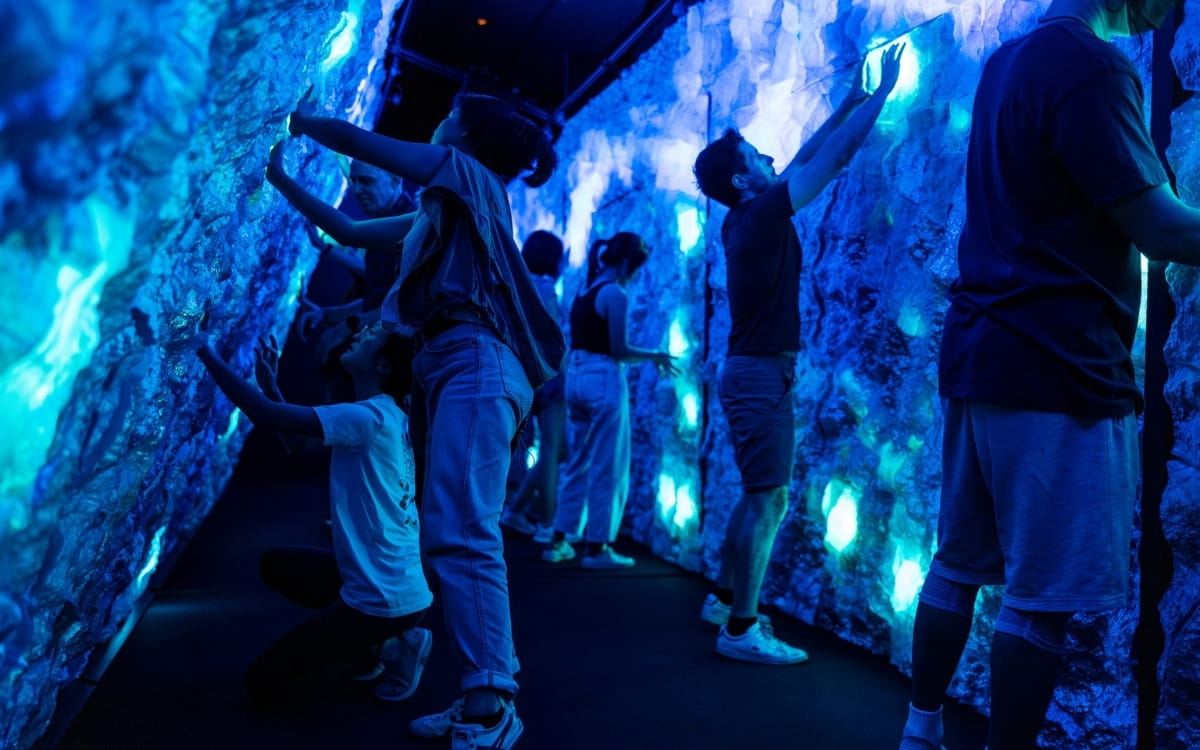
<em>Scarce City</em>. Photography by CRISPI. Courtesy of Rainshadow Studios
Building Scarce City with sustainability in mind consisted of a lot of trial and error. Eventually, Mak built the experience modularly, allowing it to be installed in various permutations across different venues, limiting single-use designs and materials. Using recycled plastic in the 3D-printed cave walls reduced the amount of new material needed for the project.
Mak is also working on a sustainability report to do a stocktake of Scarce City’s environmental impact, and allow her and her team to reflect on how they can continue to reduce waste and energy for future iterations and projects.
Taking a different and more organic route, scenographer Tanja Beer brings the process of fermentation to the stage of Pickle Party by creating a set consisting of jars upon jars of fermenting pickles. At an upcoming public programme, Pickle Party: Building the “Set”, she, together with Ang, will lead participants through the process of pickling food and these jars will eventually be integrated into the stage design. Beer also teases, saying that the audience can have a “nibble at the stage”, cheekily referencing a point in the performance where audience members will be offered pickles from the jars to consume.
Presenting an organic, edible and biodegradable set onstage allows other practitioners to reimagine their relationships with stage design, fabrication and disposal of sets. Having audiences construct part of the set taps into an underappreciated pillar of sustainability: community involvement. Many hands make light work. By turning their manpower challenge of pickling food into an opportunity for wider community engagement, The Theatre Practice might reap many unforeseen rewards for future projects.
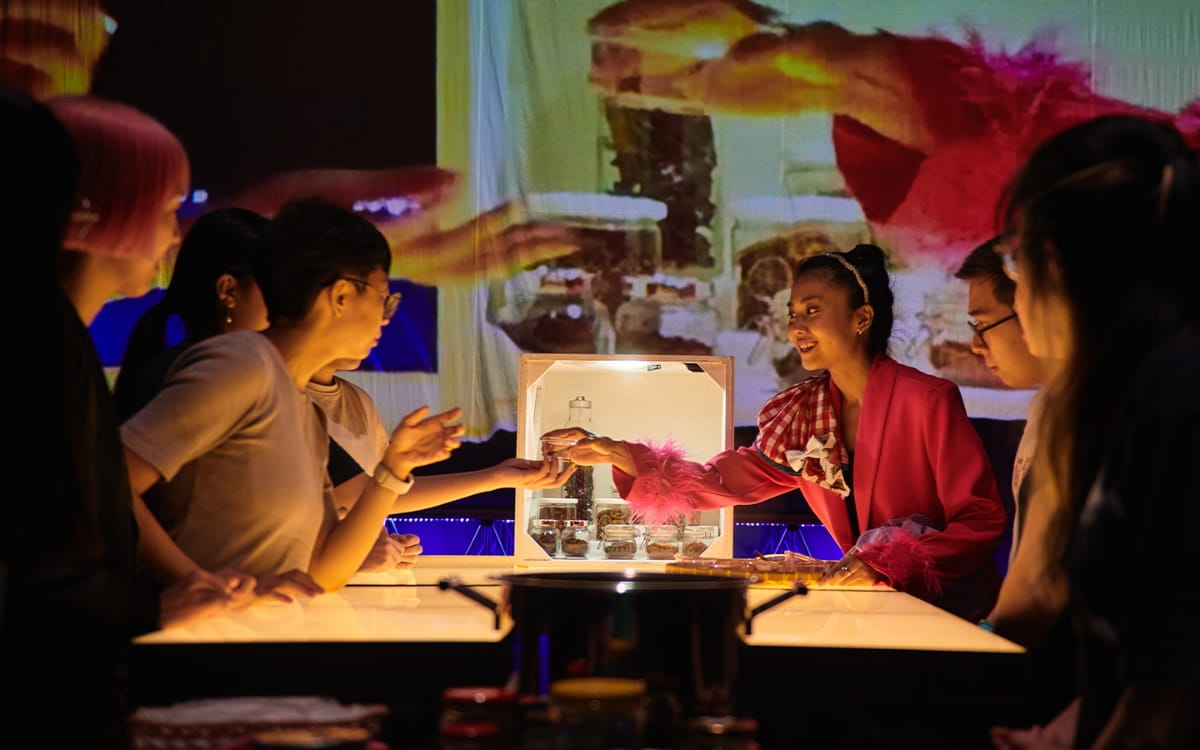
<em>Pickle Party</em> BTS. Images taken from a closed-door work-in-progress showing in 2023. Photography by Tuckys Photography. Courtesy of The Theatre Practice.
When discussing the climate and sustainability, many are intimidated by the amount of work they feel that they must do. This is a sentiment that is not limited to theatre alone; regardless of the industry they are in, many people want to do sustainability the correct way. The perfect way. That leads to paralysing inaction.
All the abovementioned practitioners admit in one way or another that they are not experts and their sustainable processes are not perfect. And yet, they continue to put out sustainability practices imperfectly because it is better than doing nothing at all. Their mistakes do not deter them from trying, adapting and reimplementing new eco-friendly methodology.
It is important to remember that ecology is the study of relationships in the natural world. While the examples in this essay are primarily from eco-centric productions, many theatre practitioners study relationships within their practice regardless of theme or genre. Integrating a meaningful understanding of our relationship with the natural world could be the next step in our artistic practice.
If the theatre industry only practises sustainability when a show is centred on the environment, then those efforts are performative at best. After all, if we are all ecological, as Timothy Morton says, then we better start acting like it.
Catch Scenes from the Climate Era from 18 – 20 Jun and Pickle Party 泡泡菜狂欢也! from 11 – 14 Sep as part of The Studios 2025.
Contributed by:
Cheyenne Alexandria Phillips is a climate artist, writer, theatremaker, and performer. She is also an Associate Artist with Checkpoint Theatre and a Young ASEAN Storyteller. Her recent work include: Playing With Fire (2024), The Last Gardener (The Theatre Practice, 2024), A Literary Trail of Sungei Buloh Wetland Reserve (ASEAN Centre of Biodiversity, 2022), Vulnerable, an eight-part podcast (Checkpoint Theatre, 2021) and A Grand Design (Checkpoint Theatre, 2020). Cheyenne is also a licensed tour guide and runs a spoken-word competition called Outspoken.