Lee Hock Moh

Jaafar Latiff

Iskandar Jalil

Ho Ho Ying

Han Sai Por

Anthony Poon

Goh Beng Kwan

Ang Ah Tee

Georgette Chen Liying

Foo Tee Jun

Amanda Heng

Khor Ean Ghee

Foo Chee San

David Tay

Chua Mia Tee

Chua Ek Kay

Choy Weng Yang

Constance Sheares

Chong Fah Cheong

T. K. Sabapathy

Sim Tong Khern

Chng Seok Tin

Lim Hak Tai

Laurence Koh Boon Piang

Chia Wai Hon

Joseph McNally

Sun Yu-li

Sarkasi Said

Pan Shou

Ong Kim Seng

Cheong Soo Pieng

Ng Eng Teng

Milenko Prvacki

Chen Wen Hsi

Loh Khee Yew

Liu Kang

Lim Yew Kuan

Lim Tze Peng

Chen Chong Swee

Lee Sow Lim

Yip Cheong Fun

Yeo Hoe Koon

Wu Peng Seng

Wee Beng Chong

Wang Sui Pick

Thomas Yeo

Teo Eng Seng

Tay Chee Toh

Tay Boon Pin

Tan Swie Hian

Tan Siah Kwee

Tan Lip Seng

Tan Kian Por

Tan Khim Ser

Della Butcher

Earl Lu

TributeSG
Han Sai Por
Singapore’s only dedicated stone sculptor
“When I am working in stone, the immediate contact is physical, the force of hammering, chiselling and drilling hard stone creates heat and energy. The reaction of the particles causes sparks and waves of sound. The appearance of the stone is the result, the consequence of physical reaction. Understanding the character of nature through the physical contact has become part of my sculpture.”
From 'Thoughts on Recent Works by Han Sai Por', Feb 2002, T.K. Sabapathy.
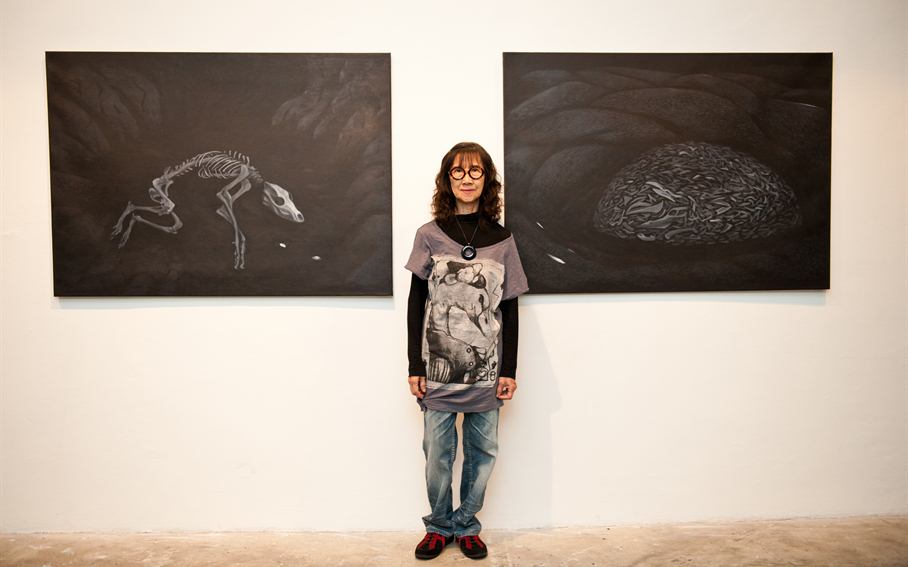
Han Sai Por, born in 1943, is Singapore’s only dedicated stone sculptor, renowned for her nature-inspired sculptures, which communicate a great empathy with nature and exude a gentle, vital spirit.Trained in the fine arts and landscape architecture, the founder of the Sculpture Society (Singapore) and former art educator has works on permanent display at numerous public places in Singapore including the Revenue House, National Museum of Singapore and Changi Airport, and in countries such as Japan, Malaysia, UK and USA. In 1995, she received the Cultural Medallion and in 2006, the Outstanding City Sculpture Award, China.
Han Sai Por was born into poverty during the Japanese Occupation on 19 July 1943 in Singapore, one of six children whose parents were so poor that the family lived as illegal squatters in a makeshift hut made of cardboard boxes and coconut leaves in Changi, with her mother scavenging to make ends meet. In spite of their poverty, Han enjoyed her childhood very much. The nearby Changi beach became her playground and Han developed a love of nature and the outdoors. Her beach adventures including making little sand figurines and later on, when her mother gave her a book of Michelangelo’s sculptures when she was 10, a childhood pastime evolved into a fascination with sculpture.
After attending school at Yock Eng High School (now known as Yuying Secondary School), Han enrolled in the Teachers' Training College and, upon graduation in 1968, became a full-time school teacher. Intent on pursuing formal art studies, she took part-time art courses at the Nanyang Academy of Fine Arts (NAFA) from 1975 to 1977, and having saved enough money, enrolled in the East Ham College of Art in UK the following year. She studied there and at UK’s Wolverhampton College of Art from 1979 to 1983, working as a hotel maid, waitress, cook and street artist to support herself, and graduated in 1983 with a BA (Hons) in Fine Art.
Upon her return to Singapore, Han worked as an art teacher. In 1984, she became one of two pioneer art educators to teach at the Nanyang Girls' High School in the new Art Elective Programme. Subsequently, she was a part-time teacher at NAFA and LASALLE College of the Arts from 1987 to 1993, and then a part-time lecturer at the National Institute of Education 1994 to 1996.
Han also became an illustrious artist. Outside of teaching, she dove into her art practice, making art and participating in local and international group exhibitions, symposiums, workshops, and art and sculpture events such as the 2nd and 3rd Asian Art Show at Fukuoka Art Museum in Japan in 1985 and 1989; Singapore Sculpture at the National Museum of Singapore in 1985; the Contemporary Asian Art Show at National Museum of Modern Art in Seoul in 1986; the Towards Peace: 5th Asian Sculpture Symposium in Kuala Lumpur, Malaysia in 1987; and many others.
Her works—mainly sculpted from large masses of stone—were a breath of fresh air in the Singapore contemporary art scene and won acclaim and awards including the 1995 Cultural Medallion. Encouraged, Han stopped teaching in 1996 to become a full-time professional sculptor. By then, she was already on the way to amassing a solid body of work with numerous installations and local and international public commissions. In 1990, she received a scholarship by the British Arts Council in UK and the National Arts Council in Singapore to work on a Portland Sculpture Park project on the Isle of Portland in Dorset, England with installation artist S. Chandrasekaran to transform the old limestone quarry into a sculpture park (for which Han created Flow Through the Rocks). By then, she had also held her first solo exhibition, Four Dimensions at the National Museum Art Gallery, Singapore, in 1993.
Since then, she has held other solo exhibitions of works as diverse as 1999’s Rainforest at Plastique Kinetic Worms in Singapore, featuring for the first time, her charcoal drawings alongside sculptures, and 2002’s 20 Tonnes – Physical Consequences, whose monolithic blocks hewn from a single granite block were a contemplation of the primordial act of stone sculpting and a celebration of “the appearance of stone”. Han has also exhibited even more widely in countries such as Indonesia, India, Denmark, Canada, New Zealand and Russia, and worked on more commissions including 2000’s Orchid Journey—a series of four granite works commissioned for a sculpture park in Suzhou, China—and several public commissions in Singapore such as 1998’s Seed Series at Esplanade – Theatres on the Bay, 2001’s water-inspired Shimmering Pearls at Capital Tower, 2004’s interactive and wave-like Progressive Flow at One Marina Boulevard, and the graceful Floral Inspirations and Singapore – A Garden City at the Changi Airport. Her works overseas have earned her the top prize at the 11th Triennale India (2005), the Outstanding City Sculpture Award, China (2006) and a finalist placing in the 2008 Beijing Olympic International Tour Exhibition.
The 2000s also saw Han achieving two new firsts when she founded the Sculpture Society (Singapore) in 2001 and pursued studies in landscape architecture at New Zealand’s Lincoln University from 2004 to 2008. With the former, she created Singapore’s first society for local sculptors with opportunities for collaboration, discussion, workshops, exhibition and support, with a special focus on environmental issues. With the latter, she became Singapore’s first landscape architecture-trained sculptor and found exciting, new ways to marry her passion for sculpture with her love of nature in her practice.
Although known as a stone sculptor with a preference for granite and marble, Han sometimes also works with found natural materials. The large kernels in Seeds (2006) were carved from sandstone excavated from the Fort Canning Hill during the National Museum’s redevelopment. The sculptures she made as the first artist-in-residence at the Sculpture Pavilion at Fort Canning Park in 2009 were made from the trunks of tembusu trees. And in 2011’s site-specific installation, The Black Forest, at Esplanade’s Jendela (Visual Arts Space) gallery, Han placed found wooden objects amidst sculptures, drawings and paintings.
The majority of Han’s works are sculpted masses of natural stone mined from quarries in Singapore, Malaysia, China, Italy and Japan. Although many are large, they have a soft and thoughtful quality. Most often shaped in elemental, organic, nature-inspired forms with continuous surfaces that are inviting to touch (except for a series of geometric works made during a brief exploratory period in the early ’90s), they seem to interact with and sit on the natural landscape with ease. They also exude a vital energy, the essence of the substance of which they were made brought forth by Han’s intuitive and sensitive approach to her materials. In 1989, she explained, “In my sculpture, I like to depict life and nature…to create pure, essential form, rather than a mere superficial imitation of nature. I would like to think my sculpture has a force or inner life inside struggling to get out.”
Currently, Han serves as the Sculpture Society’s honorary president and remains devoted to her art-making. Her sculptures on permanent display in public spaces around the world in Japan, Malaysia and the USA, and in numerous locations in Singapore, are a large but quiet, gentle presence in their various environments, humming with innate and meditative life.
Timeline
1943
Born in Singapore.
1956 to 1960
Attended Yock Eng High School (now known as Yuying Secondary School).
1965 to 1968
Attended Singapore Teachers’ Training College, Singapore.
1968 to 1978
Teacher at Temasek Secondary School, Singapore.
1975 to 1977
Attended Nanyang Academy of Fine Arts, Singapore.
1979 to 1980
Attended East Ham College of Art, UK.
1980 to 1983
Attended Wolverhampton College of Art, UK. Graduated with BA (Hons.) in Fine Art.
1983
Returned to Singapore.
1984
One of two pioneer art teachers in Nanyang Girls’ High School, as part of the new Arts Elective Programme by Ministry of Education, Singapore.
1985
Notable work – sculpture Growth.
Group exhibition – 2nd Asian Art Show, Fukuoka Art Museum, Japan.
Group exhibition – Singapore Sculpture, National Museum Art Gallery, Singapore.
1986
Group exhibition – Contemporary Asian Art Show, National Museum of Modern Art, Seoul, South Korea.
1987 to 1993
Part-time teacher at Nanyang Academy of Fine Arts.
Part-time teacher at LASALLE College of the Arts.
1987
Group exhibition – Towards Peace: 5th Asian Sculpture Symposium, Kuala Lumpur, Malaysia.
1988
Notable work – sculpture Spirit of Nature.
Received Best Entry Award, Singapore National Theatre Trust.
Group exhibition – Basics, National Museum Art Gallery, Singapore.
1989
Group exhibitions – 3rd Asian Art Show, Fukuoka Art Museum, Japan.
Group exhibition – The Time Show, The Artists Village, Singapore.
Sep 1989
Group exhibition – Six Men Sculpture Exhibition, Orchard Point Exhibition Hall, Singapore.
1990
Received scholarship for Portland Sculpture Park, awarded by British Arts Council (UK) and National Arts Council (Singapore).
1991
Group exhibition – Sculpture in Singapore, National Museum Art Gallery, Singapore.
Group exhibition – Quarry Art Exhibition, British Council, Singapore.
1992
Notable work – sculpture Object C.
Group exhibition – Shodoshima International Sculpture Symposium, Shodoshima, Japan.
1993
Received sponsorship to attend the International Painting and Sculpture Symposium (India), awarded by the Singapore International Foundation.
Group exhibition – ESPACE 3356, Raffles City Atrium and The Substation Gallery, Singapore.
Group exhibition – Yashiro International Sculpture Symposium, Yashiro, Japan.
1993 to 1994
Member, Arts Resource Panel, National Arts Council.
Feb 1993
Notable work – Four Dimensions.
First solo exhibition Four Dimensions at the National Museum Art Gallery, Singapore.
1994 to 1996
Part-time lecturer at National Institute of Education, Singapore.
1995
Received Cultural Medallion for contributions to visual art.
1996
Group exhibition – Hojer International Sculpture Symposium, Hojer, Denmark.
Became a full-time sculptor.
1997
Group exhibition – International Snow Sculpture, Quebec, Canada.
1998
Group exhibition – IMPRINTS on Singapore Art: Works of 40 NAFA Artists, Singapore Art Museum, Singapore.
1999
Solo exhibition – Rainforest at Plastique Kinetic Worms, Singapore.
2000
Group exhibition – Art in the Park 2000, Christchurch, New Zealand.
Group exhibition – Orchid Journey, Suzhou, China.
2001
Founder, Sculpture Society (Singapore).
Group exhibition – Pulp Friction: Materials in Contemporary Art, Singapore Art Museum, Singapore.
2002
Finalist at the Women Inspire 2002 Awards.
Notable work – 20 Tonnes.
Solo exhibition – 20 Tonnes – Physical Consequences at the MITA Atrium, Singapore.
Group exhibition – Borrowed Scenery, Indonesia.
Group exhibition – 1st International Miniature Sculpture Exhibition, Taiwan.
2003
Group exhibition – Yogyakarta Arts Festival, Yogyakarta, Indonesia.
2004 to 2008
Enrolled in Landscape Architecture in Lincoln University, New Zealand.
2005
Received award in Sculpture and Painting section at the XI Triennale – India, organised by Lalit Kala Akademi (National Academy of Art of India).
Group exhibition – XI Triennale – India, Crafts Museum New Delhi, India.
Group exhibition – Selected Artworks by Han Sai Por and Ahmad Osni Peii, Sculpture Square, Singapore.
2006
Notable work – Seeds.
Received Outstanding Sculpture Award, China.
Solo exhibition – (Oasis by) 1 Singapore Artist: Han Sai Por, Sculpture Square, Singapore.
Group exhibition – International City of Sculpture Events and Exhibition, Zhenzhou, China.
2008
Finalist, Beijing Olympic International Tour Exhibition, China.
2008
Group exhibition – 2008 Olympic Games, the Landscape Sculpture, Beijing, China.
2008 to 2011
Member, Fourth Singapore Note and Coin Advisory Committee.
2009
First artist-in-residence, Sculpture Pavilion, Fort Canning Park, Sculpture Society (Singapore).
Solo exhibition – The Changing Landscape.
Group exhibition – Nanyang 70 Years After: A Reunion of Artists in the Academy, Nanyang Academy of Fine Arts, Singapore.
2010
Group exhibition – In Family Unity – Unity of the World, International Exhibition of Sculptures and Photos, Yekaterinburg Art Foundation, Russia.
2011
Solo exhibition – The Black Forest, Esplanade – Theatres on the Bay, Singapore.
2012
Honorary President, Sculpture Society (Singapore).
1 Aug 2015 to 3 Jan 2016
Solo exhibition – Harvest, Esplanade – Theatres on the Bay, Singapore.
Image Gallery


TributeSG celebrates the arts community’s most senior members, and those who have made a lifetime of contribution to the arts. These artists, administrators, educators, patrons, and champions include many Singapore arts pioneers who laid the foundations of the vibrant arts and cultural scene we enjoy today. The many profiles in TributeSG let us into the minds and worlds of these pioneers, and help us understand our shared arts heritage. When we revisit their works and rediscover their journeys, we learn where we came from and how we came to be. Collectively, their stories tell the tale of the making of a nation’s artistic identity.
In putting together this collection, the TributeSG team consulted an external advisory panel, consisting of Arun Mahiznan, Choo Thiam Siew, J. P. Nathan, K. K. Seet, Kwok Kian Chow, and Iskandar Ismail. Those selected to be profiled in TributeSG met one of the following criteria: they were at least 60 years of age as of 12 Oct 2016, or deceased, or had received national recognition in the form of the Cultural Medallion. This journey of arts archival officially came to a close on 12 Oct 2016, after four years of extensive research, interviews and collation of information graciously provided by the TributeSG pioneers, their families and peers. TributeSG also benefited from enthusiastic help from like-minded friends and organisations who supported Esplanade’s cause—to remember, honour and celebrate Singapore’s arts pioneers.